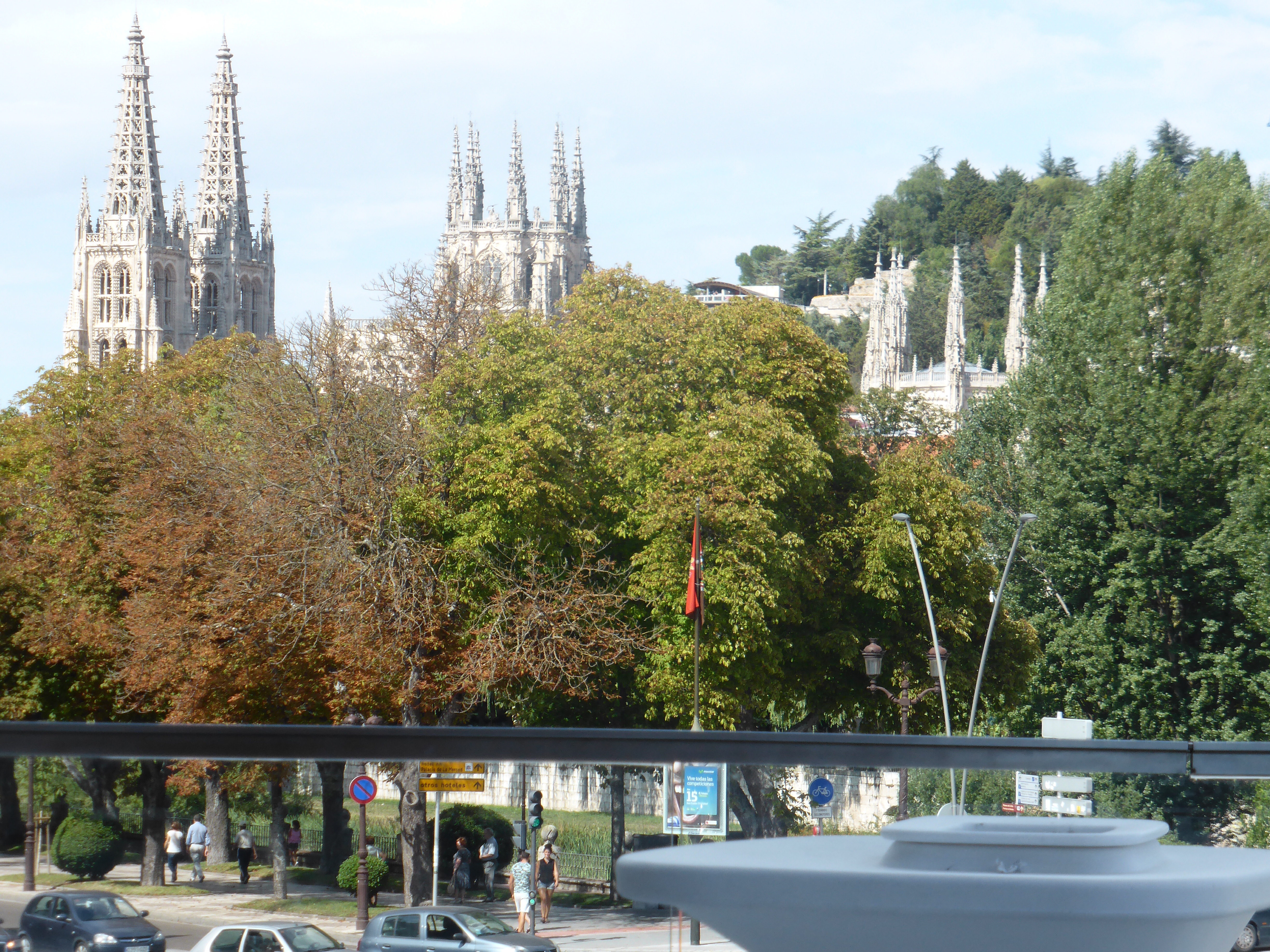
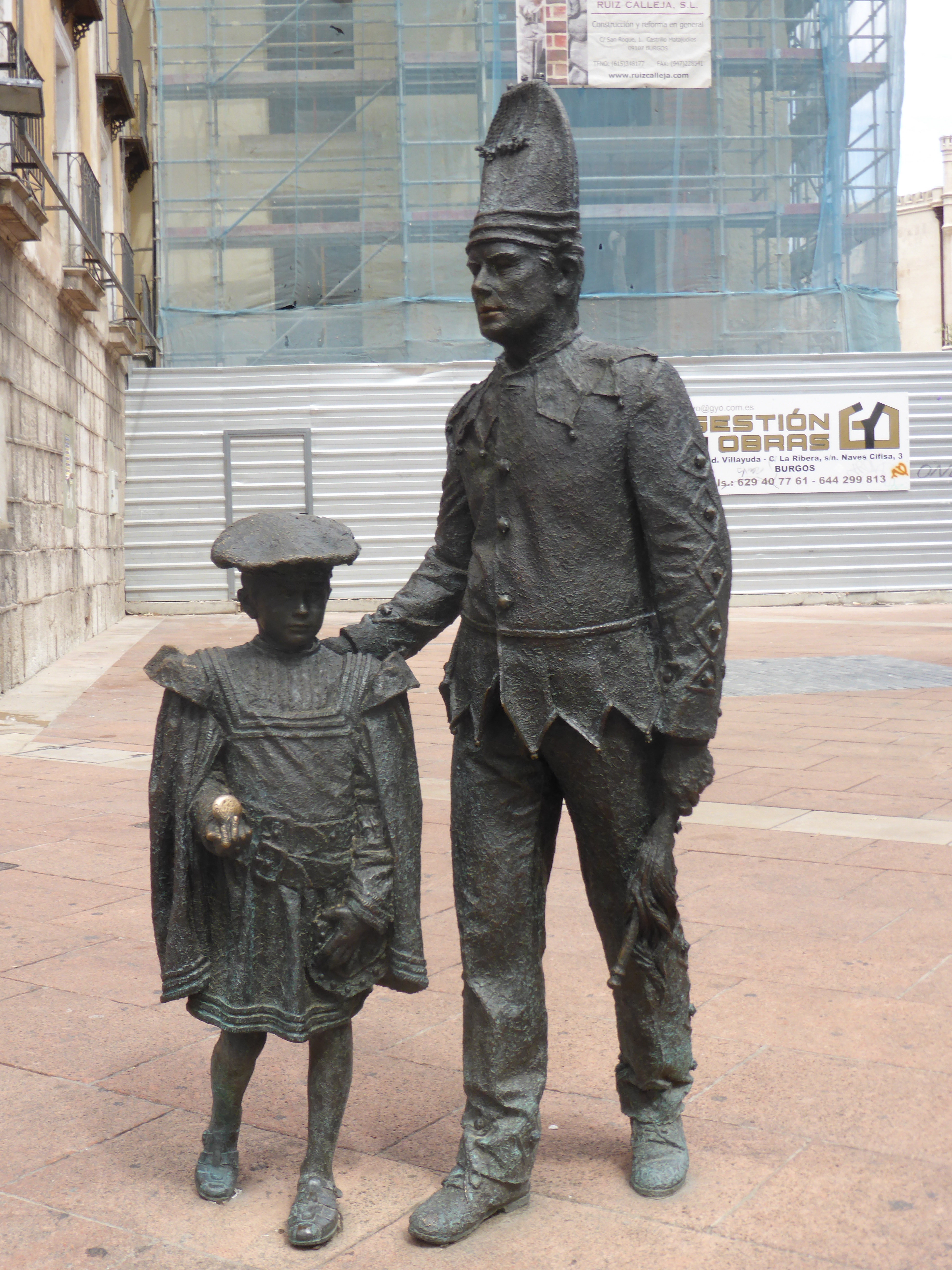
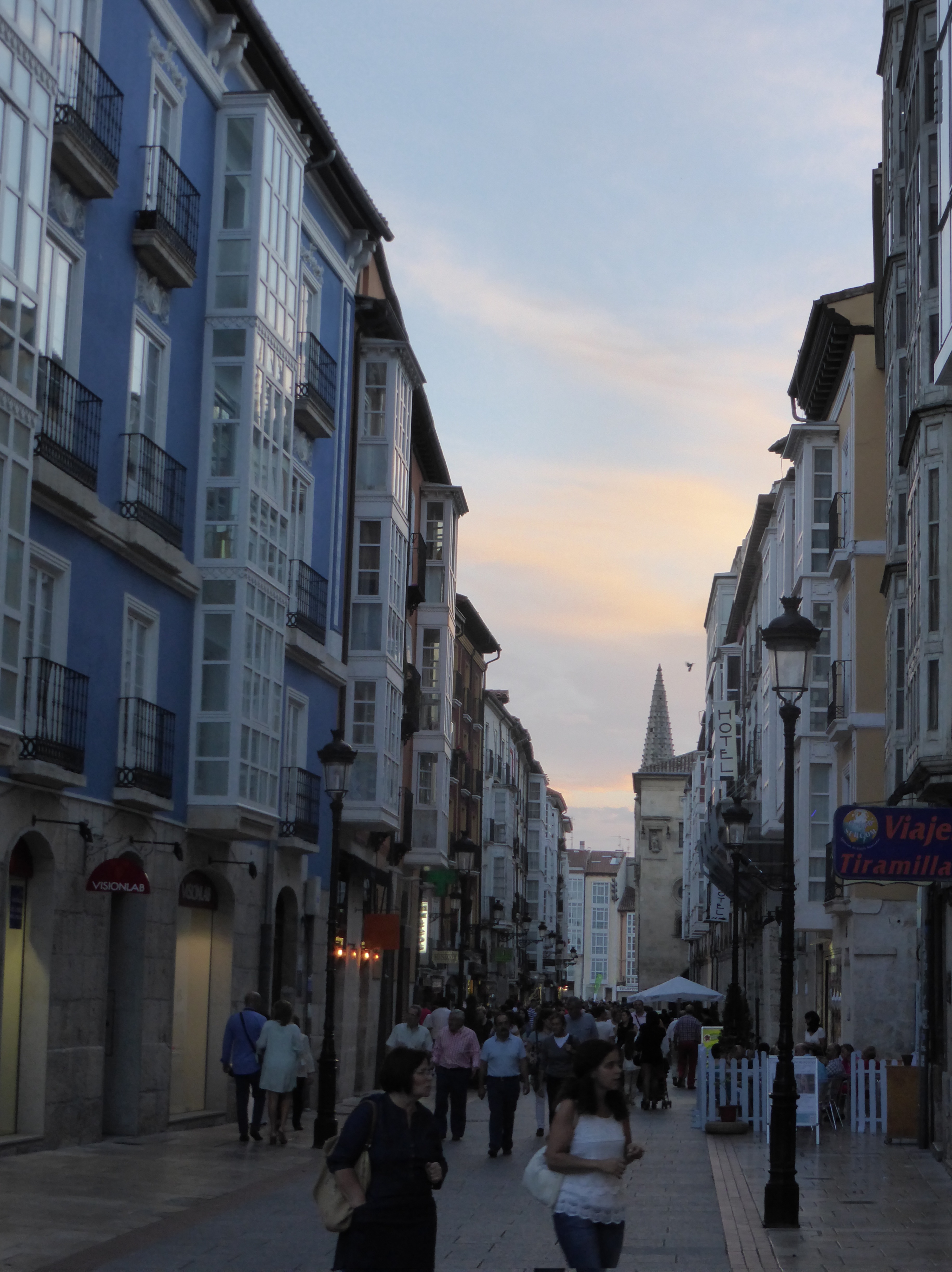
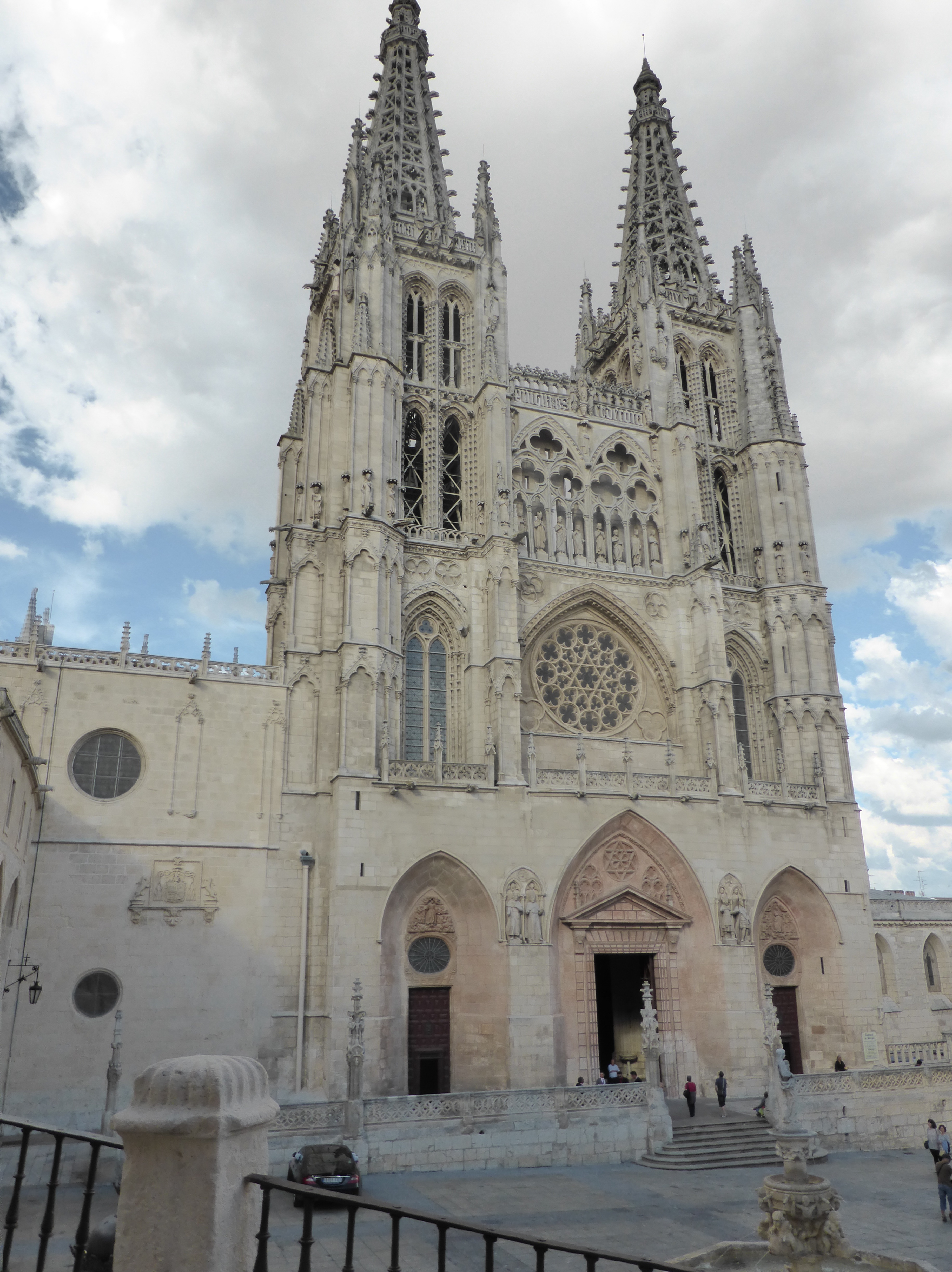
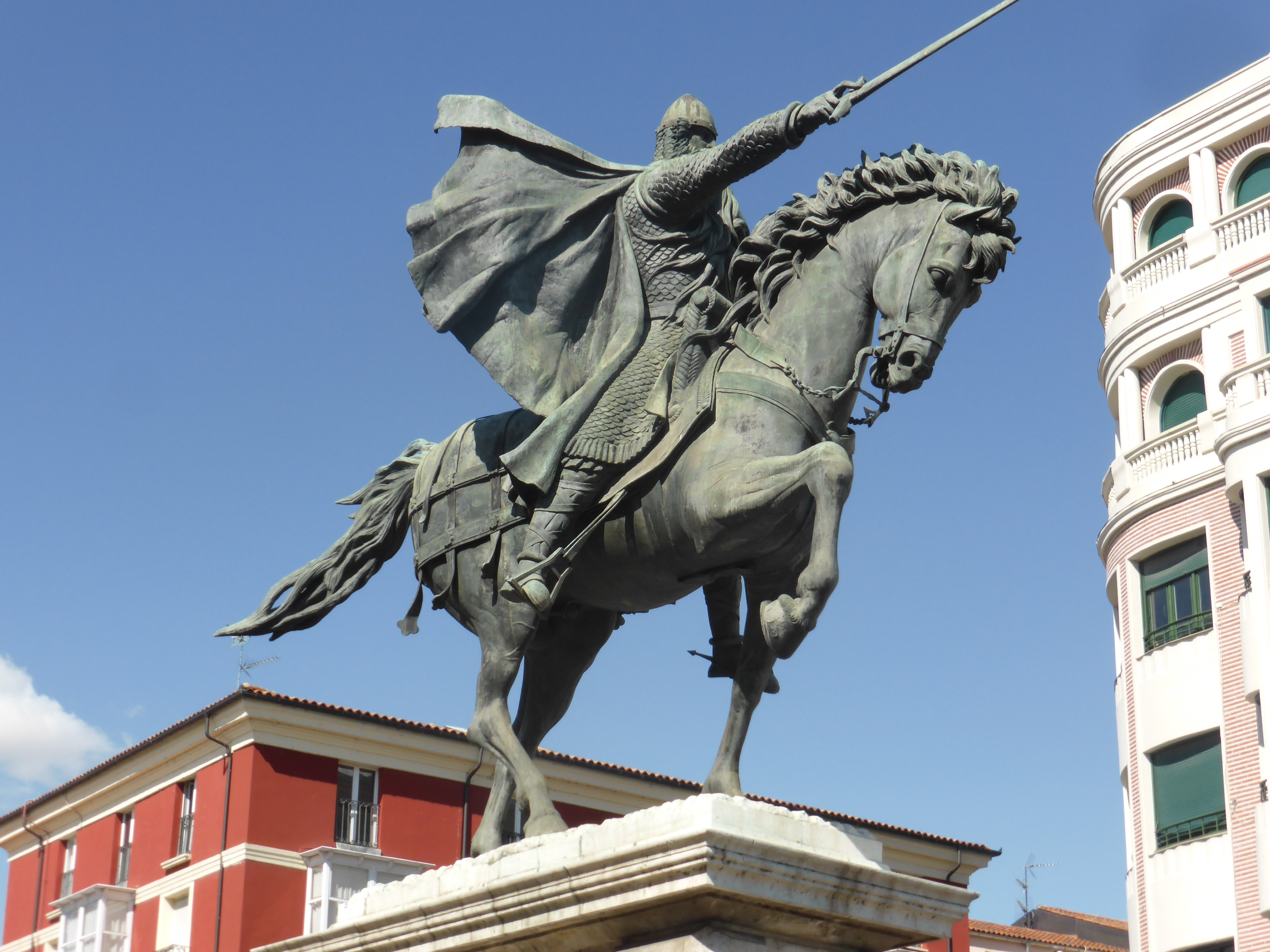
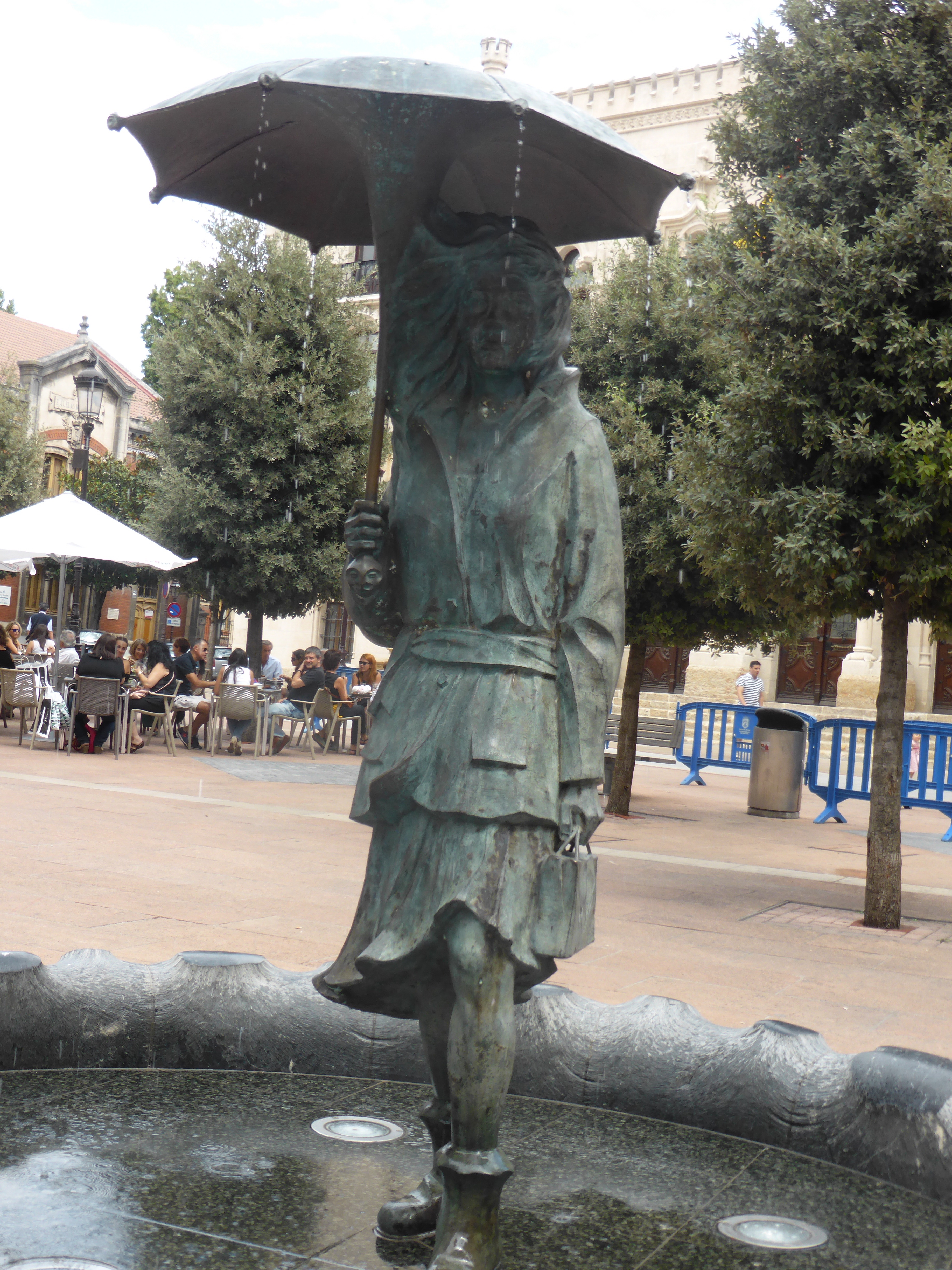
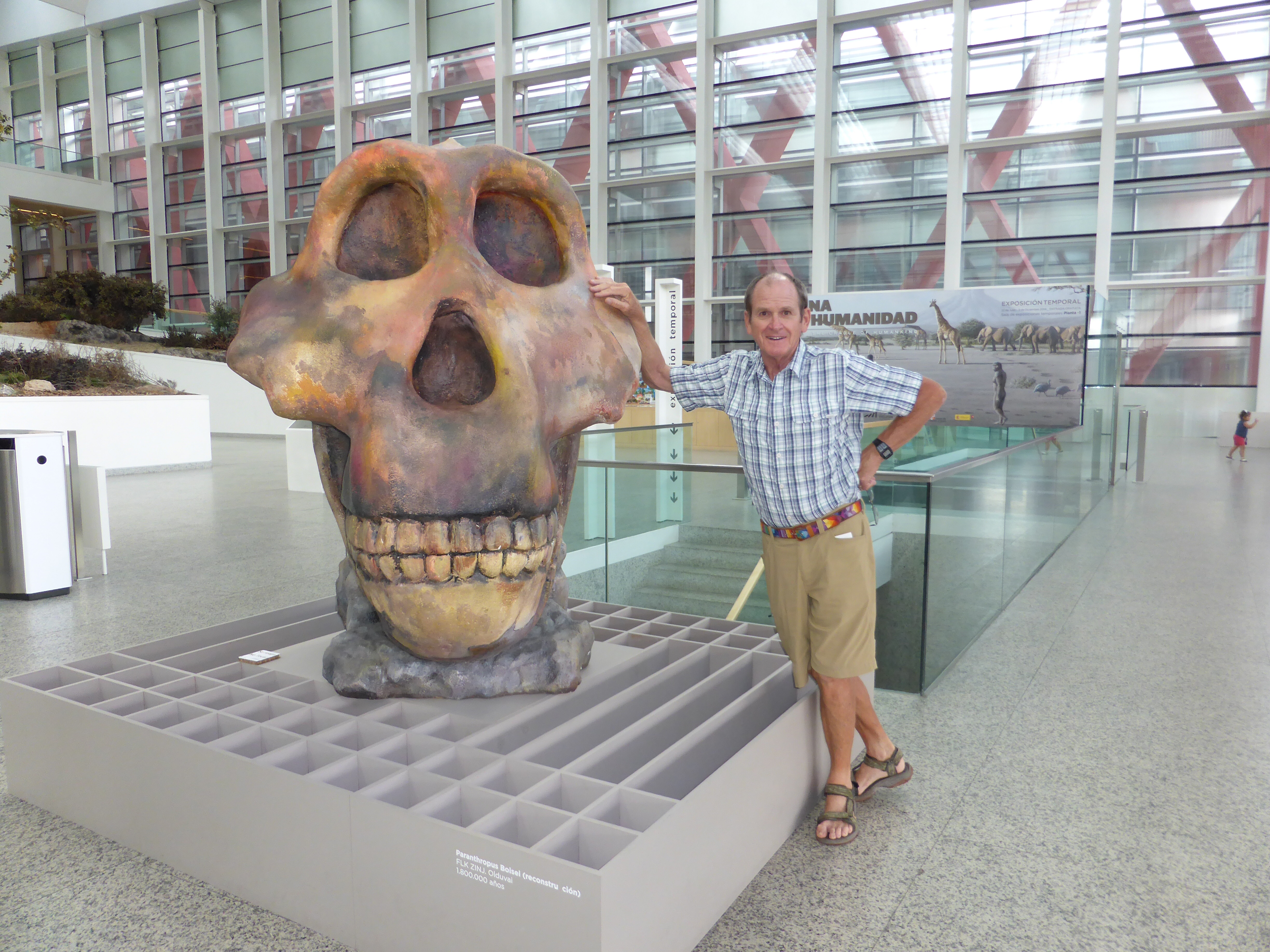
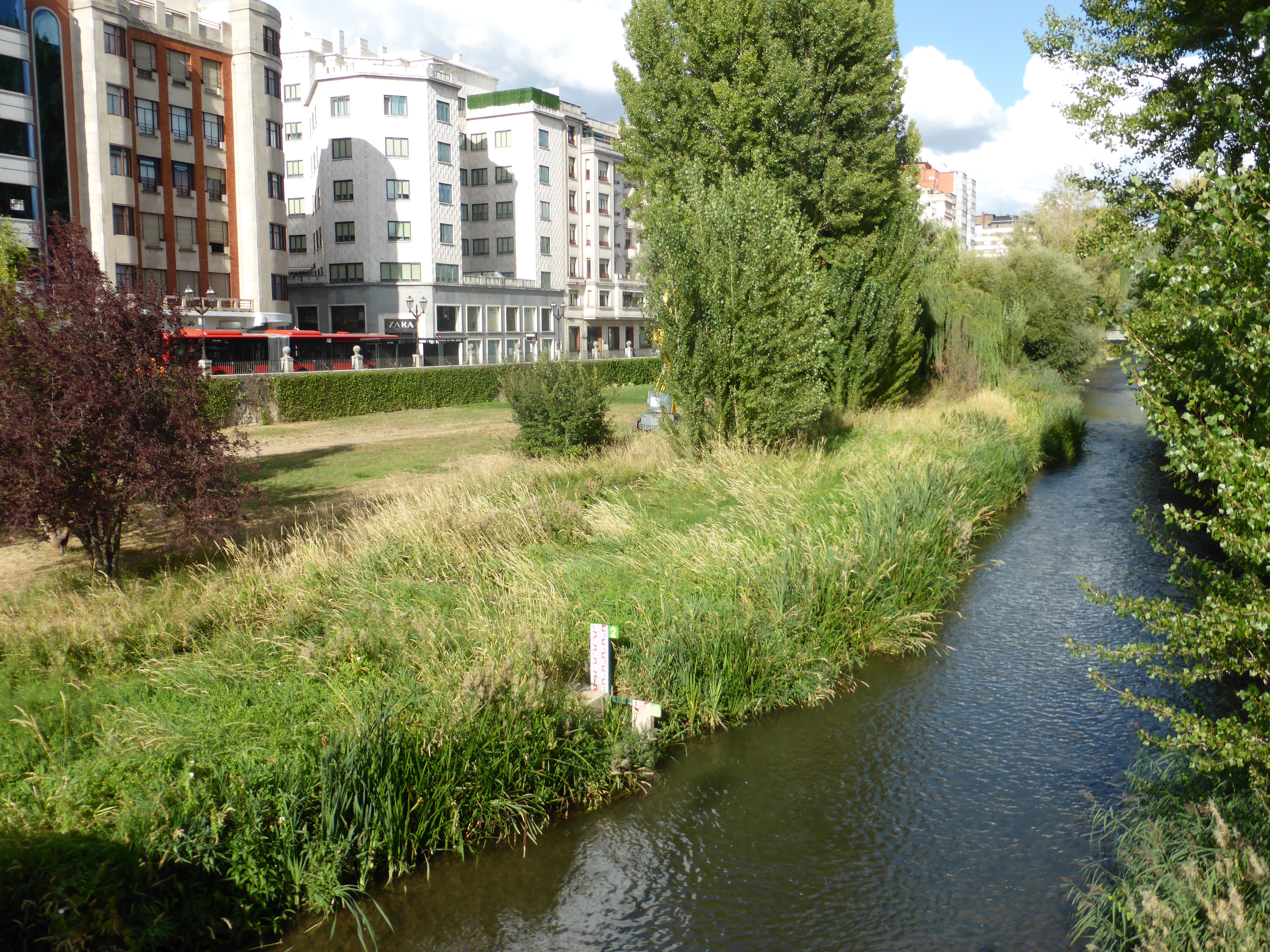
The beautiful scene as we entered Burgos – fall colours and the 800 year old cathedral on the horizonWe thought that this looked like Gavin and Christian!walking back to the hotel at sunset. A great day off!The beautiful cathedral. First started in the 12th and 13th centuries. When finished it did not have the spires … We think it must have really resembled Notre Dame. Later in the 15th century the spires were added.As we arrived we were welcomed by El Cid. His sword ( named Tizona) was recently bought by the government for 1.6 million Euros ( didn’t come with the statue)Hard to see, one of so many fanciful statues about town – this one a fountain with water falling off the umbrellaGoes to show how the evolution of man can go wrong……The Rio Arlanzon River – obviously the scene of high water – note the centuries old (green) walls to prevent flooding.
DAY 20: September 13. ( rest day in Burgos)
Today once we finished our chores (laundry) we decided to be tourists. On our walking days we are often too tired to take in the sites. A pilgrimage is not quite the same as a vacation. Peregrinos sometimes need to reconcile themselves to this.
Burgos is a lovely city—-well planned and clean. All along the Rio Arlanzon there are park lands. The streets on either side of the river have many inviting outdoor cafes. Burgos is the capital of Burgos province in the Castile area of Spain and has population of 178,000. It is best known for its Gothic architecture, primarily the Catedral de Santa Maria built in the 13th century. This cathedral is known as the wedding cake cathedral because of its ornate spires. El Cid ( aka Rodrigo Diaz not Charlton Heston) the Castilian hero was born near Burgos. His body lies In the cathedral.
There is an incredible museum in Burgos called “The Museum of Human Evolution”. It began as a result of the discovery of ancient caves in the Sierra Atapuerta Mts. by a coal mining company digging a railway trench. The artifacts date back over a million years and are said to be the earliest ancestors of Europeans. In 2000 the site was declared Heritage of Humanity by UNESCO. The display was excellent but the two hours we allotted was not enough time. That goes for Burgos as well. Just a day does not do it justice…but the Camino calls us:-)
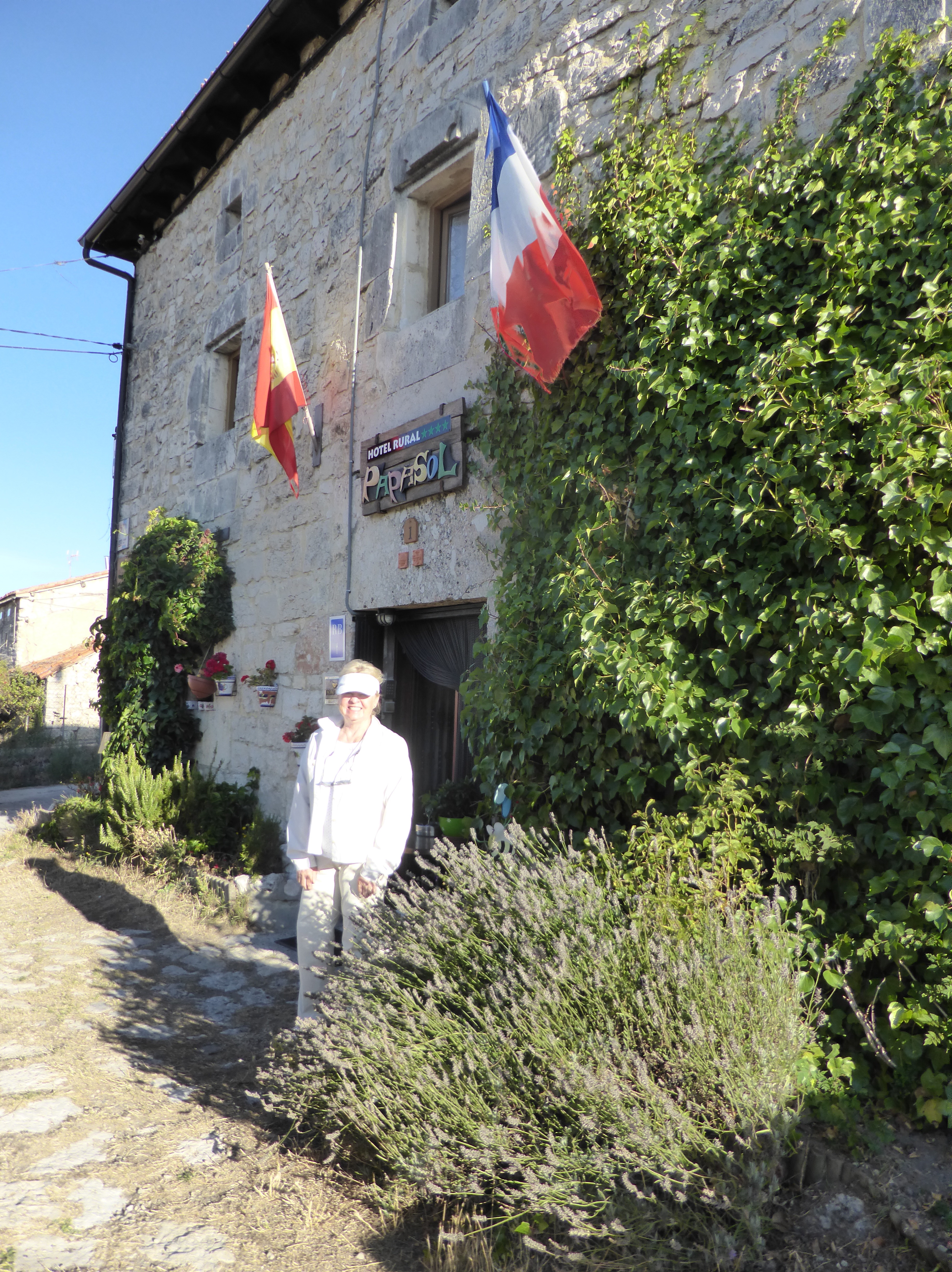
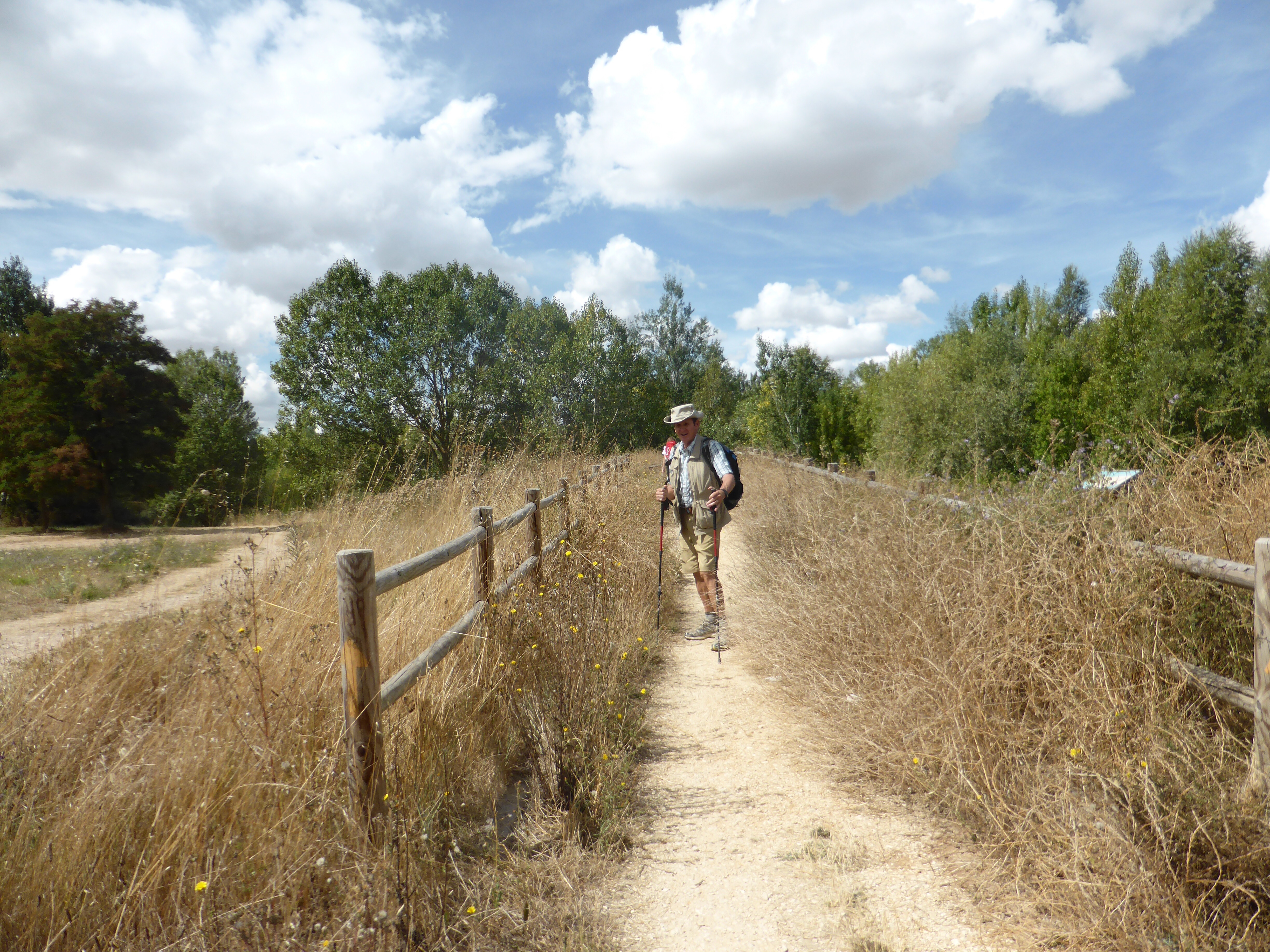
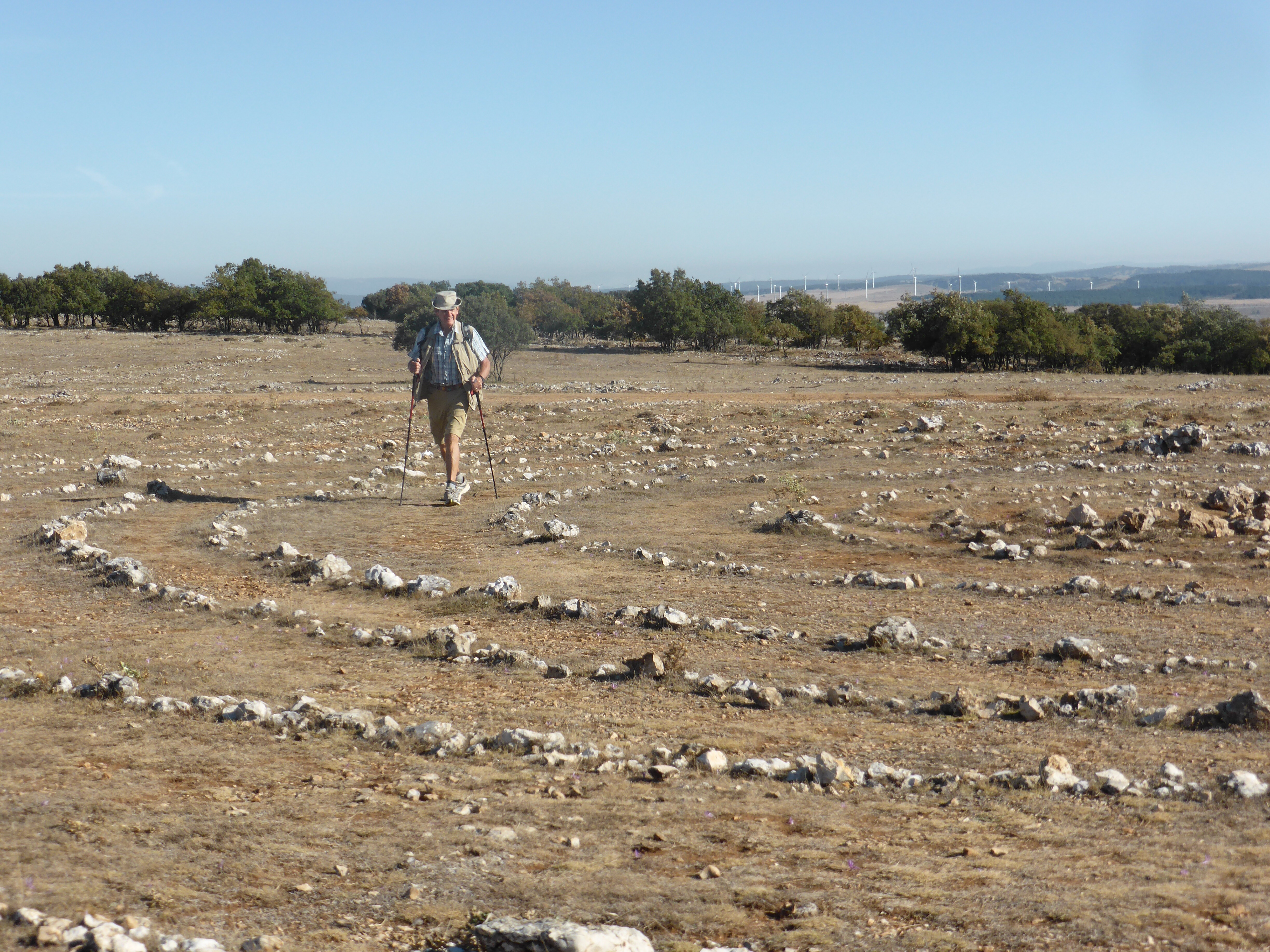
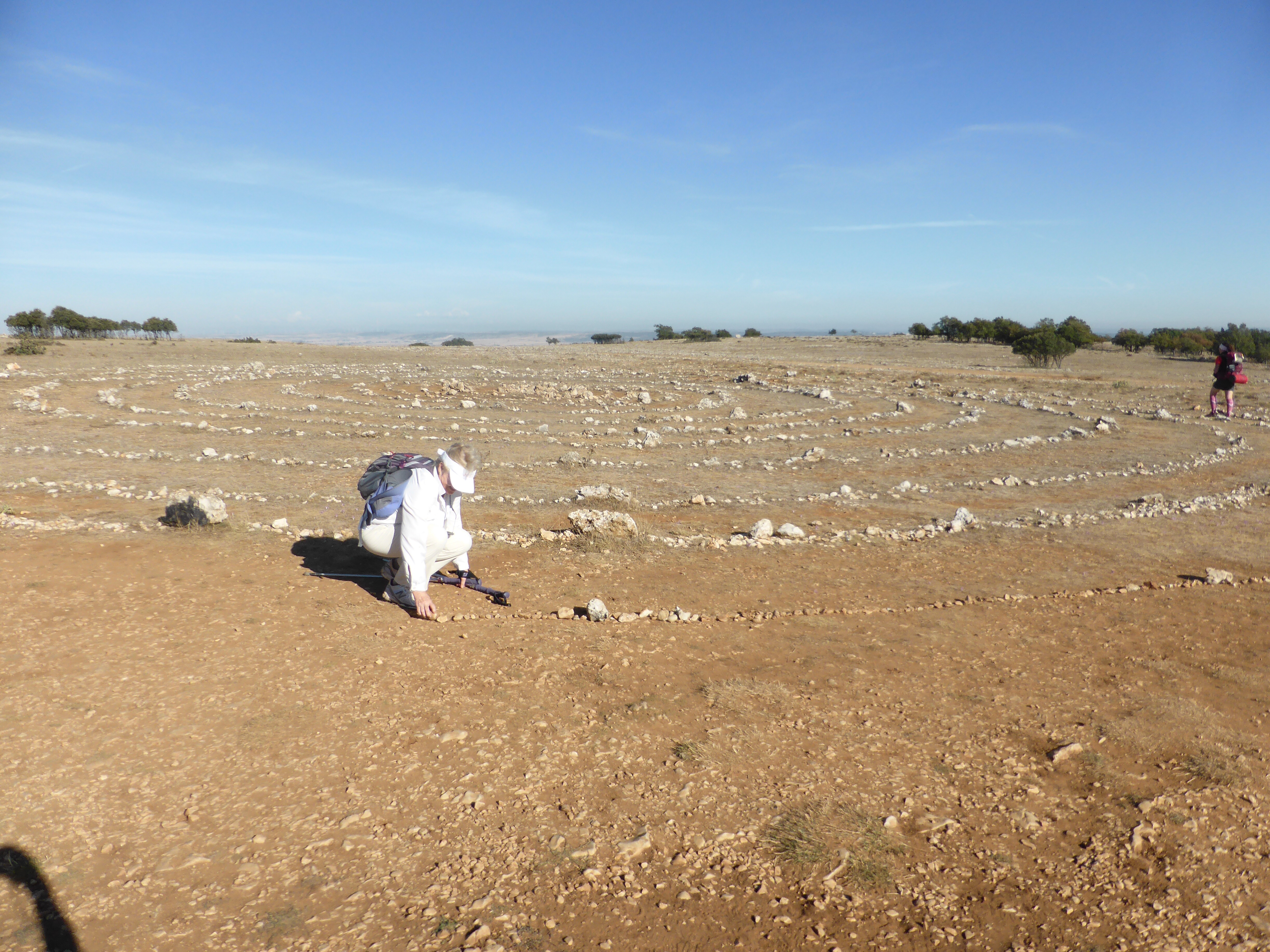
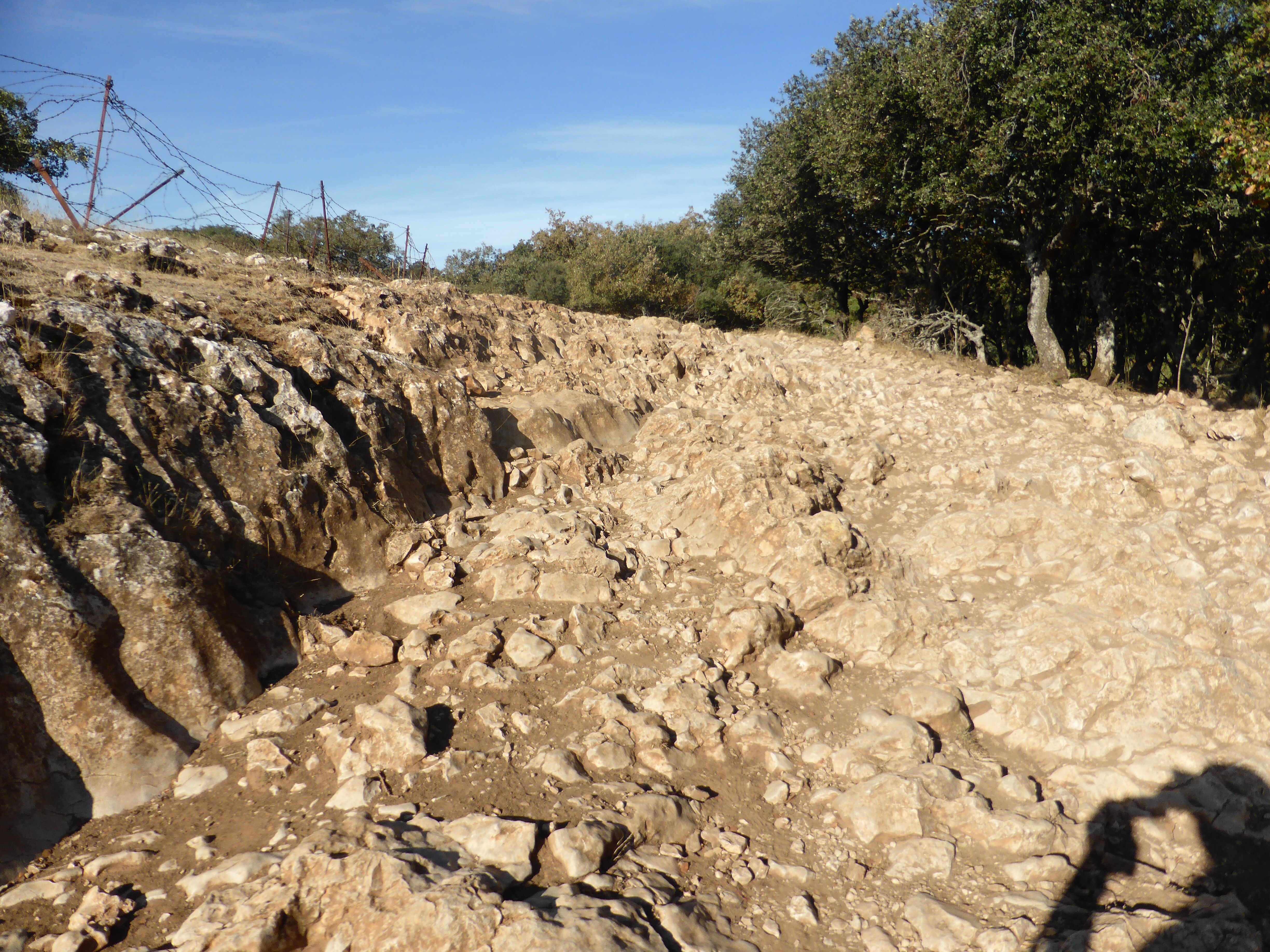
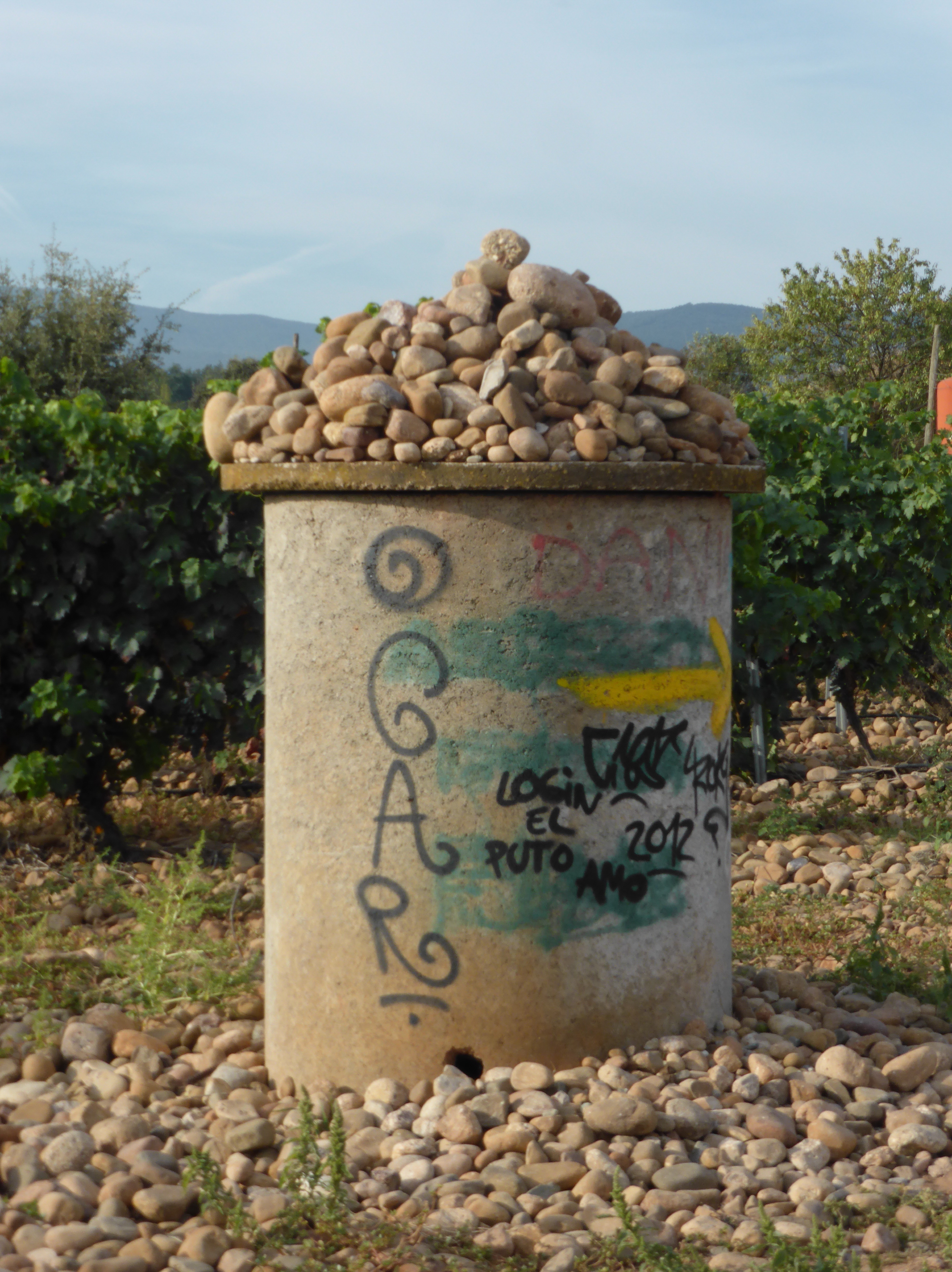
Our funny little hotel in Atapuerca, population 202.Most houses have to be 2-300 years old.This was the scene earlier this evening – what seemed to be a calm Friday evening in downtown Burgos. By early evening the streets were filled, we mean packed. with Spaniards of all ages walking the streets… it seems a routine thing to be on the streets of the inner towns till late at night. Lots of street noise, competing recorded music blaring from almost adjacent storefronts and children yelling. As I type it is after11 pm and it is still very noisy, complete with young children who do not seem to have bedtimes!Walking a 4 -6 km long path through a nature conserve bordering Burgos which has a population of 200,000This is the labyrinth or as some other pilgrims called it a “Prayer Circle”. Many years ago it was started with a cairn and a few stones leading out starting a circle of stones around the cairn. Over time the trail of stones formed concentric circles with each circular trail about 2 feet further from the center. Didn’t count but I would estimate that there were over 20 circles of stones.Here Mutti adds a stone for each of our families. Dad spent a few moments walking a few of the inner circles, he felt it very moving to think of the thoughts and situations behind the stones placed so long ago.The steep climb to the top of the Matagrande ridge was a bit of a challenge. A couple of kms of rough going, great for goats.
DAY 19: September 12 (Atapuerta to Burgos 22+km)
Despite the creaking floors, clunking doors and Spanish bed pillows (we will include a photo), we had a good sleep. Our early peregrinos driven by 1. avoiding the heat of the day 2. needing to get to an albergue in time to get a spot, are up before dawn, head lights on and gone. Everyone was very considerate about being as quiet as possible when leaving—kind of them. We actually had the breakfast room all to ourselves:-) We will soon be known on the way as “the lazy peregrinos”.
Our walk began a bit chilly as we had a head wind coming from the north. It was very comfortable especially as once again we began climbing and quickly warmed up.
Unless you look very carefully at your map, you do not see that this land is crossed with river valleys and small mountains. Thank heavens, the meseta is just over one of these “hills”!
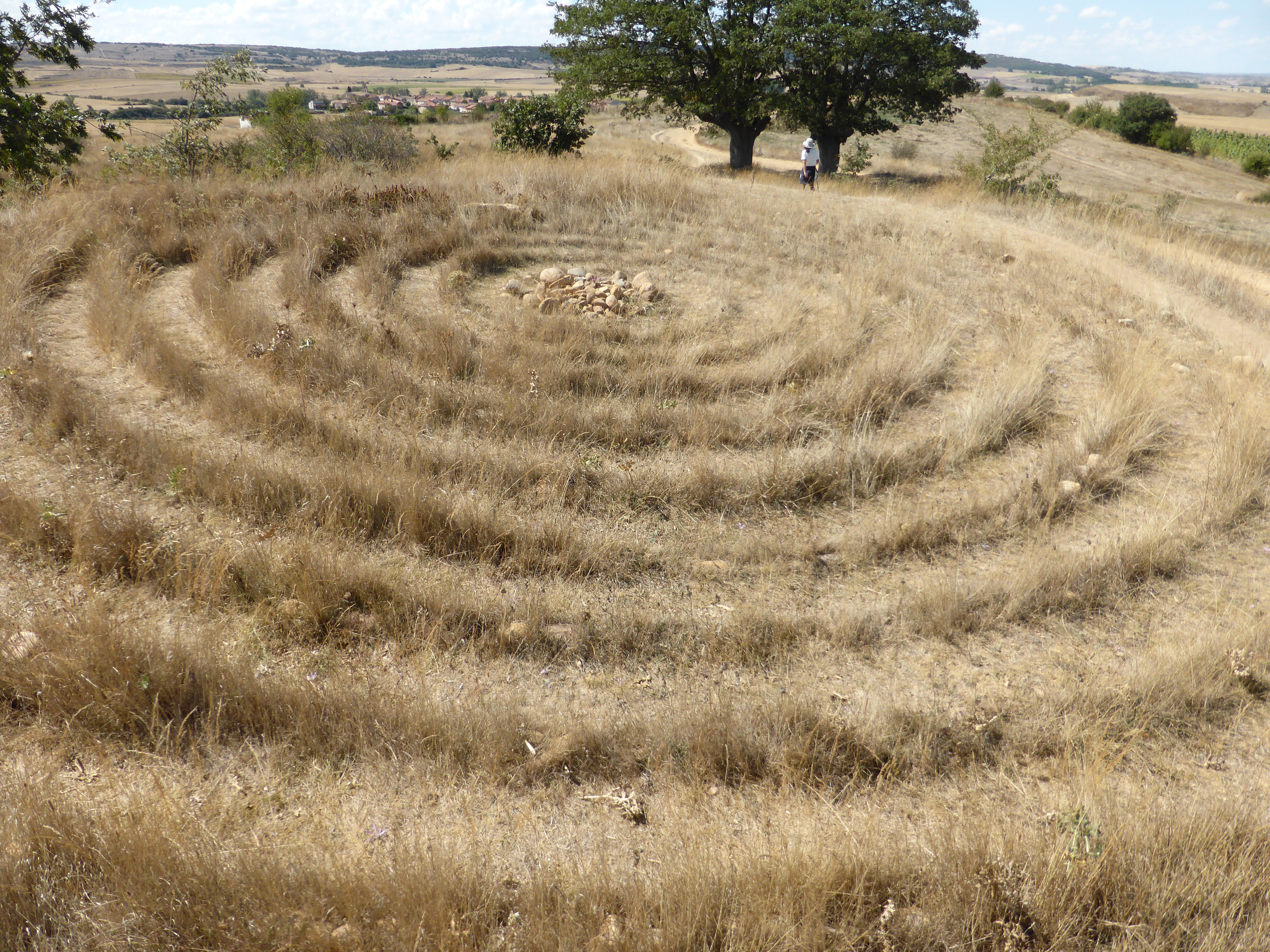
There was an infinity labyrinth once we reached the top. This has been built out of rocks by peregrinos and each pilgrim passing is to walk the labyrinth and add to it….so we did.
Enroute we walked portions with a nun from Slovenia, women from Sweden and Italy, and a sweet couple from New Jersey. He is a young pastor and she has just finished divinity college.
There are two routes leading to Burgos—one through the industrial area and the less travelled one through a nature preserve. We chose the less travelled and discovered it was also less marked. Dad and his GPS app kept us on track.
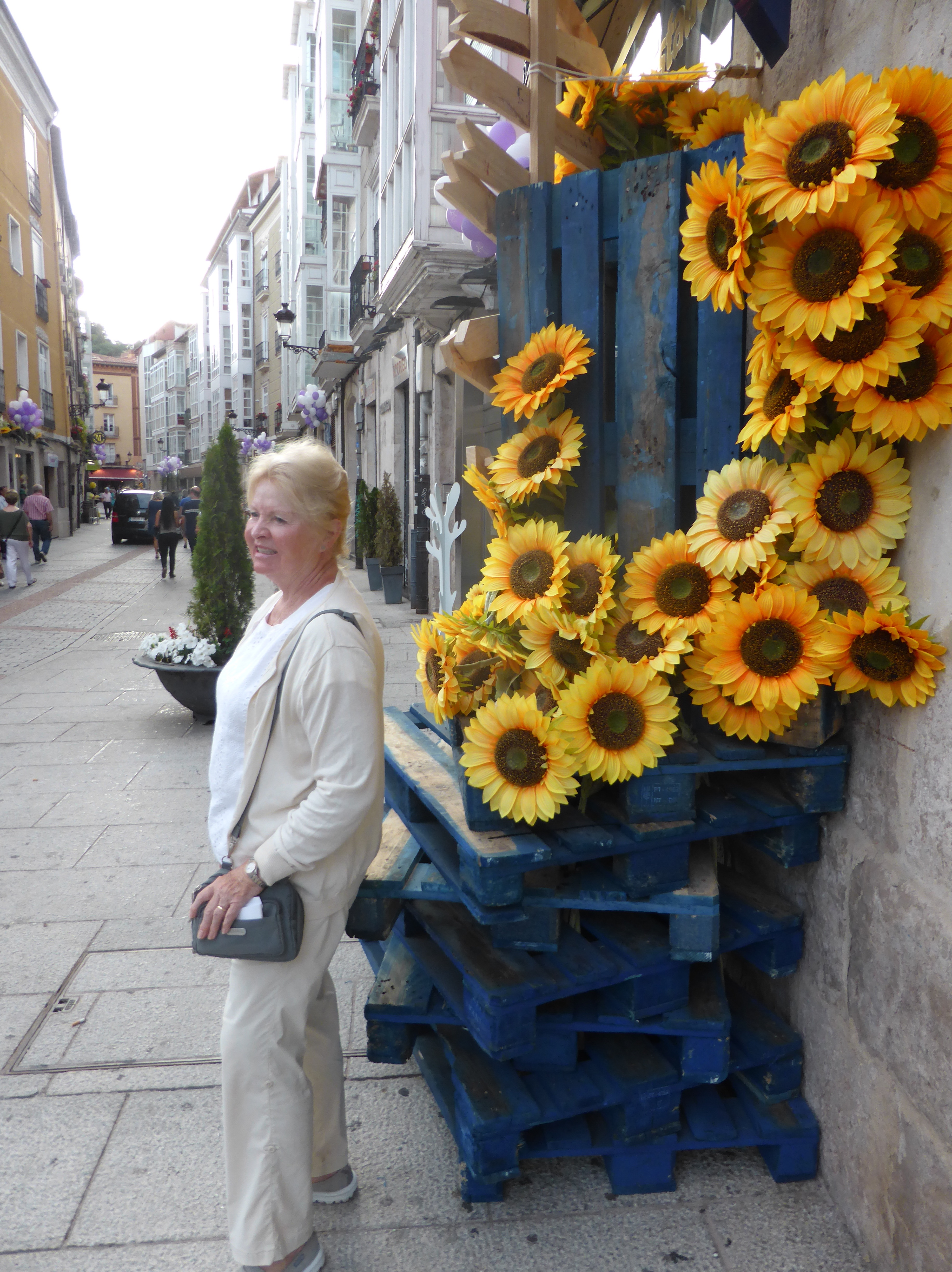
Once again our hotel is by the church and the plaza under our window is festive tonight:-) It is decorated with balloons and sun flowers, a crowd is milling about, there are competing musicians, and earlier fireworks. We are beginning to think this is just how Friday is celebrated in Spain.
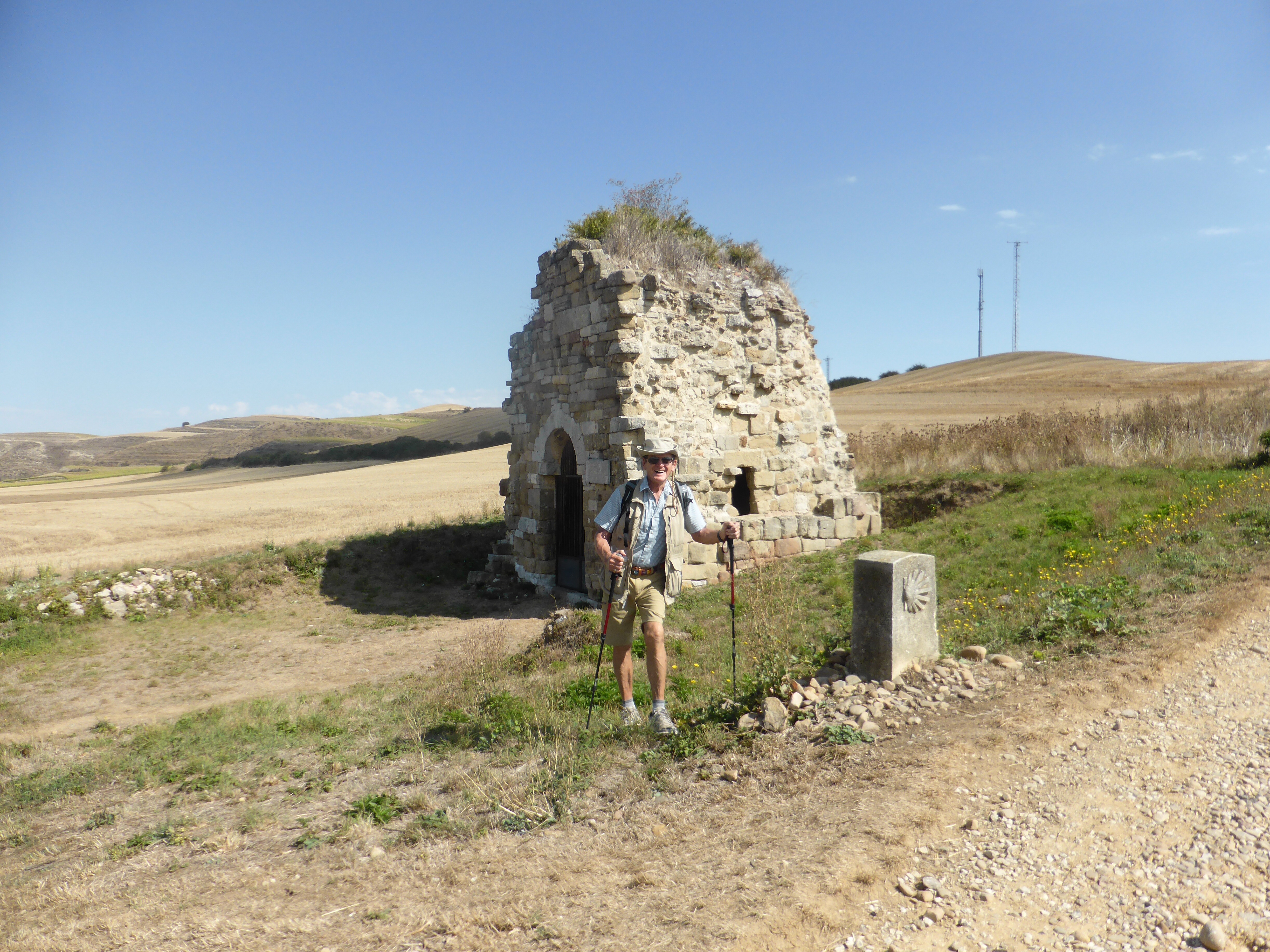
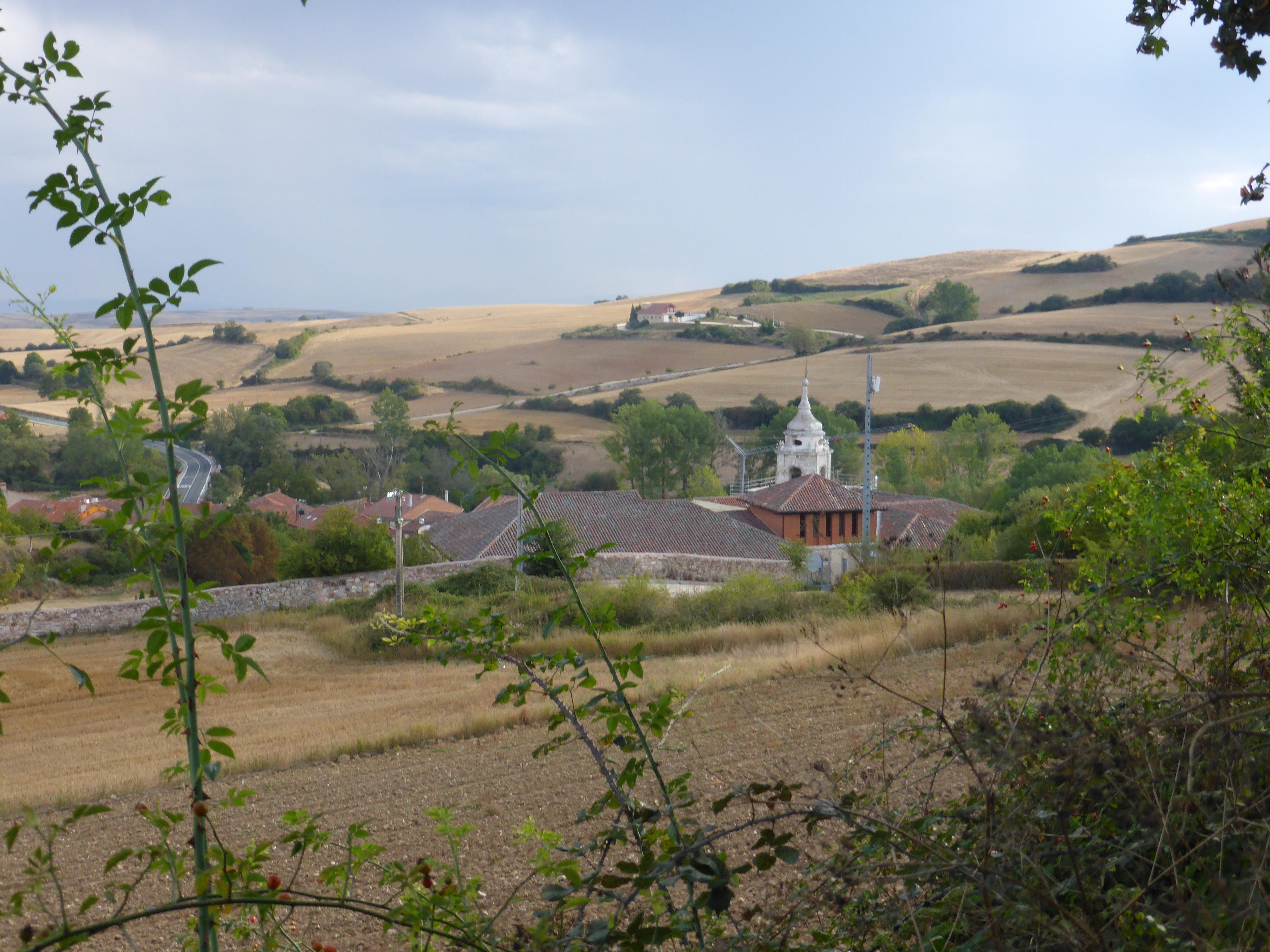
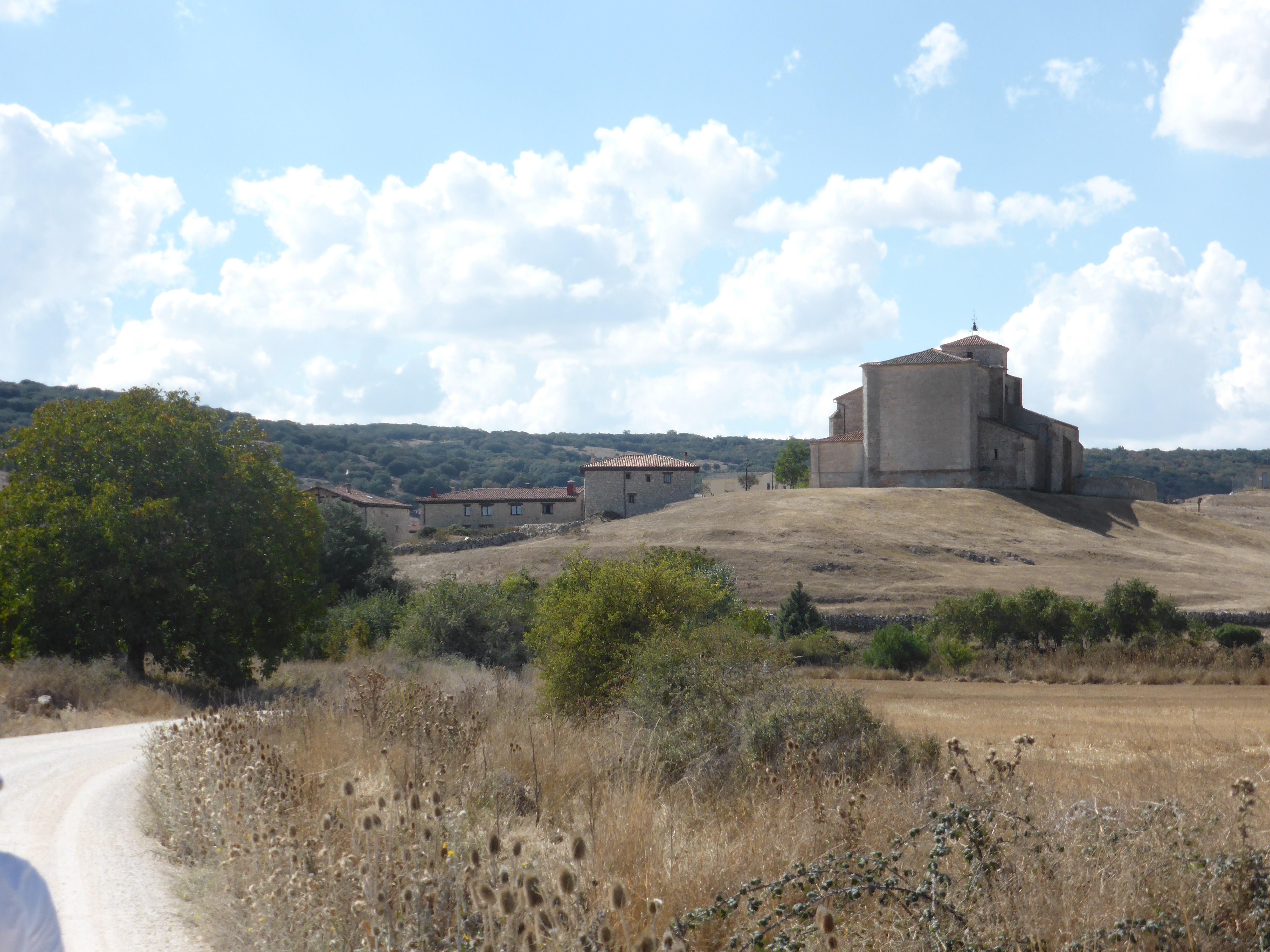
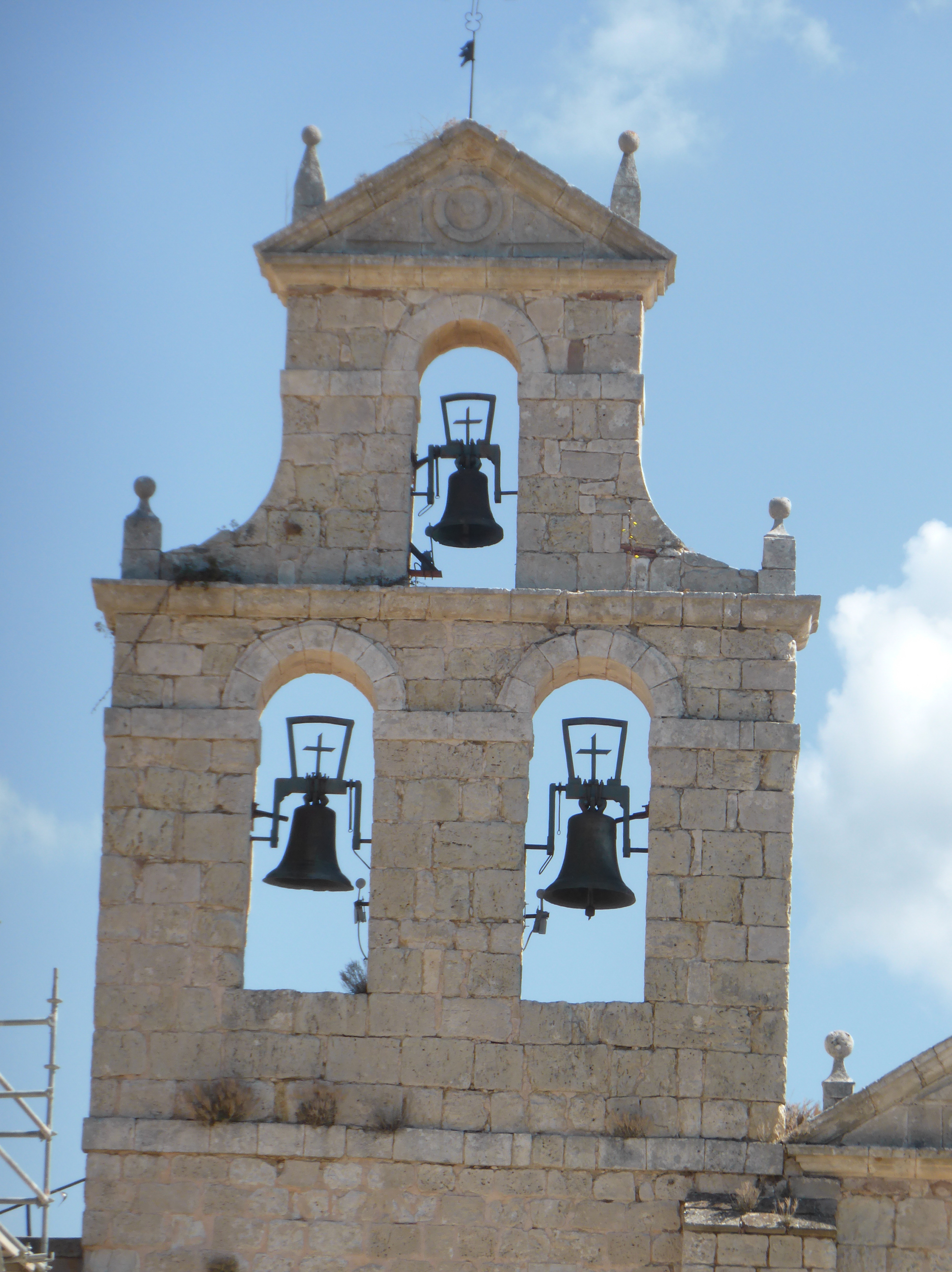
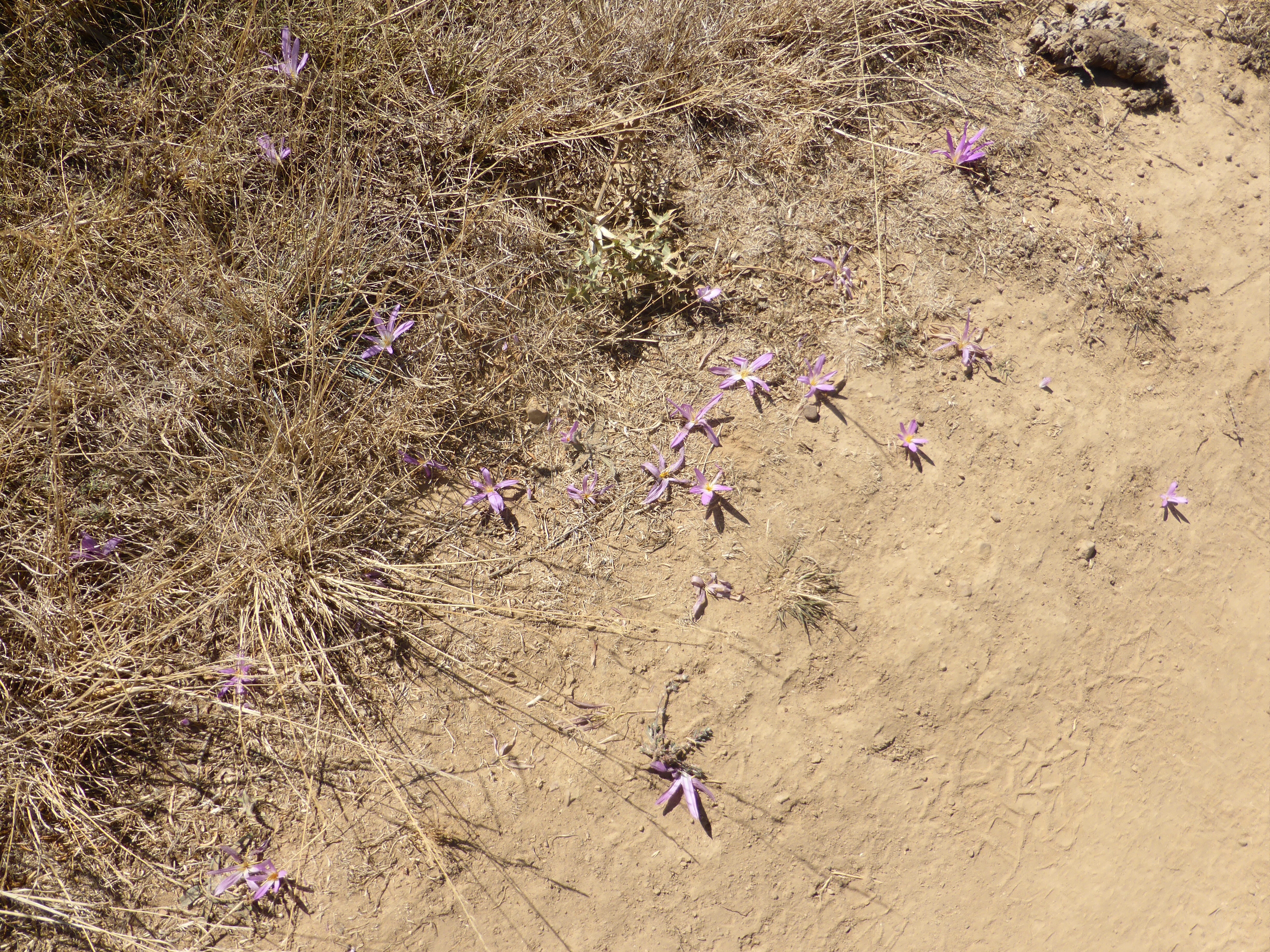
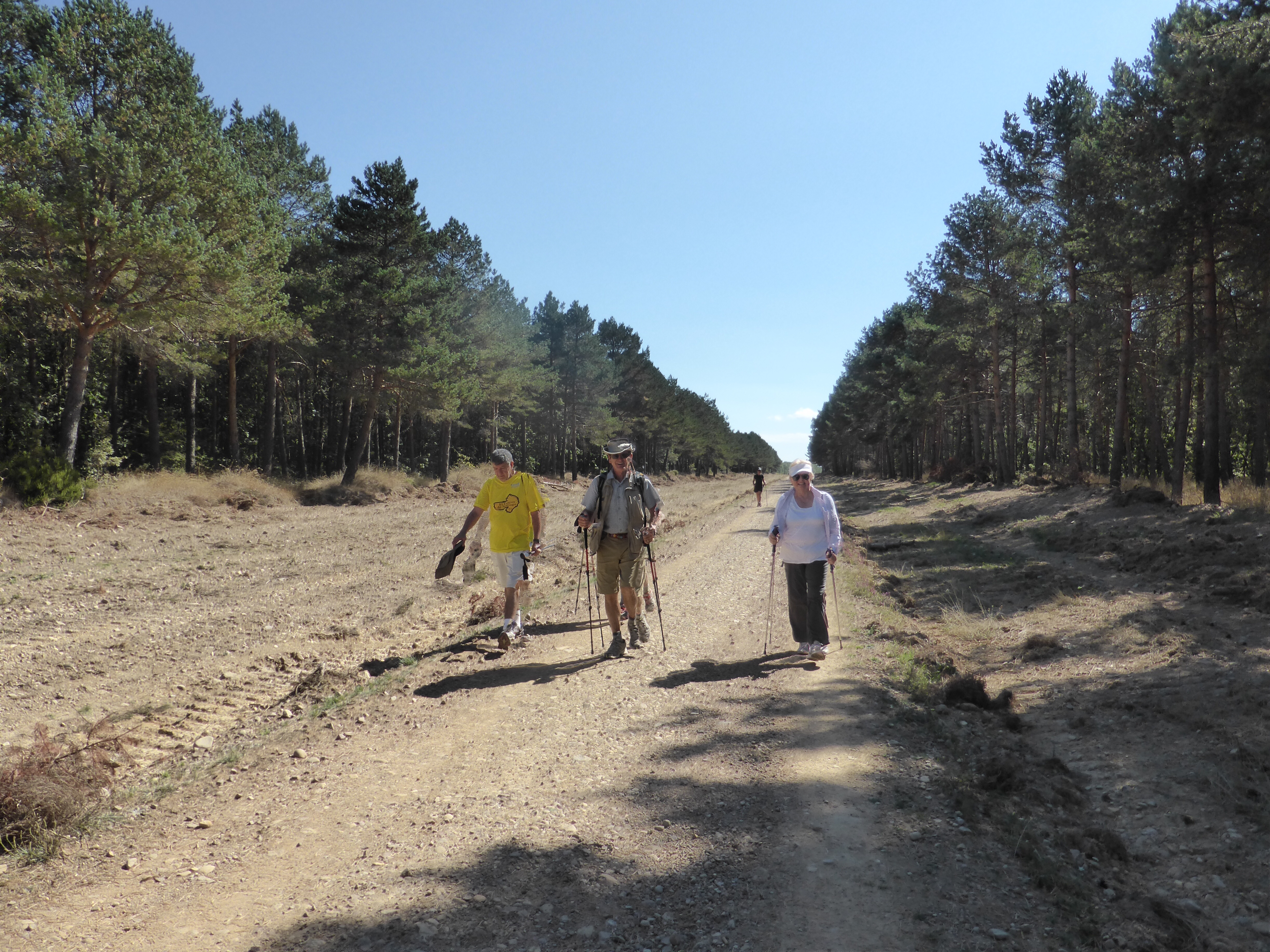
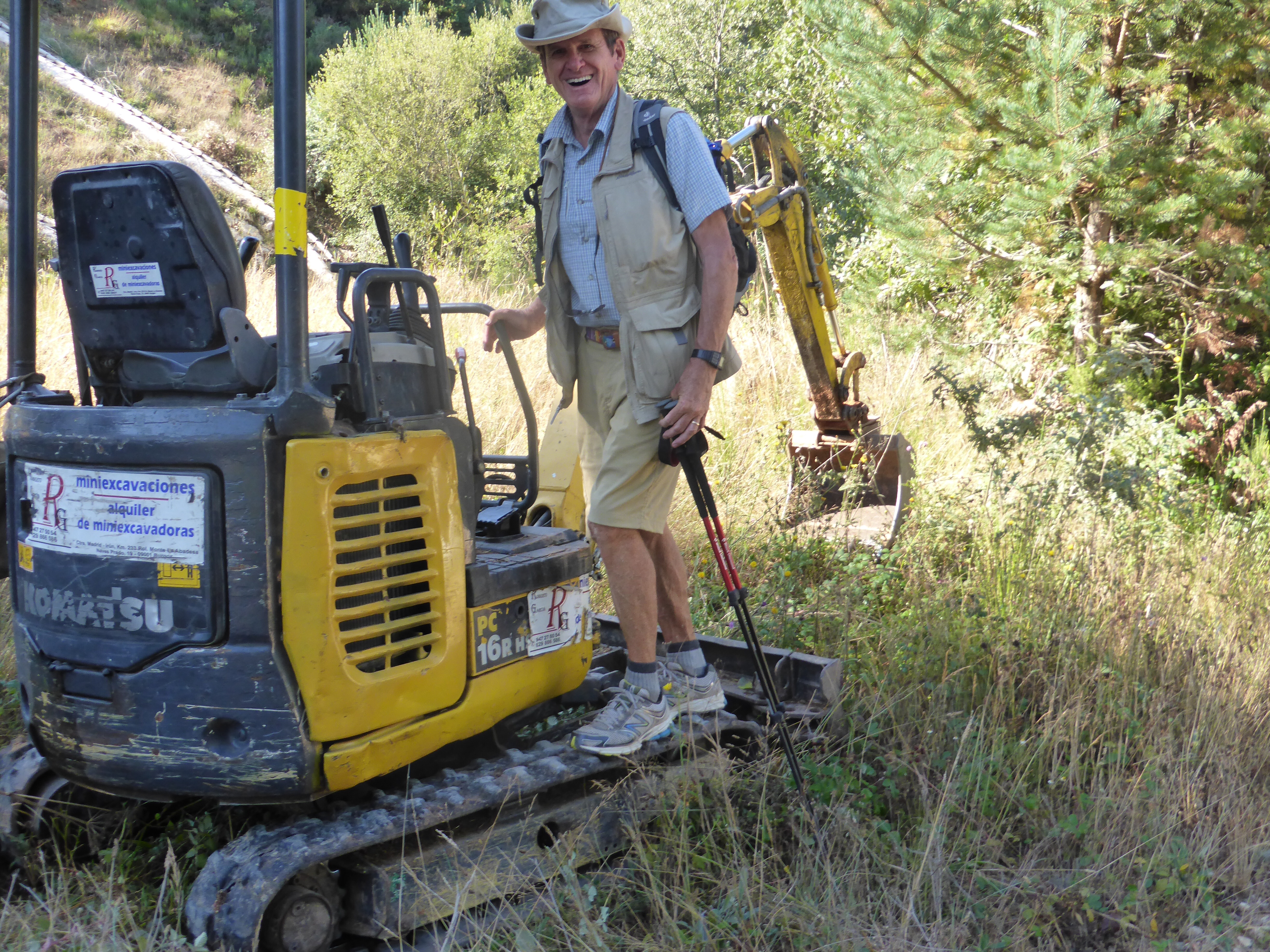
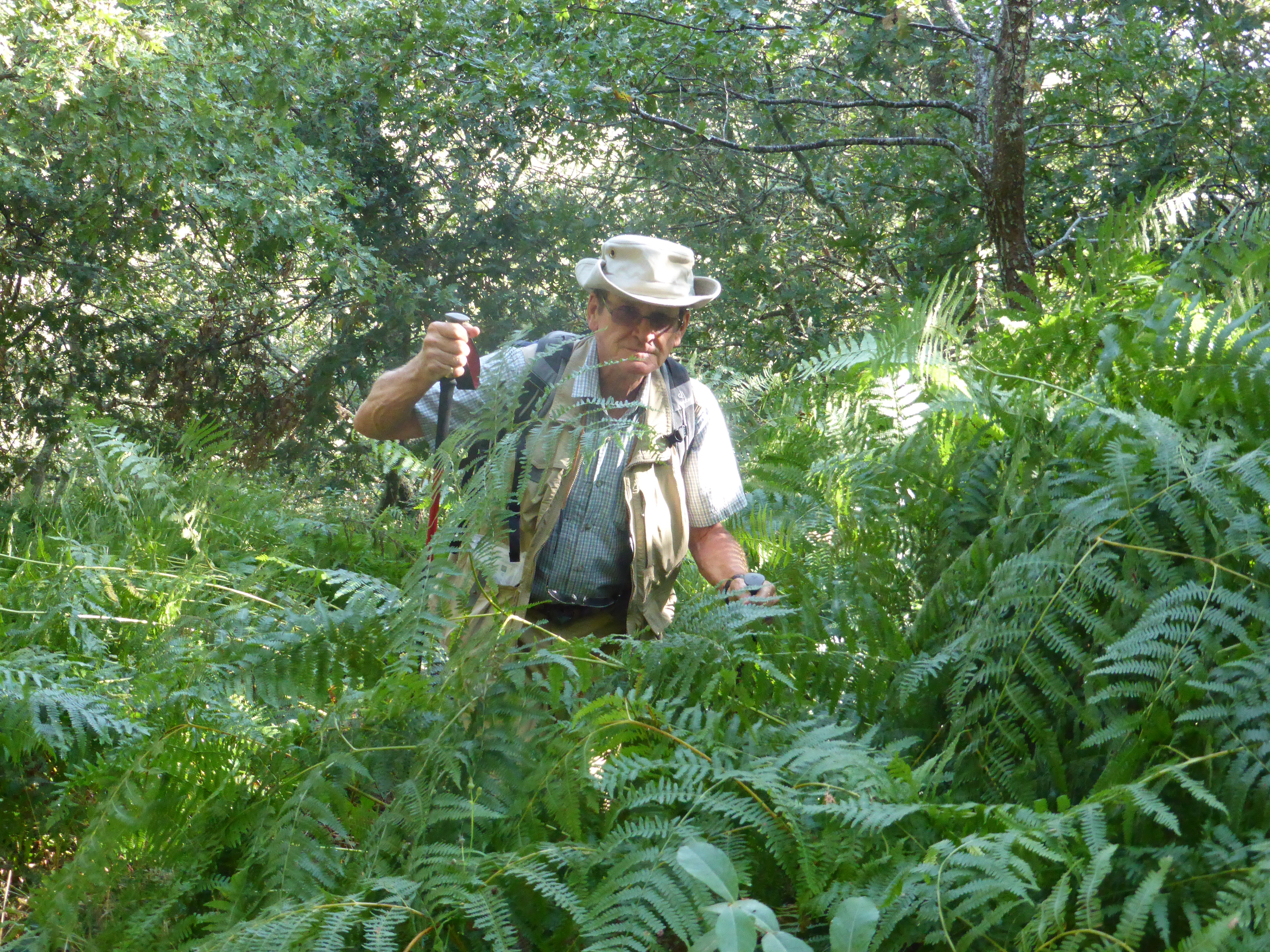
12 th century Hermitage of Saint Felix – who lived in this complete with his eco roof!Pastoral scene as we depart Villafranca Montas de Oca ( translation – ‘the geese mountains) 900 year old church, almost as old as we felt climbing the 1000 feet after leavingOur destination today – 6 hours of walking. This is Atapuerca population 202 (was 200 sixteen years ago). Typical of so many ancient villages – a huge ancient and beautiful church in the center of a very quiet village with many flower boxes and a single cafe, serving good coffee and fresh bread!the bells at the Romanesque monastery, in San Jaun de Ortega, built as a help point for pilgims 1000 years agoPilgrims leave some strange signs…. here concentric circles, the largest 50 feet in diameterYou have to look closely – these tiny blossoms seemingly arise from the dirt without stems or leaves. They appear to have been thrown there but they actually growing there,Suddenly we are almost back up at the 1000 foot level. Here in beautiful pine forrest walking a fire line cut from the managed pine forestNeed Garner and Emmitt’s help hereNot all is good and clear going! Note the ferns – we are in wet climates on rain side of mountains
DAY 19: September 11 Villafranca Montes de Oca (20km)
The dear concierge sent us on our way by showing us an easier route out of town. (Sometimes it is good to be some of the oldest people on the Camino:-)
Somehow the word “montes” meaning mountains did not clue us in and the first hour of climbing came as an unwelcome surprise. Actually, we are pretty good going up.Mutti’ s knee has given her problems on descents. She has several methods of getting down the mountains now that work for her without too much pain. First, If the path is wide enough she traverses it—slow but sure. Next, if the path is narrow. Mutti crouches down and descends. This only works if she is not holding others up. Finally on steep hills that have no rough areas or loose gravel, Mutti maneuvers down backwards with Dad guiding her. We have noticed others with knee problems trying these techniques now, too.
Much of today’s walk was through a forested area–pine, beech, and gnarly oak trees. The undergrowth on the shady side was tall fern and on the sunnier opposite side great swaths of purple heather blooming. A cooling breeze carried the refreshing scent of pine to us—a lovely treat after yesterday’s manure odour. We have been walking through areas of drought for several days now. Our path has been graded wide for a fire break as everything is so very dry.
There is selective logging in these forests and a few of the towns manufacture furniture. These forests are also said to be home to wild boar, deer, wild cats,otters, foxes, badgers, and wolves. We are disappointed to see no wildlife. This has been common throughout our entire trek so far.
We stop for a break at San Juan de Ortega and visit the monastery built by him and Santo Domingo for the Santiago pilgrims. Despite renovations going in it is a peaceful place.
Onward towards Atapuerca as we hope to get there in time to visit the UNESCO world heritage site 3 km.from the town.
We follow signs to a tourist centre specifically for the archeological site. It is a huge structure but closed for siesta which should end in ten minutes. Exactly on time a young woman appears to open the building. She speaks English very well and tells us there are only tours in Spanish and no written translations in any other language.Her advice is to save our money (30 Euros each) and see the display when we get to Burgos. We are disappointed as this is where the caves, tools, drawings and fossils of the earliest Europeans from 1.2 million years ago were found, but we heed her advice.
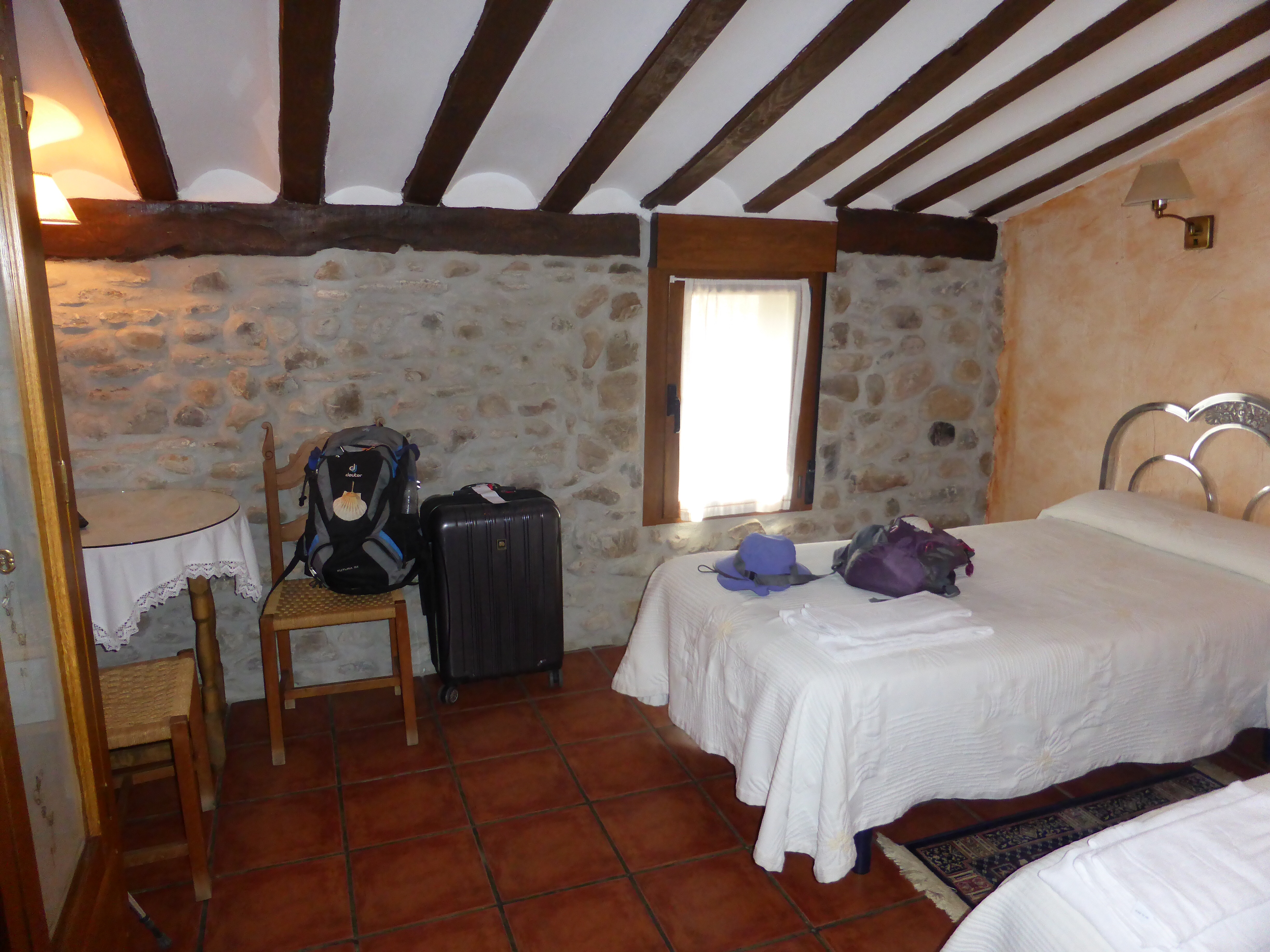
Our abode tonight is a casa rural in a very small village. It is an ancient building with a congenial host so who cares if the doors fit poorly and allow spy holes? Also, the supper was simple but very tasty. As Grandma Sword used to say, “Hunger is a savory sauce.”
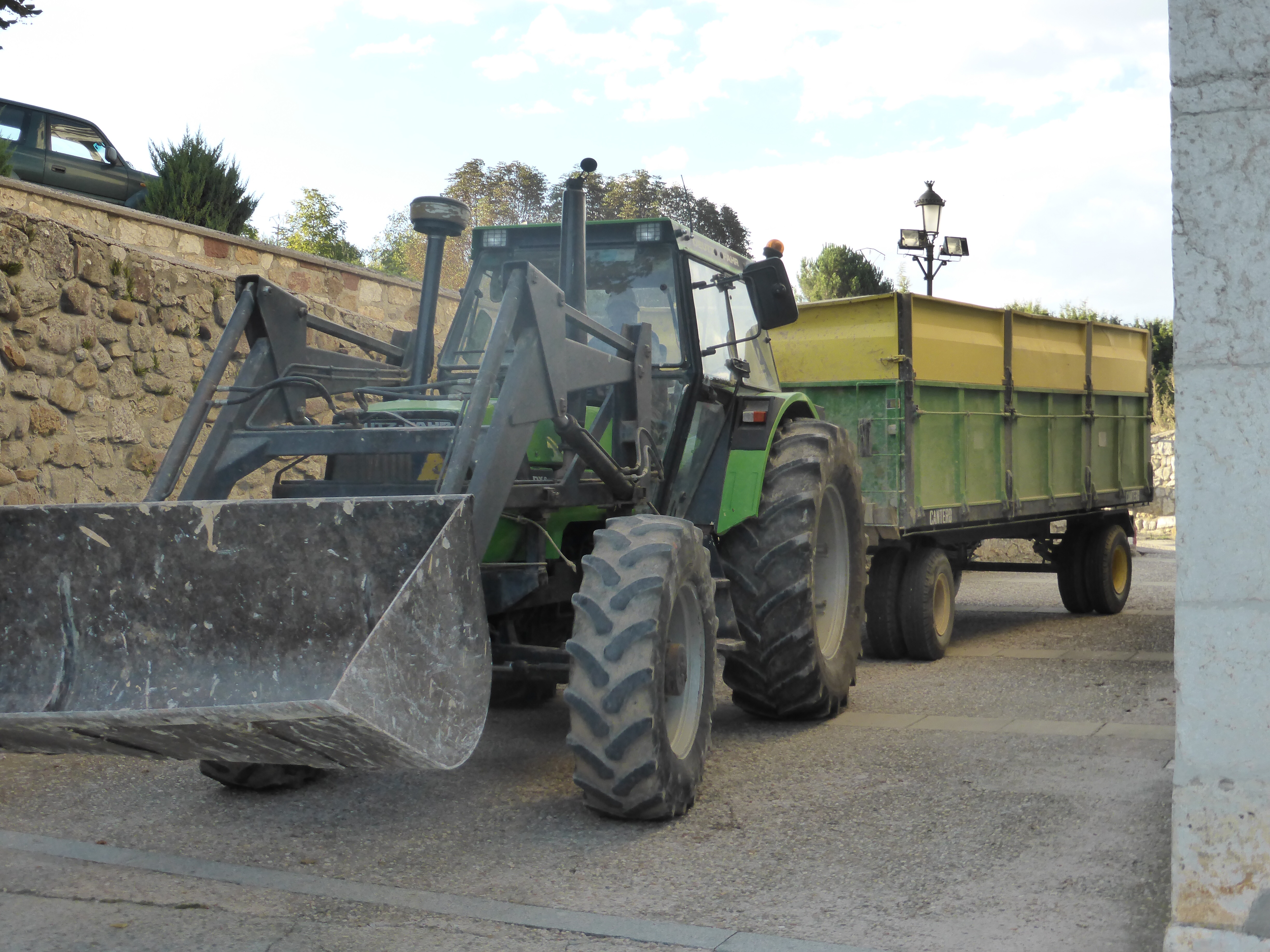
ESPECIALLY FOR GARNER AND EMMITT… a big digger hauling a load of potatoes (Note – a New Holland product – see them everywhere here)
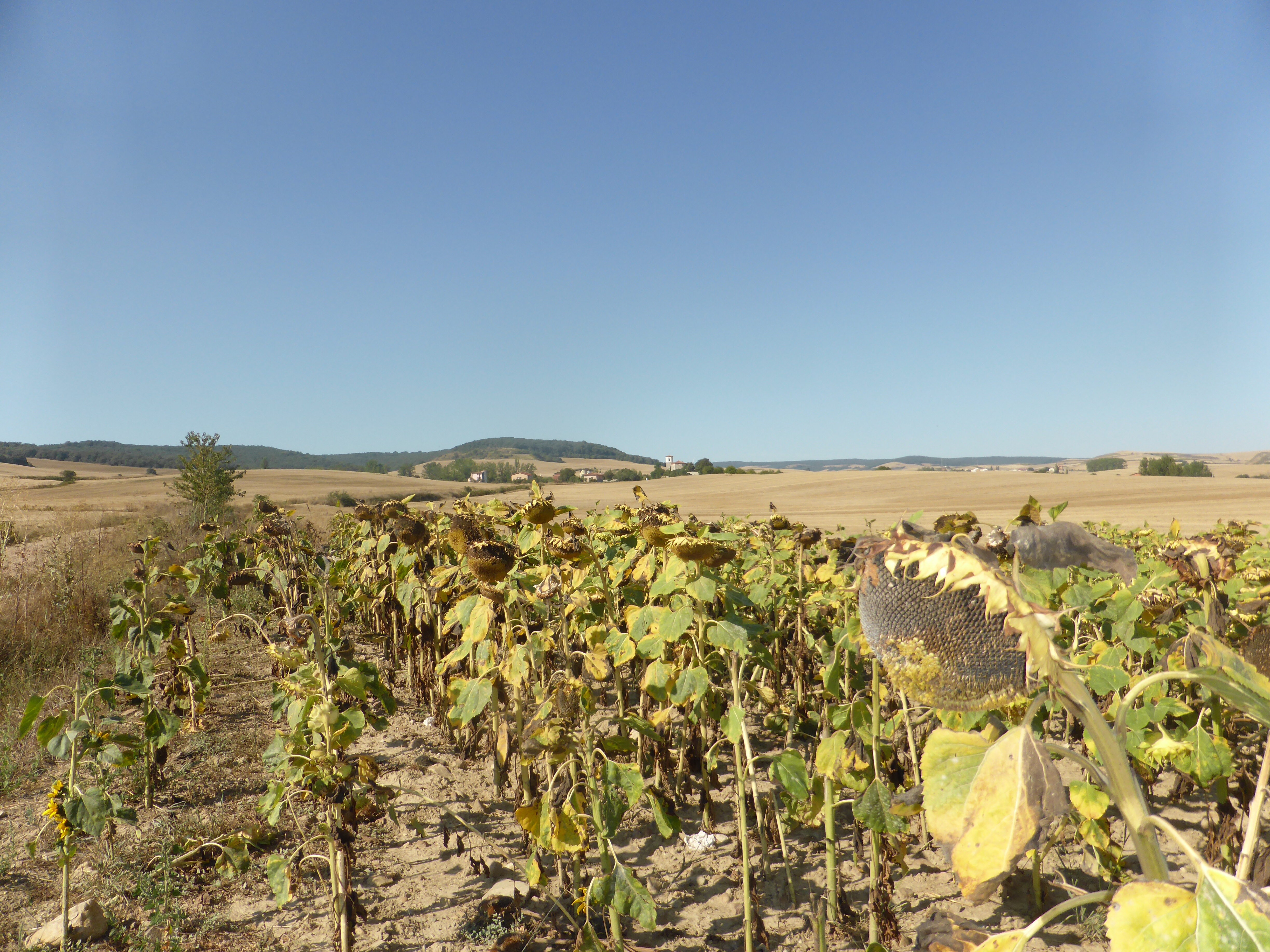
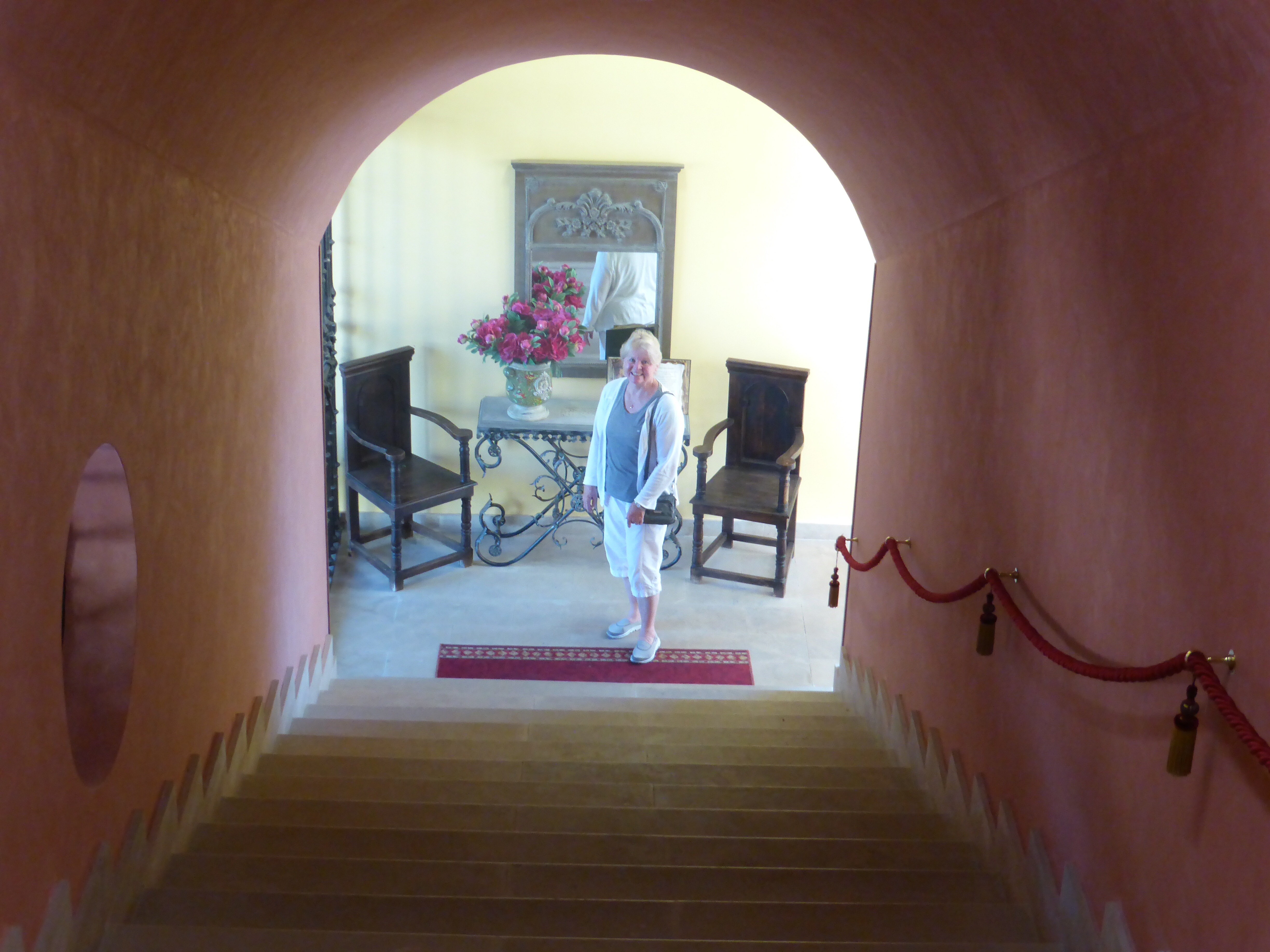
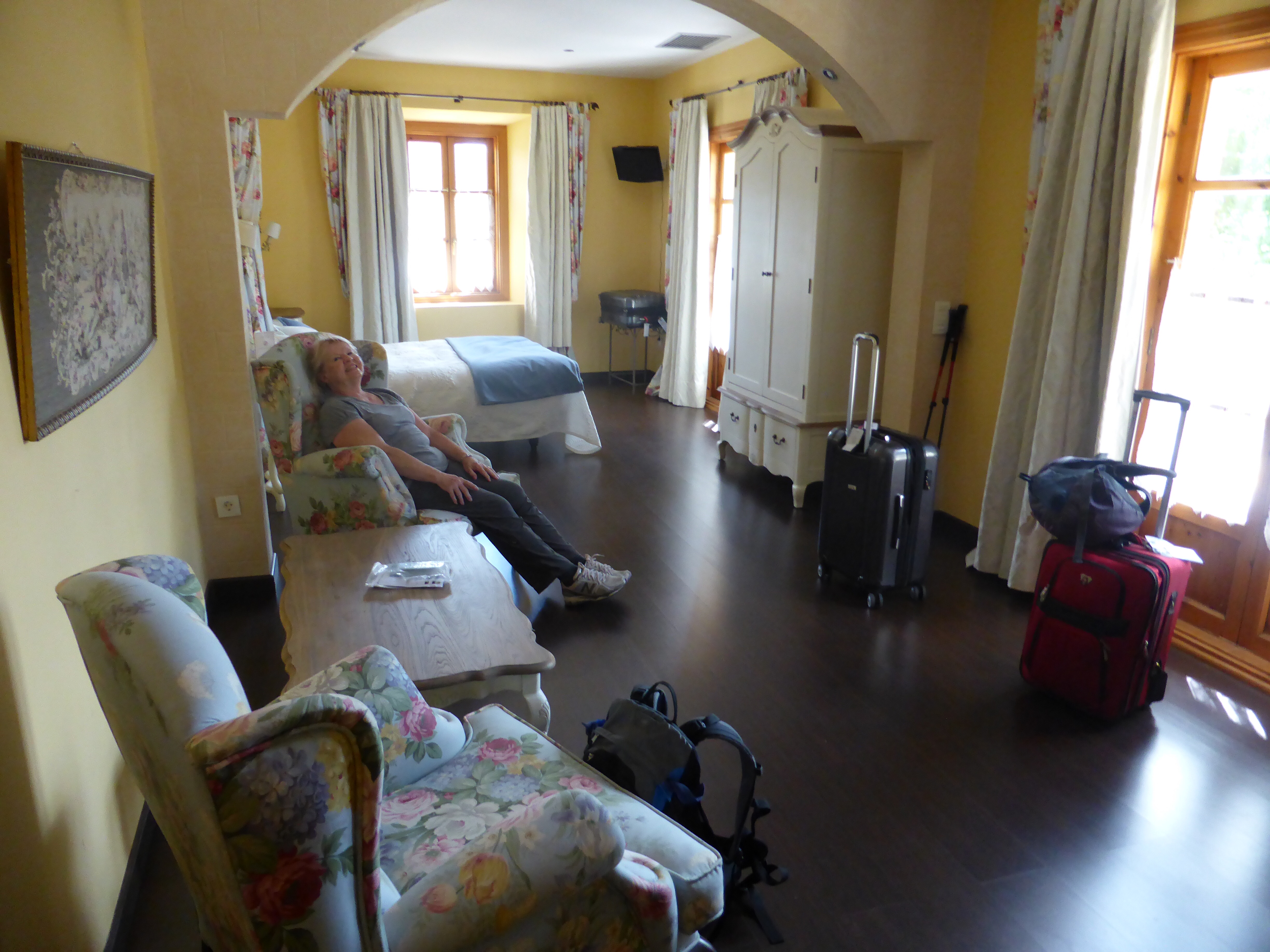
Just a pretty picture with a little village in the distance. ( Interesting how accurately we can estimate time to walk – that village is about 15 min away). Note the sunflowers – no longer pointing toward the sun, we do not know why they are grown, most of the seeds have been eaten by the birdsThe stairs leading to the Queen’s Room… where we are at the top of the stairs. This is a huge old beautiful hotel in the middle of no where. Good choice Mutti!And finally – the Queen’s Room…. three times the size of the one last night. And yes – a tub!
DAY 18: September 10 BELORADO to VILLAFRANCA MONTES de OCA (12km)
We were on our own for most of today’s walk. The other peregrinos were travelling further and had started long before us and at a faster pace. One Japanese fellow was left with us as we were having breakfast. He spoke English well but no Spanish and he was trying to ask the inn keeper’ s wife if they would take his suitcase to the bus stop. Yesterday, Mutti had said about five words in Spanish to the owners, so (in desperation, we suppose) the woman turns to Mutti and starts asking her in very rapid Spanish what the man was saying. It was a mini sitcom. For some reason Mutti knew the Spanish words for luggage and bus:-) Alfredo, the inn keeper got his car keys and we hope our fellow pilgrim and his suitcase got to the bus stop.
The landscape today was more fields of stubble and sunflowers. The sunflowers are past their prime and sorrowful looking with their heads bowed. Although we thought we were going to be on the flat meseta for the past several days, we have discovered it really begins right about where we will end this year’s walk. The climbs are gentler now but often still long. It sometimes feels like we are going up forever.
Our hotel is a grand old place, perhaps a bit over decorated but we have “the Queen’ s”room. We don’t know which queen:-) It is spacious and there are lots of windows. Despite it being hot again today, the nights are always lovely and cool. Once again we are right beside the church. When booking we did request to be in the historic areas not remembering that churches are almost always the cent er of town. We have daily reminders to be prayerful:-)
We realize suddenly we have only a week left of our Camino until next year—5 days to walk and 2 rest days!!
These days have passed so quickly. Only writing this blog had kept us aware of the date. It has been easy to lose ourselves in the tempo of our footsteps, the solitude, and just being very present in our world. One pilgrim wrote that she began the Camino “from a life at the speed of light and completed it at the speed of life”. Walking long distances does cause you to slow down in all ways. It is very nice.
Dad has had fun trying to determine the demographics of Camino pilgrims….at this time of year his breakdown is 10% over 60, 50% between 40-60 and 40% under 40. The under 40 increases when school is out and families hike together. We have not met anyone else over 70 yet.
In a discussion with some fellow pilgrims, the fact that we came over the Pyrenees seems to astound. In our planning we had considered the easier valley route but we really wanted to walk the traditional Camino Frances. We had read that it could be difficult but we believed breaking the climb and descent into two days we could do it. On further reading after the fact the descriptions are “tortuous”, “unbearable”, “brutal” and “wicked”….it is a good thing we did not read these articles or we may well have chosen the easier and safer route. Unknowingly, we have gained the cachet of walking over the Pyrenees:-)
Before closing :
we (Mutti) had a George Clooney sighting in our hotel restaurant. She actually managed a surreptitious photo as evidence. It turns out George is in Venice.
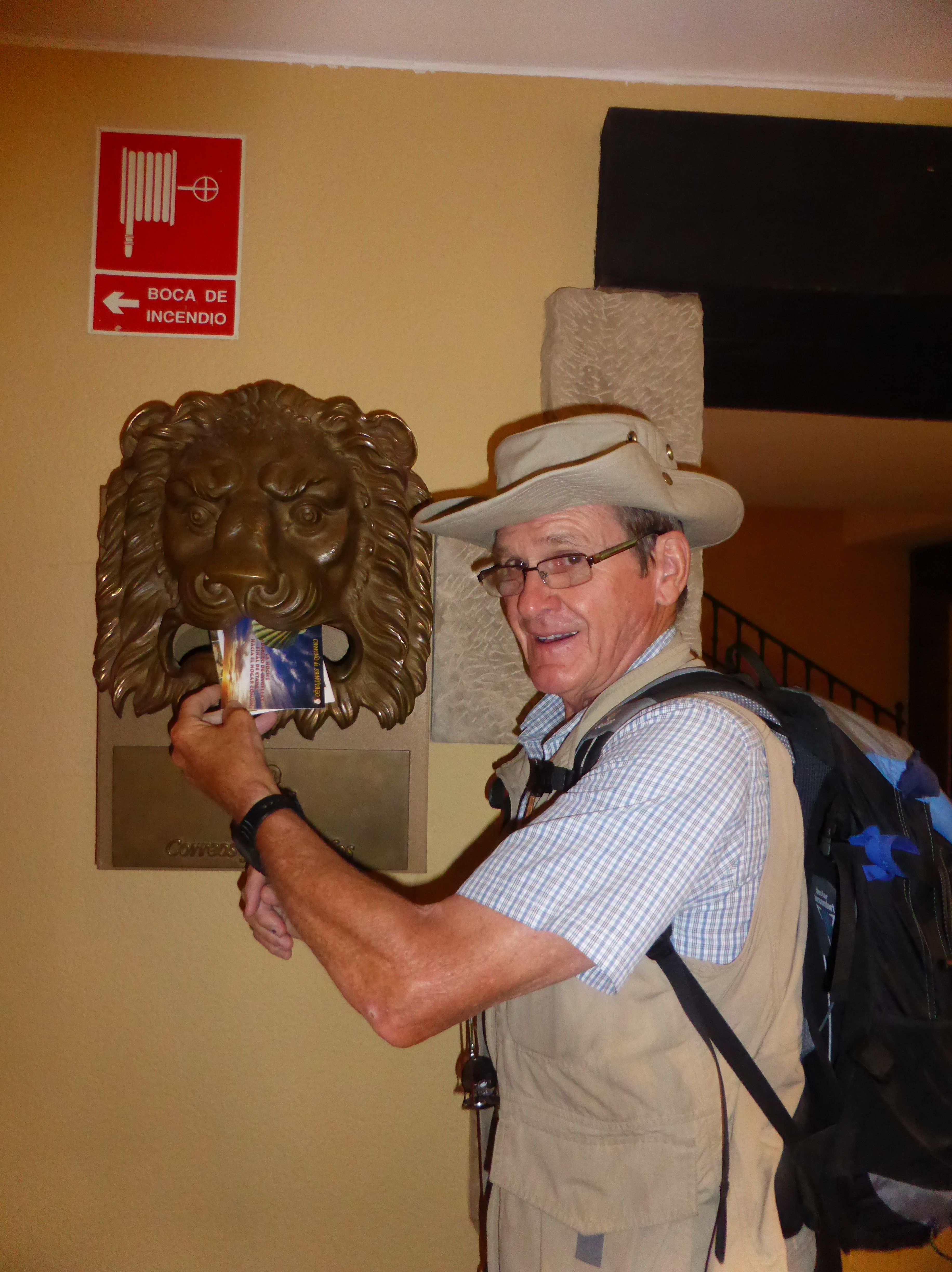
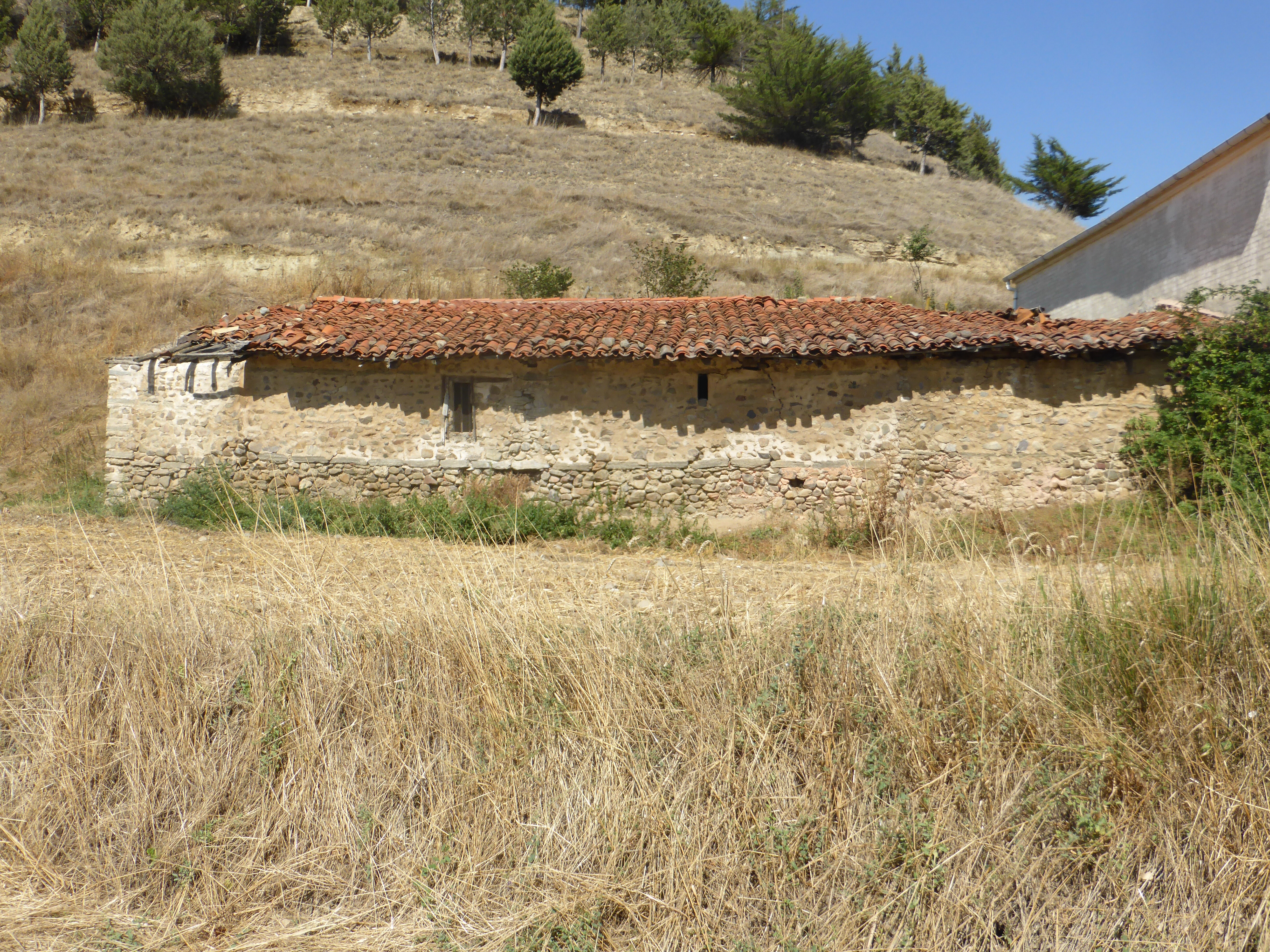
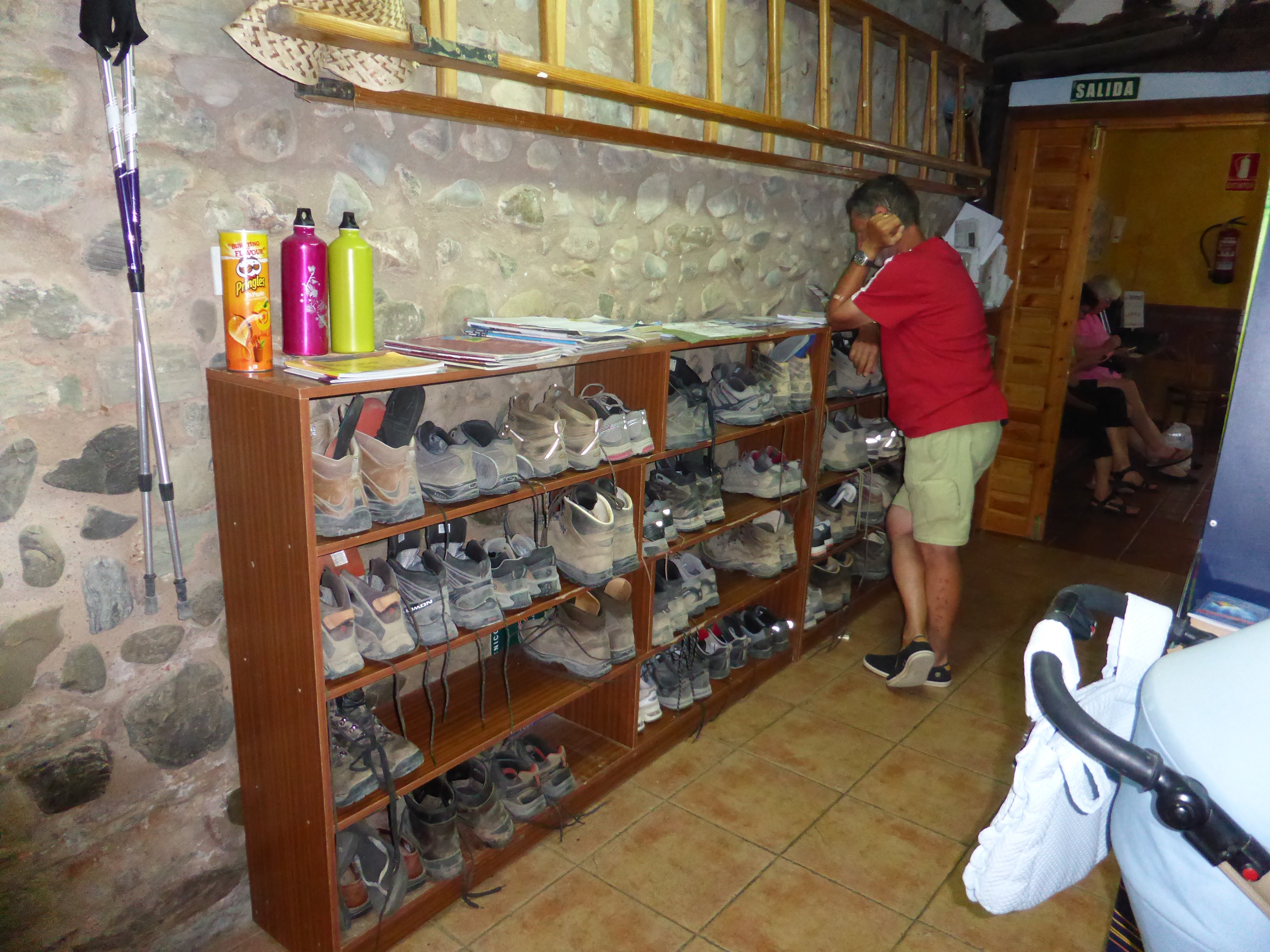
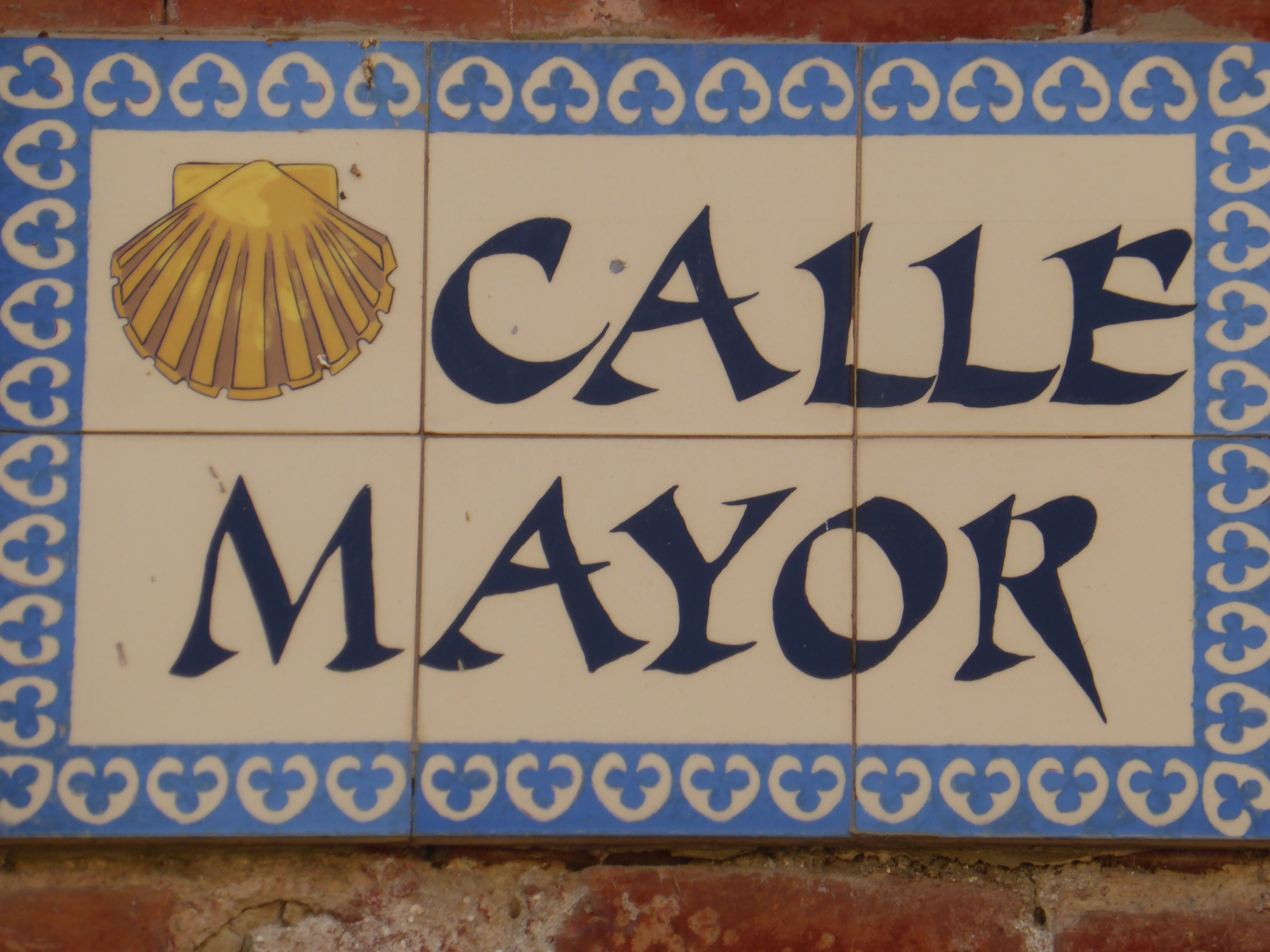
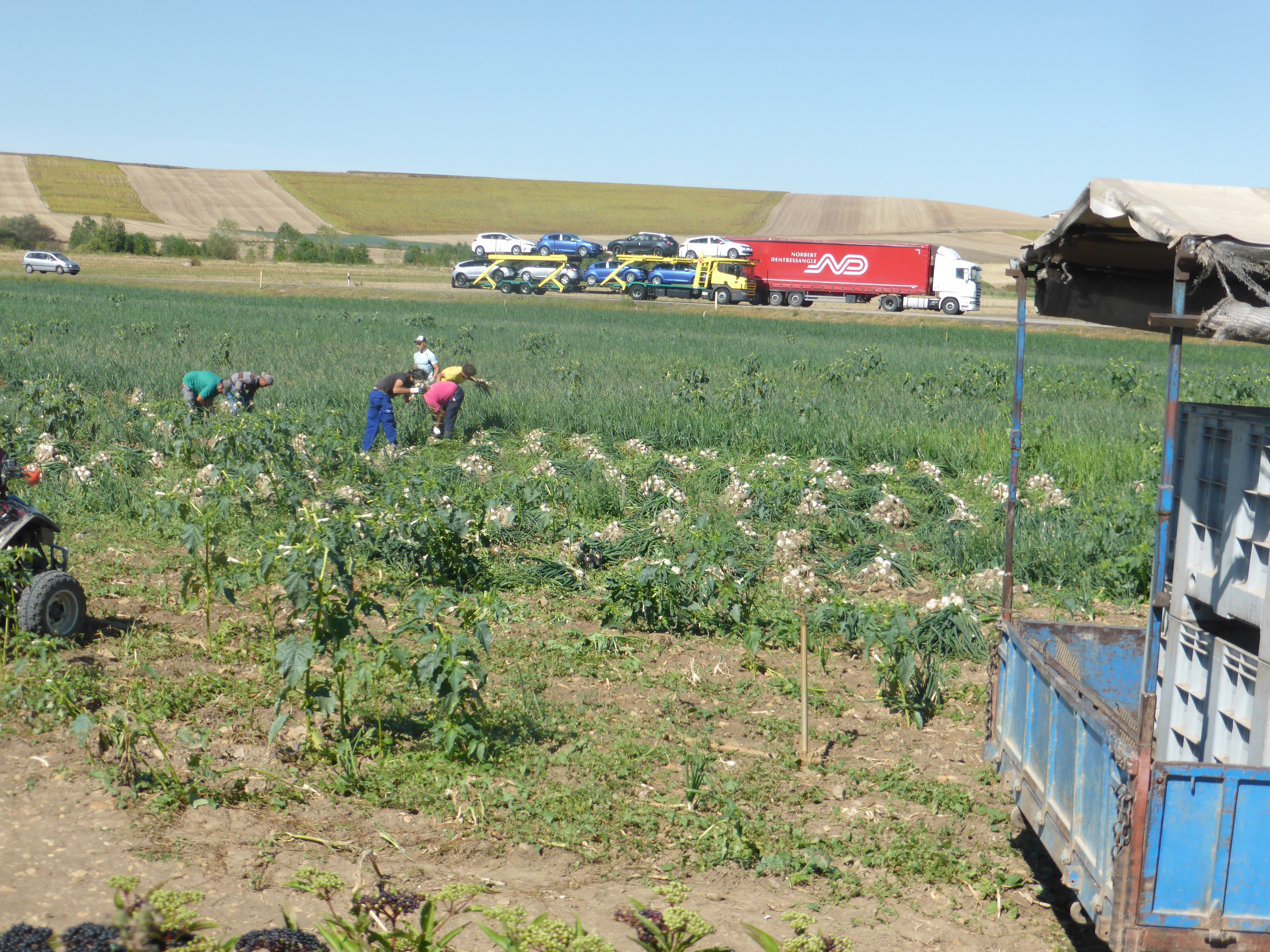
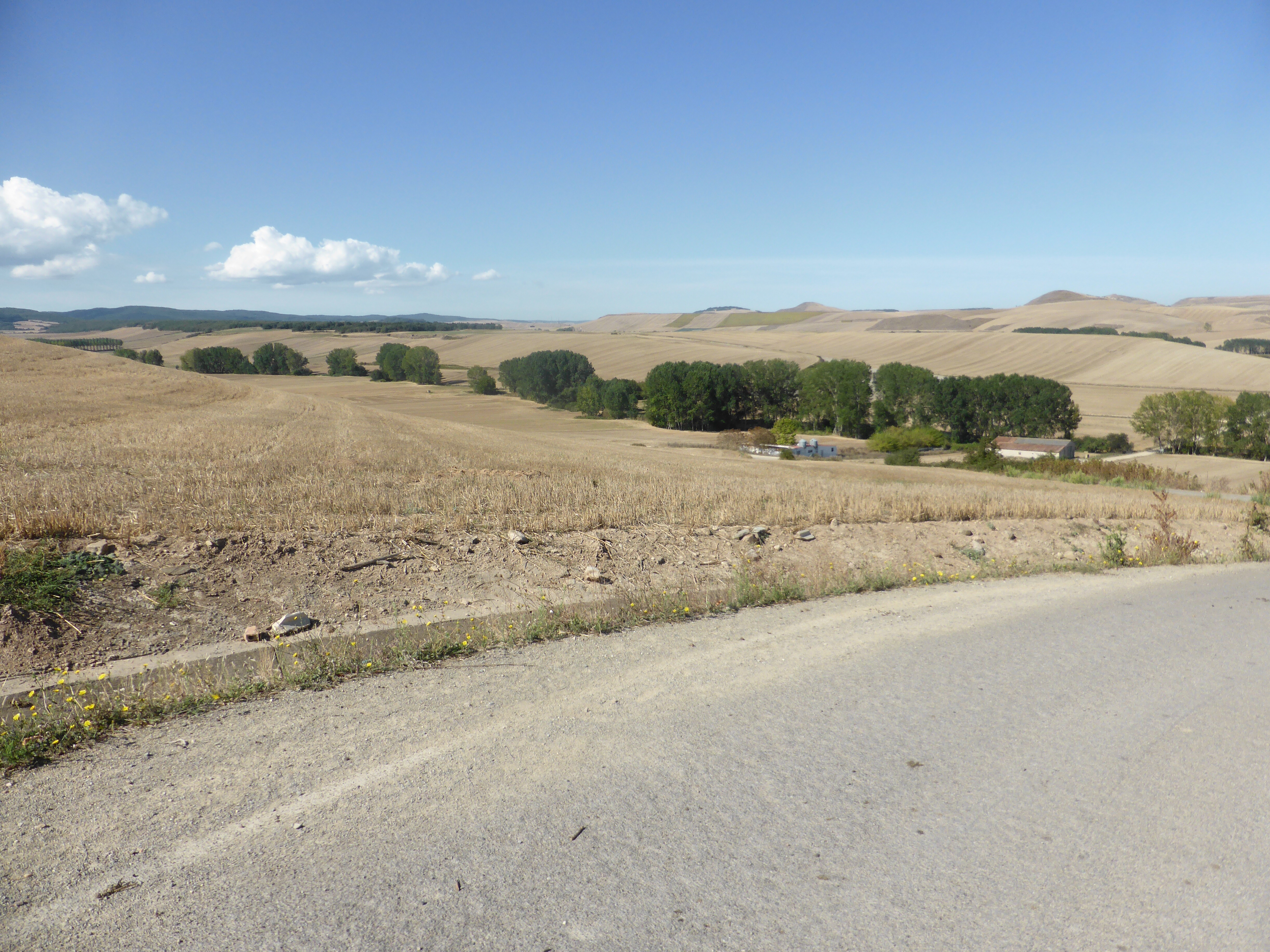
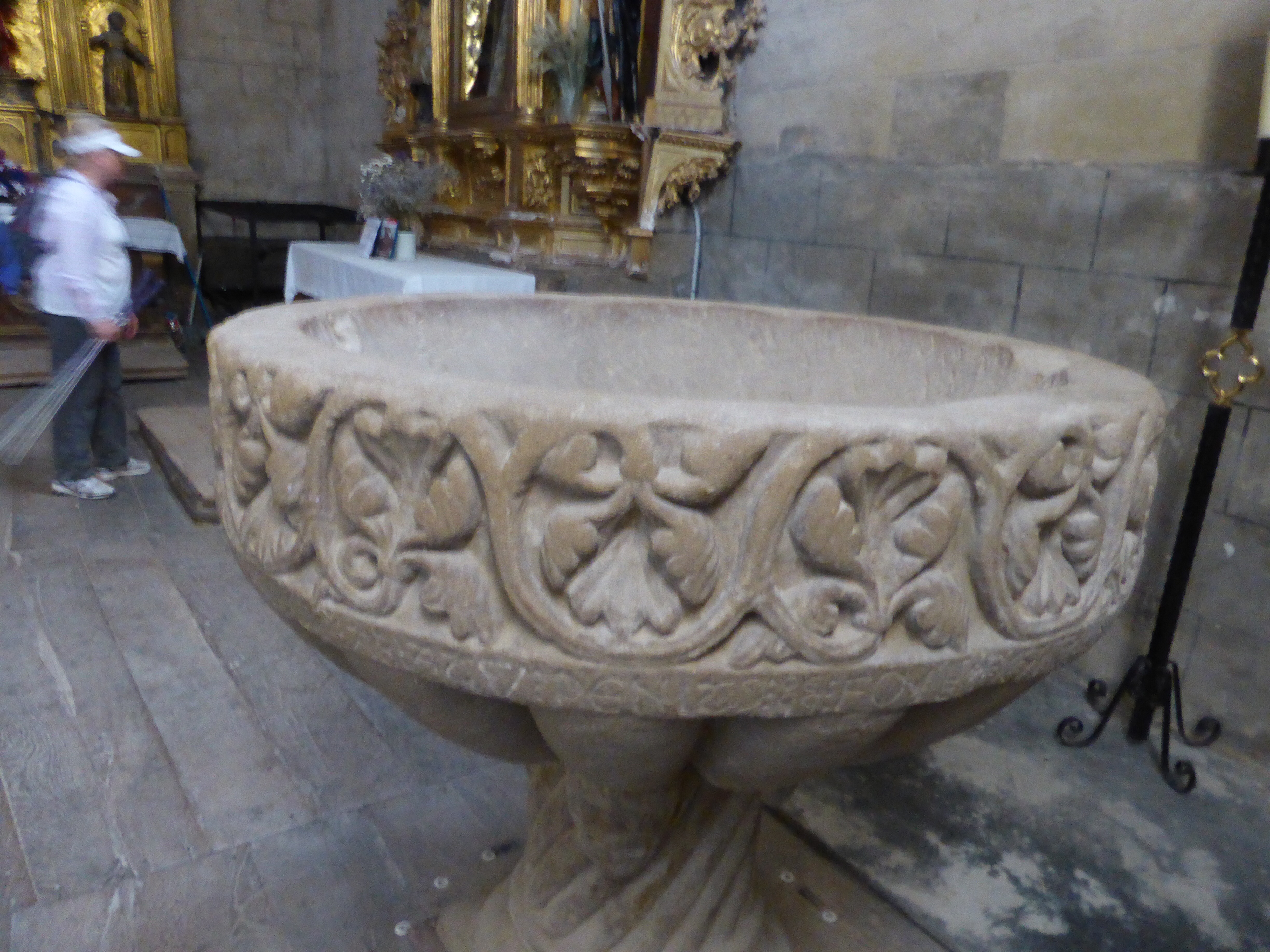
For all the Grandchildren – we are always sending you postcards even if we have to risk being bitten by a lion!Our hotel room tonight. Love the old outside rock wall. Probably over 300 years old. Run by a hard working family who keep it squeaky clean.We thought this was our hotel ….. Something out of the old west!A friend we met along the wayThe boot / shoe room. All pilgrims remove their out door footwear in the auberge where accommodation is less than $15 a night. We ate at one tonight where the accommodation was less than $7Every town has a ” Calle Mayor” – translation: High StreetThat is a field of onions being picked and for Garner: that is a BIG RED TRUCKThought we were leaving Moose Jaw for Swift Current!!A 600 year old baptismal fontThis is the church that serves a town of less than 1500 people. It was built almost 600 years ago. Ladysmith is just over 110 years old.
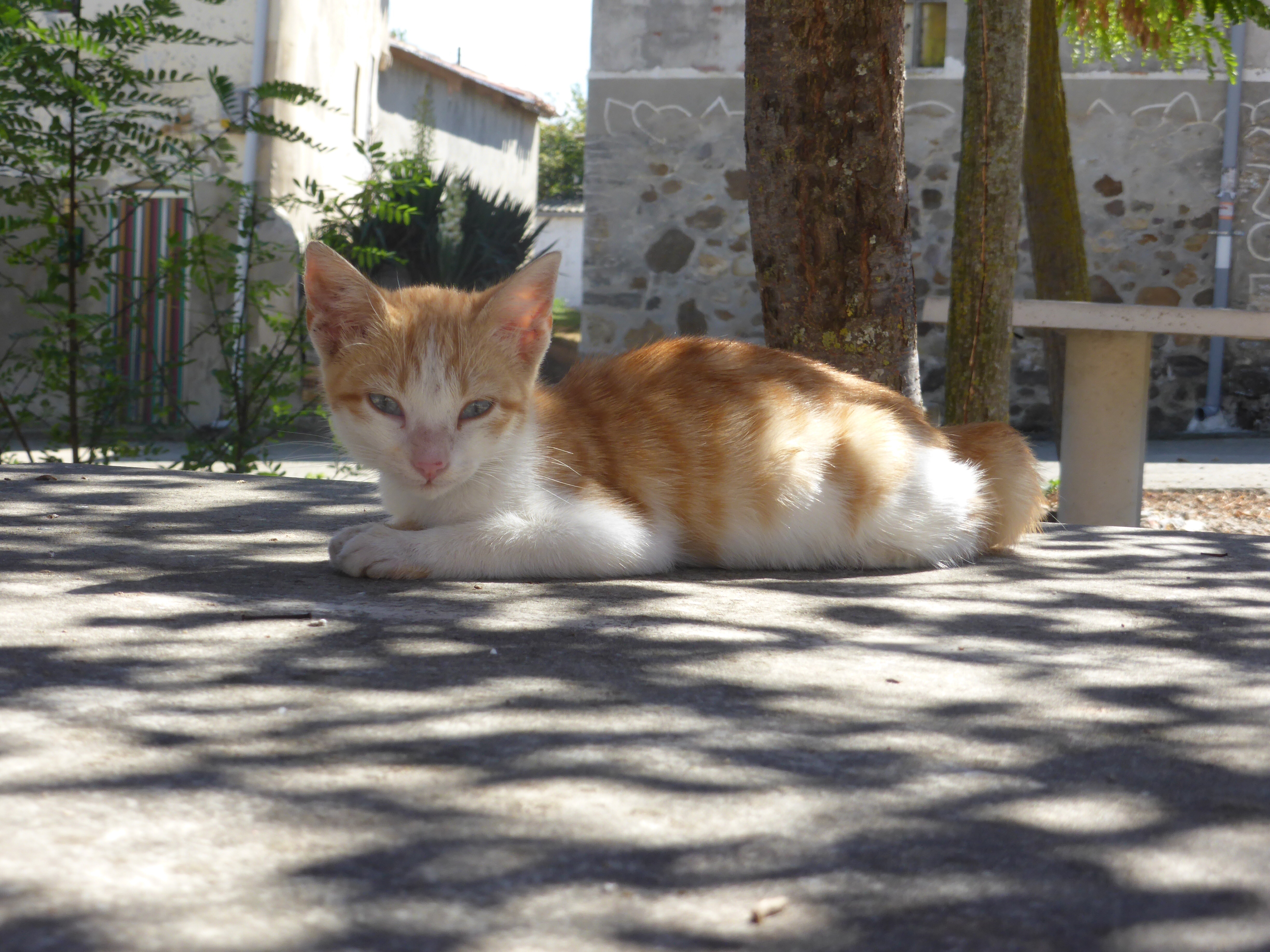
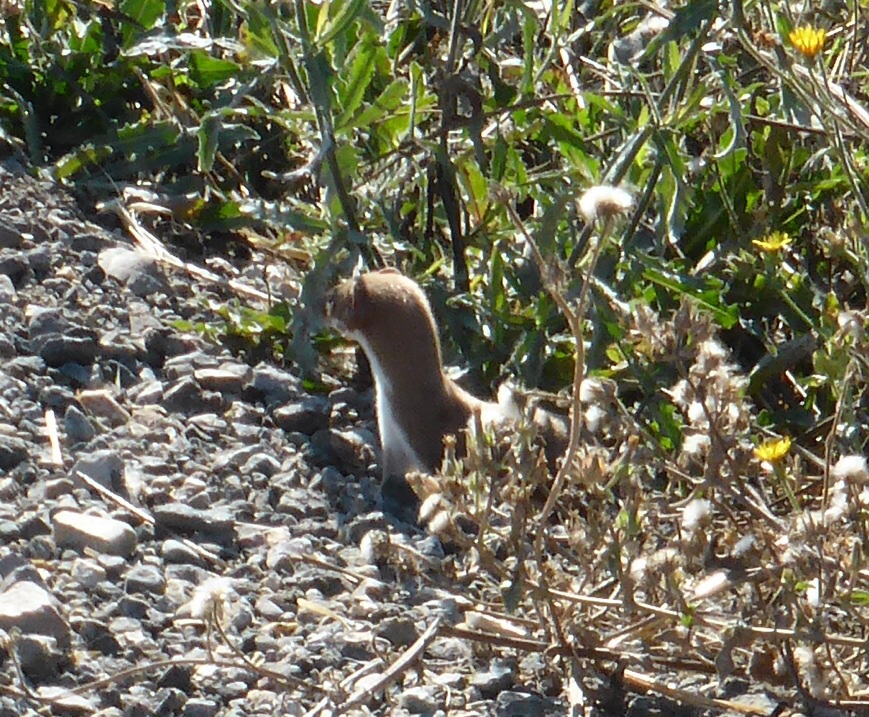
Don’t know what it was. About 6 inches long with a white chest and looked like a small (cute) gopher
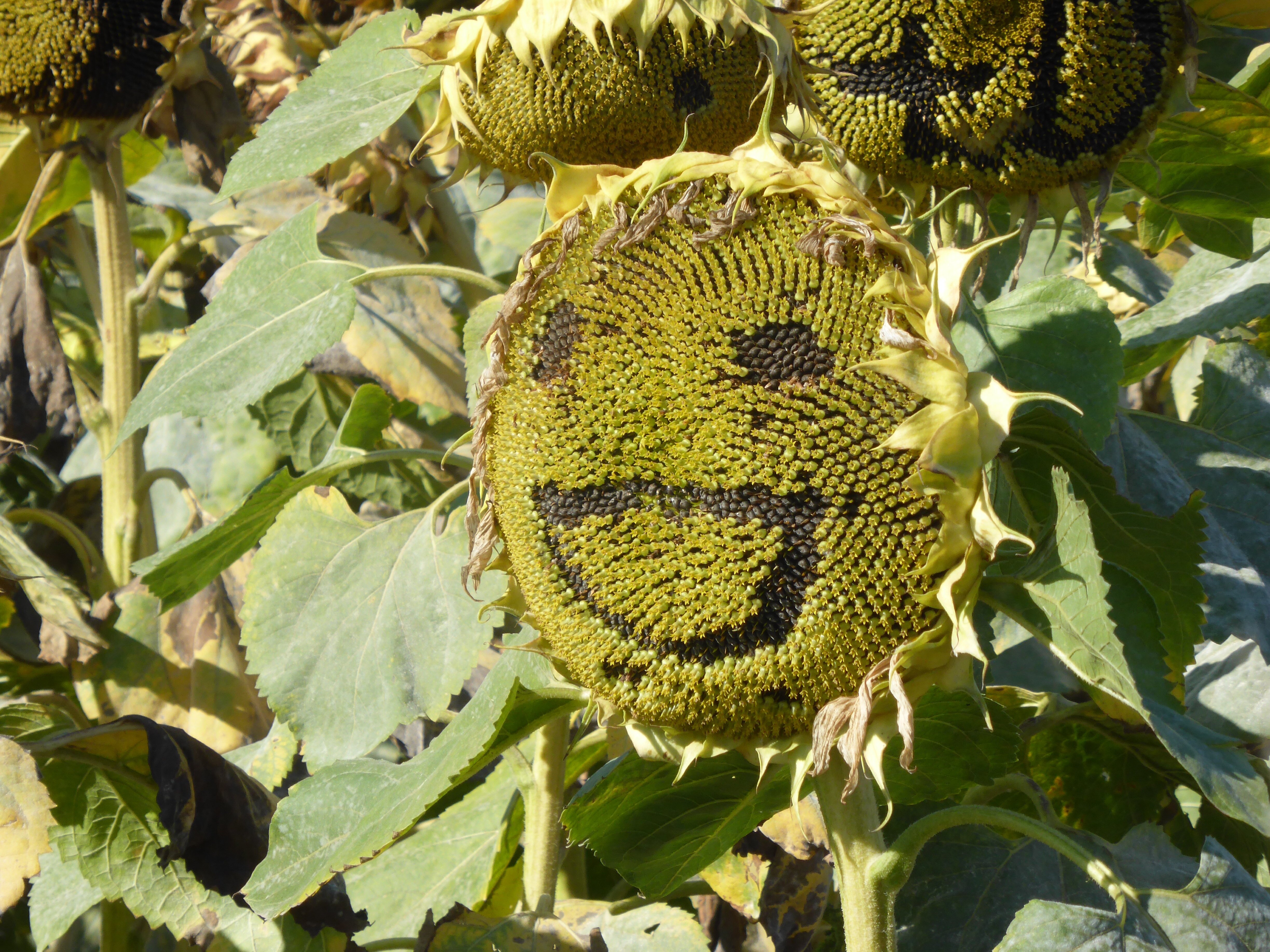
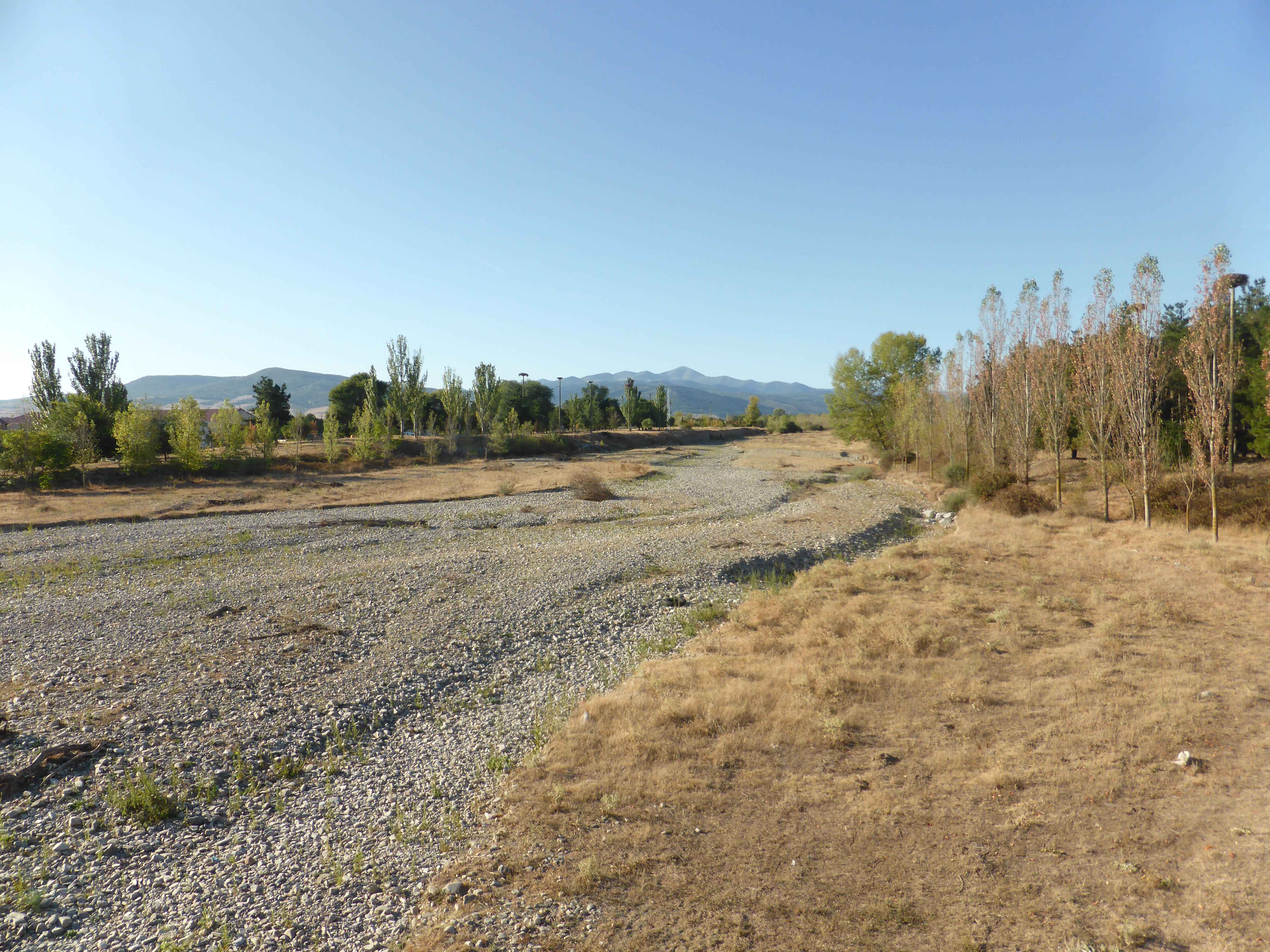
A sunflower happy face done by pilgrims or a friendly farmer:>)Rio Oja – should be full of water but we are experiencing a serious drought – we have not seen rain in 17 hot daysMutti the pilgrim!
DAY 17 Sept 9 Santo Domingo de la Calzada to Belogrado (23km)
The guide book description of today’s walk “alongside the highway with detours into towns and across fields—-easygoing with the usual ups and downs of the Camino”…..mmmm
Our stoney path did follow the highway for long distances and the constant noise of big trucks was sometimes distracting. There is a lot of transport along European highways and this is the main highway for northern Spain. It was a treat to take short detours into the villages. These villages have pilgrims passing by but not contributing much to the economy. They were rundown and not as well kept as the other villages we have visited. These seem to villages that time has forgotten.
The landscape has changed dramatically as we left La Rioja wine country and entered into Castilla with its vast fields of grain and sunflowers. The grain has been harvested and the farmers are now plowing the stubble into the soil. The country is hilly with steep slopes so they have to be adept at what they do.
We are staying at a “rural casa” –a sort of hybrid pension and simple hotel. It is run by a kindly family and is well kept. However, tonight we have half pension (this means supper). As there is no real kitchen here, we are sent with a little paper to the nearby albergue for supper.
This was an interesting experience. The albergue was very nice —-clean and attractive–and the dining area was set up like a restaurant. Albergue dining is communal and at least 50 pilgrims crowded into the room. Everyone was pleasant but the noise level required you to almost yell to your tablemates to be heard. The food was surprisingly good and the servers excellent. An aside: everyone we have encountered in Spain in the service/tourist industry works very hard. Their job descriptions must be horrendous. For example at one hotel, the young concierge also does room service, sets up the breakfast buffet and helps clean the rooms! This is a common occurrence and there is no tipping in Spain. Back to the albergue dinner. We were seated with a young female psychiatrist from Edinburgh who does a two weeks of the Camino every year. Our other tablemates were 3 Swedish women who all work together and are walking the Camino for a week. This is the first time we have encountered pilgrims who break their walk into manageable pieces —not everyone is retired or can get 6 weeks off work:>) Anyhow, we had a lovely time and great conversation (when we could hear it:>)
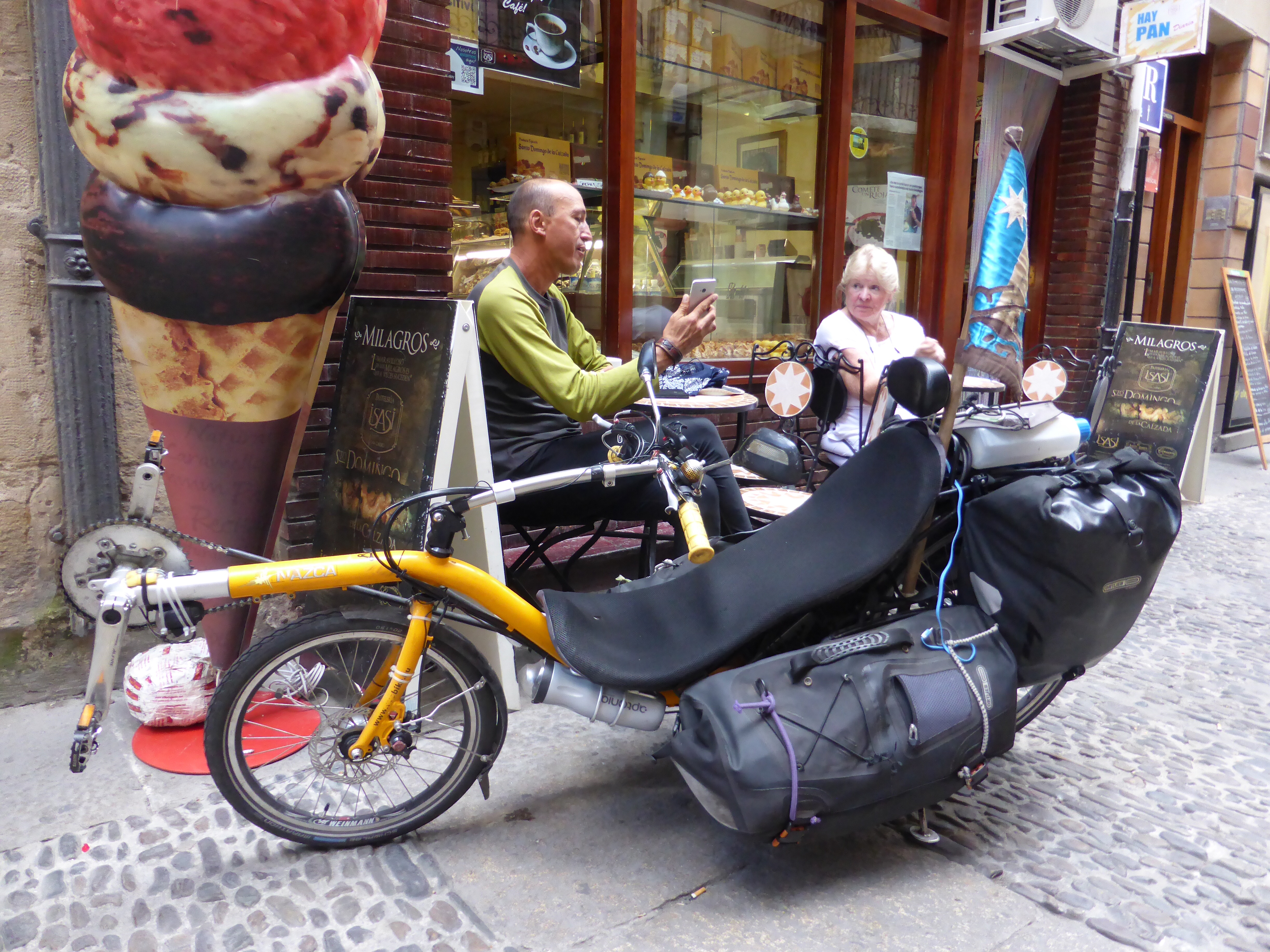
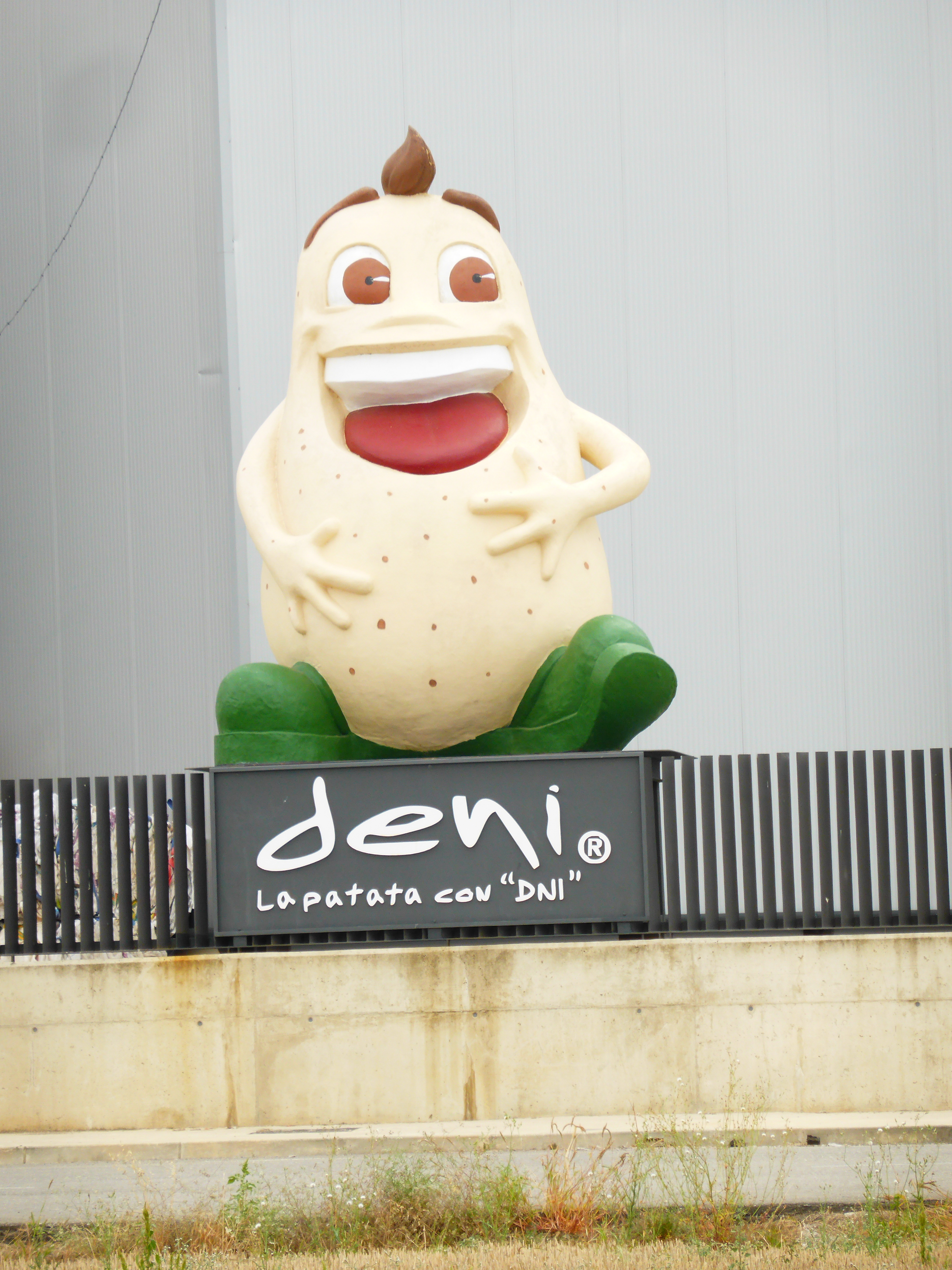
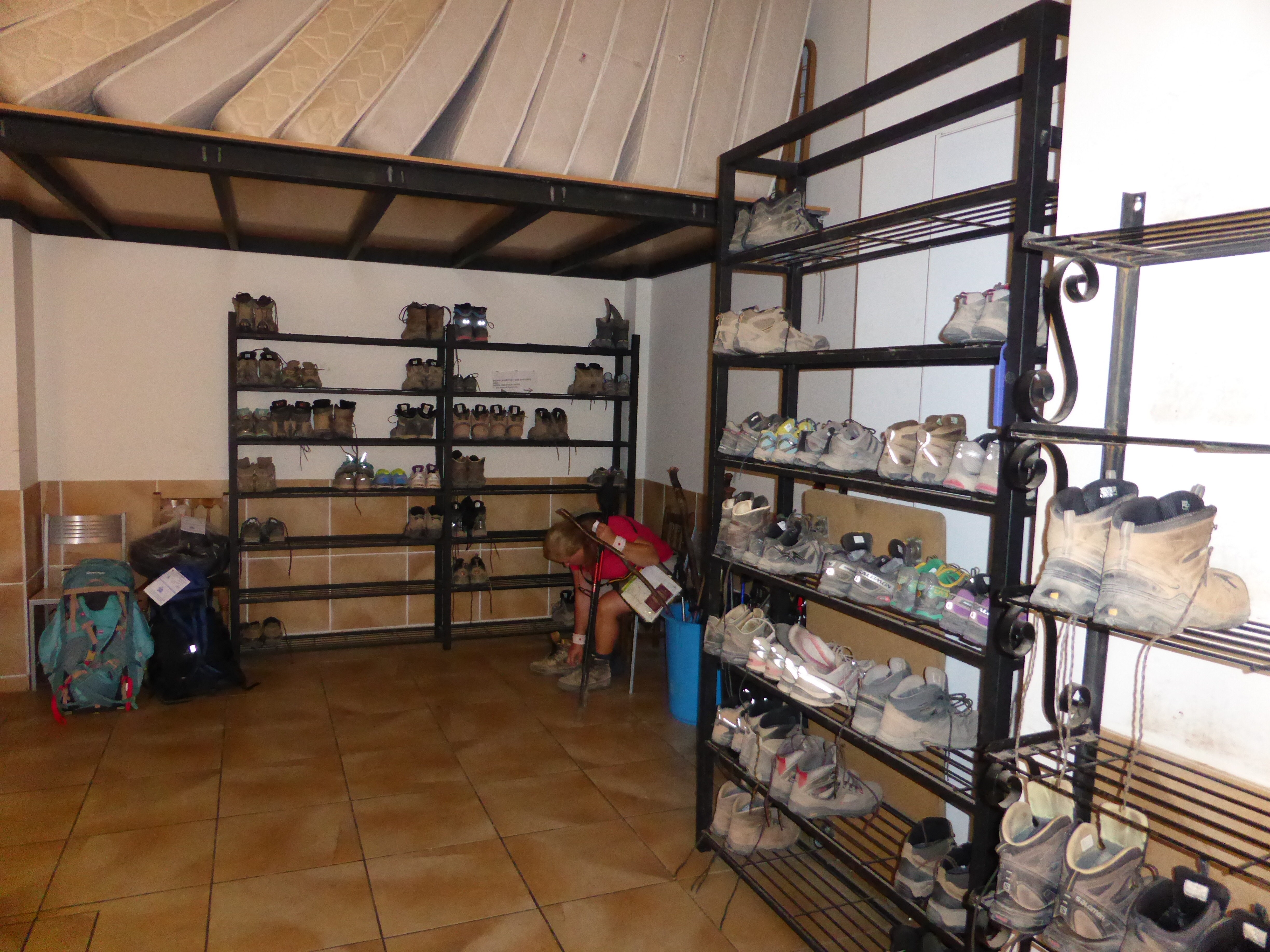
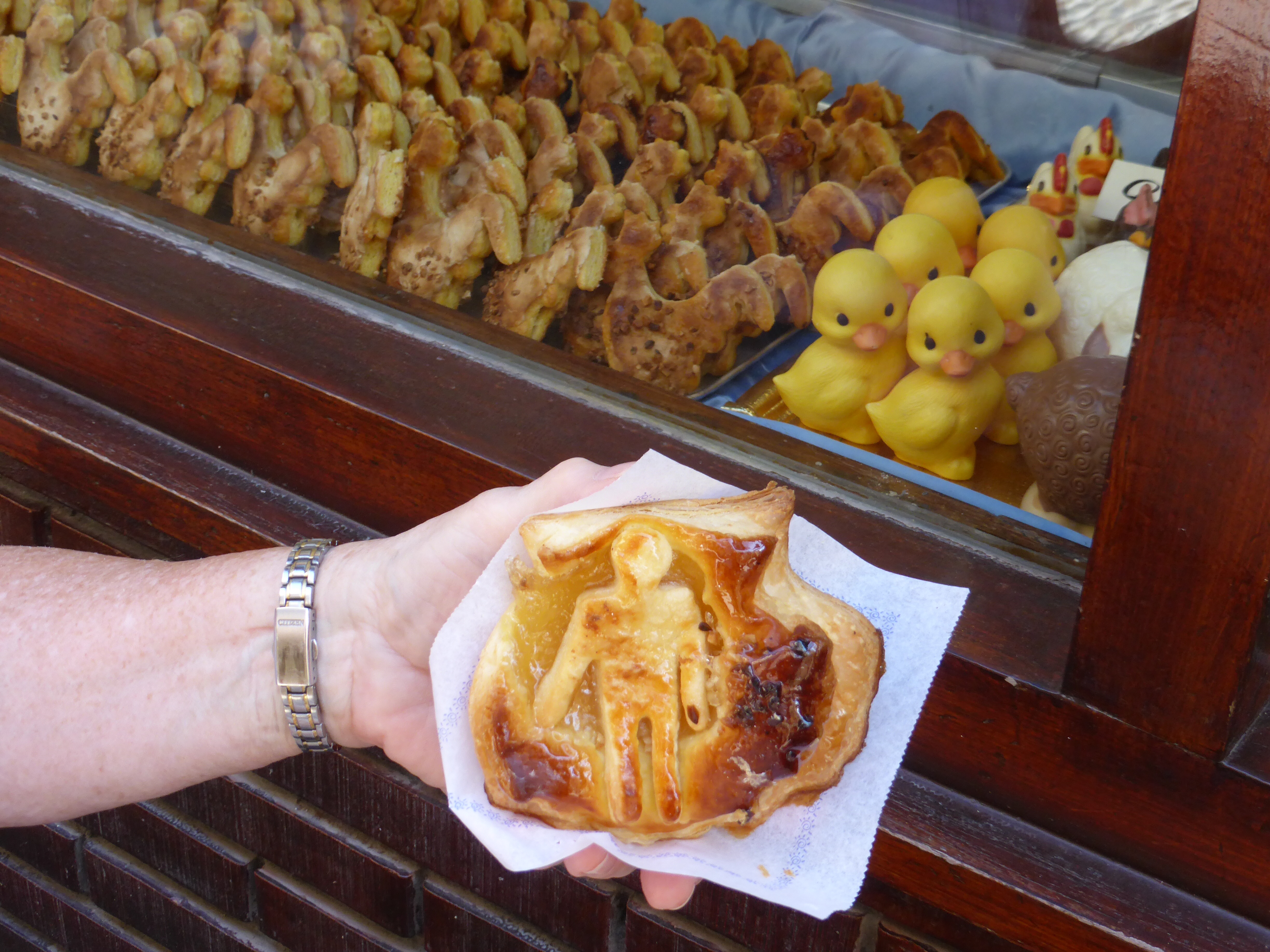
A day for coffee and treats.Amazing the people you meet , here is Zoltan from Hungary. He is on the last leg of his 15 month around the world bicycle tour. He did the Camino 10 years ago – it changed his life. Still owns his pizza shop but lives a very simple and basic life and is very happy to have shed most of life’s trappings. Amazing bike – latest in efficiency, he even has a solar powered cell phone!This is a potato growing area – here is the mascot for the local potato company – for the grandchildren!An Auberge ( a hostel) here in Spain an Albergue – very basic communal accommodations costing from 5 to 10 Euros a night ($7 – $14) used by the majority of pilgrims. I snuck into the one here – this picture is the “boot room”Called the “Ahorcaditos” – a local specialty – an almond pastry depicting the Pilgrim on the Camino Shell. Very good! For all the Grandchildren,check out the yellow pastry ducks!!
DAY 16: September 8 REST DAY IN DAY IN SANTO DOMINGO DE LA CALZADA
Once again lulled by the tolling of the church bells, we enjoyed a glorious sleep knowing that this was a non-walking day:-)
Santo Domingo is named for the patron saint of civil engineers. As a young man he wanted to join a monastery but failed and he became a hermit. A chance encounter with San Gregoire, who was given the task by King Alphonso of encouraging Christians to the area to counter the growing Muslim presence, resulted in Santo Domingo being ordained.
San Gregoire and Santo Domingo together oversaw the construction of roads, bridges and hostels along the way.
Coming into town we passed large storage buildings which according to the signs were full of potatoes….then we came upon a loading area with the same signage. This seems to be the potato area of Spain?
Right now we are sitting under a tree outside the lavanderia waiting for our laundry. Mutti was delighted she was able to use her very favourite Spanish phrase with the others in the laundromat. “El mundo es un panuelo” – the world is a handkerchief. A young Italian boy asked her to write the phrase in his journal….she tried to tell him that it is one of about only 10 phrases that she knows—all of them equally useless:-) Mutti says her “popularity” in the laundromat had more to do with the fact that we had detergent to share than her fluency in Spanish. We manage to communicate fine with English, Dad’s French, German and Mutti’s “Spanglish” and of course, lots of pantomime:-) Despite the continuing stream of peregrinos we are still finding very few locals speak English. It is interesting that those from South America have difficulty with the Spanish spoken here. Smiles, thumbs up and waving seem to be the international language of the Camino. We are now feeling the rhythm and spirit of our walk. Each day there is something special. Those who have written about walking the Camino note that it is “a place of frequent coincidence and serendipity”. That it is:-)
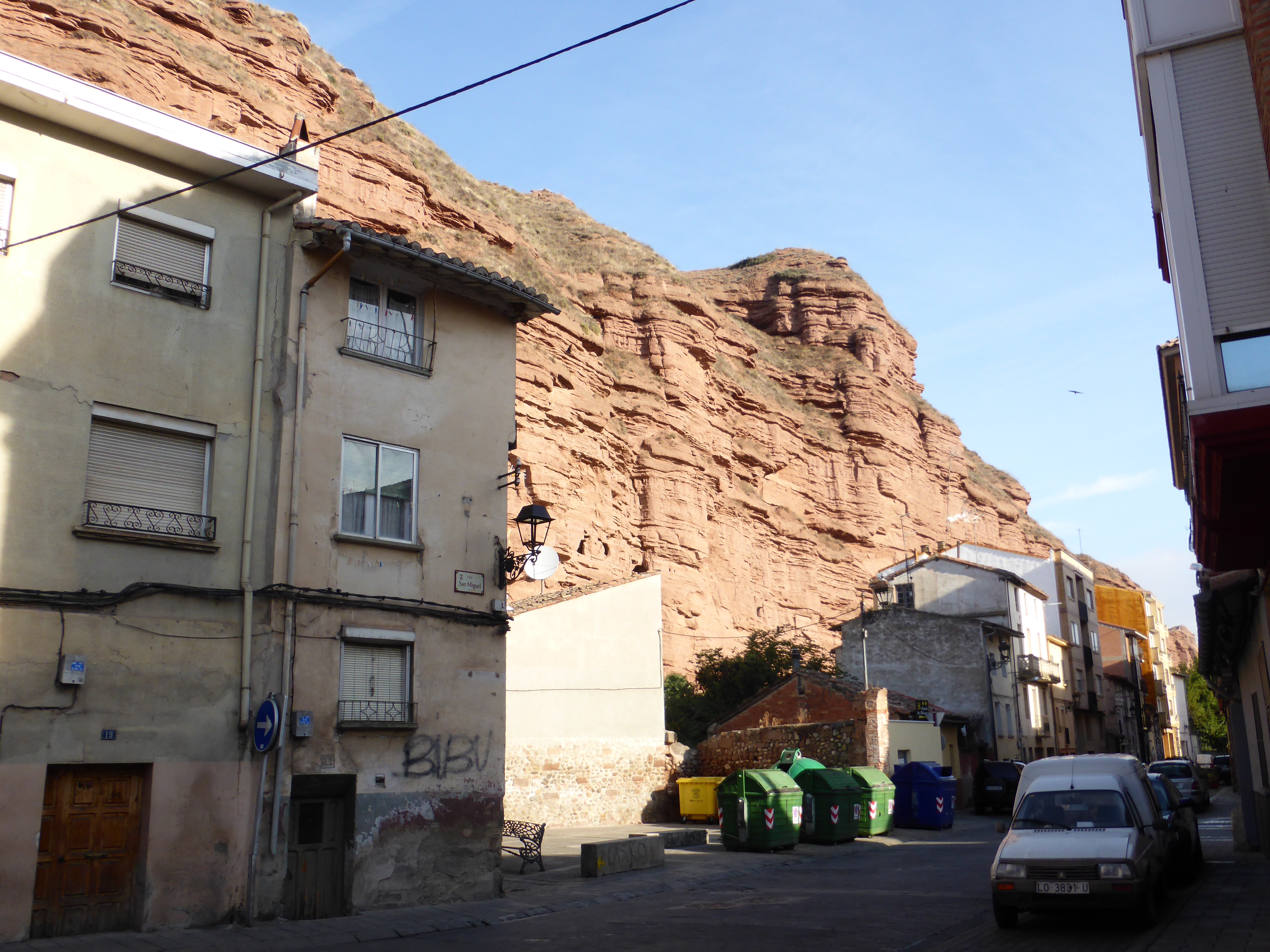
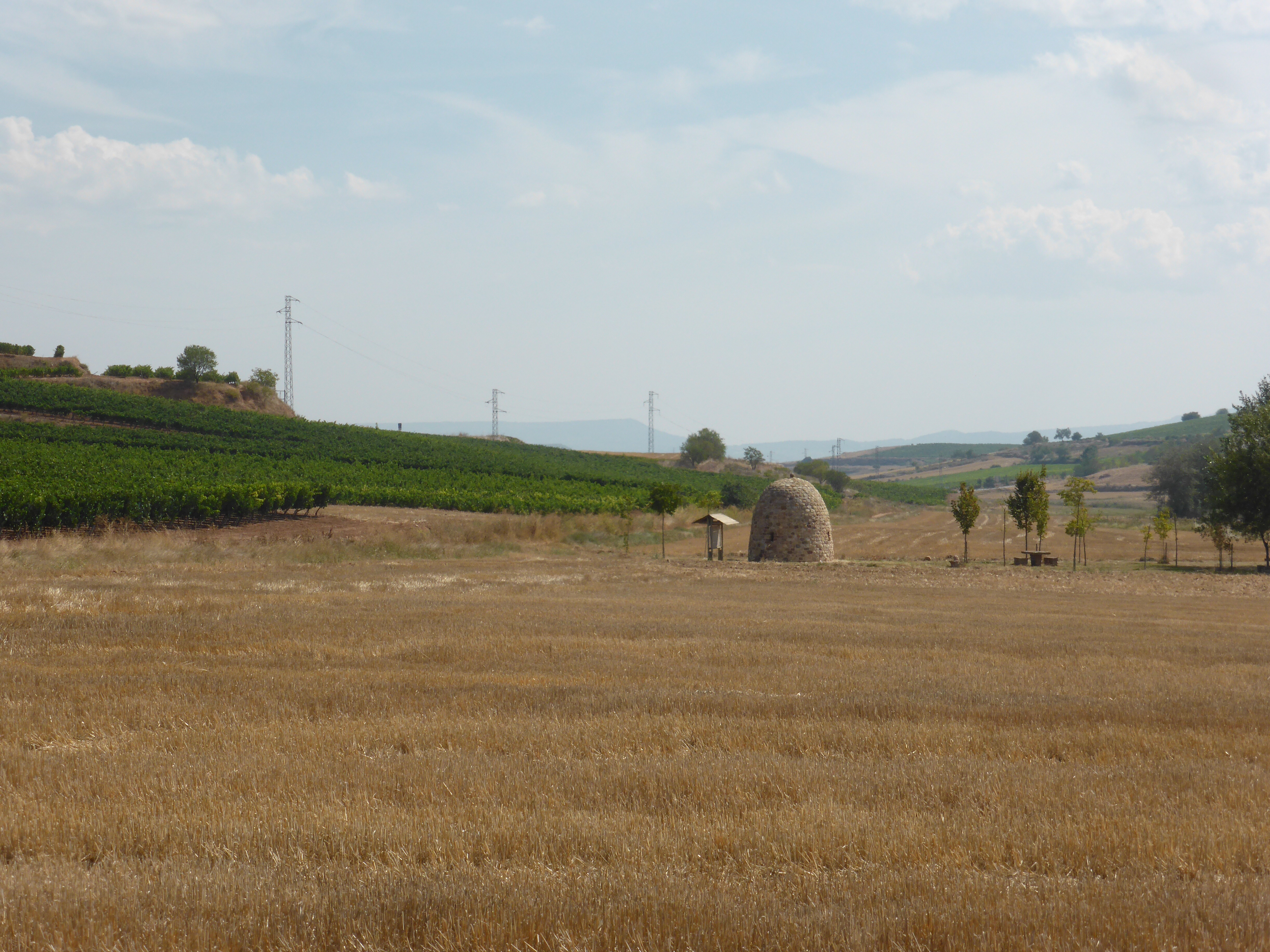
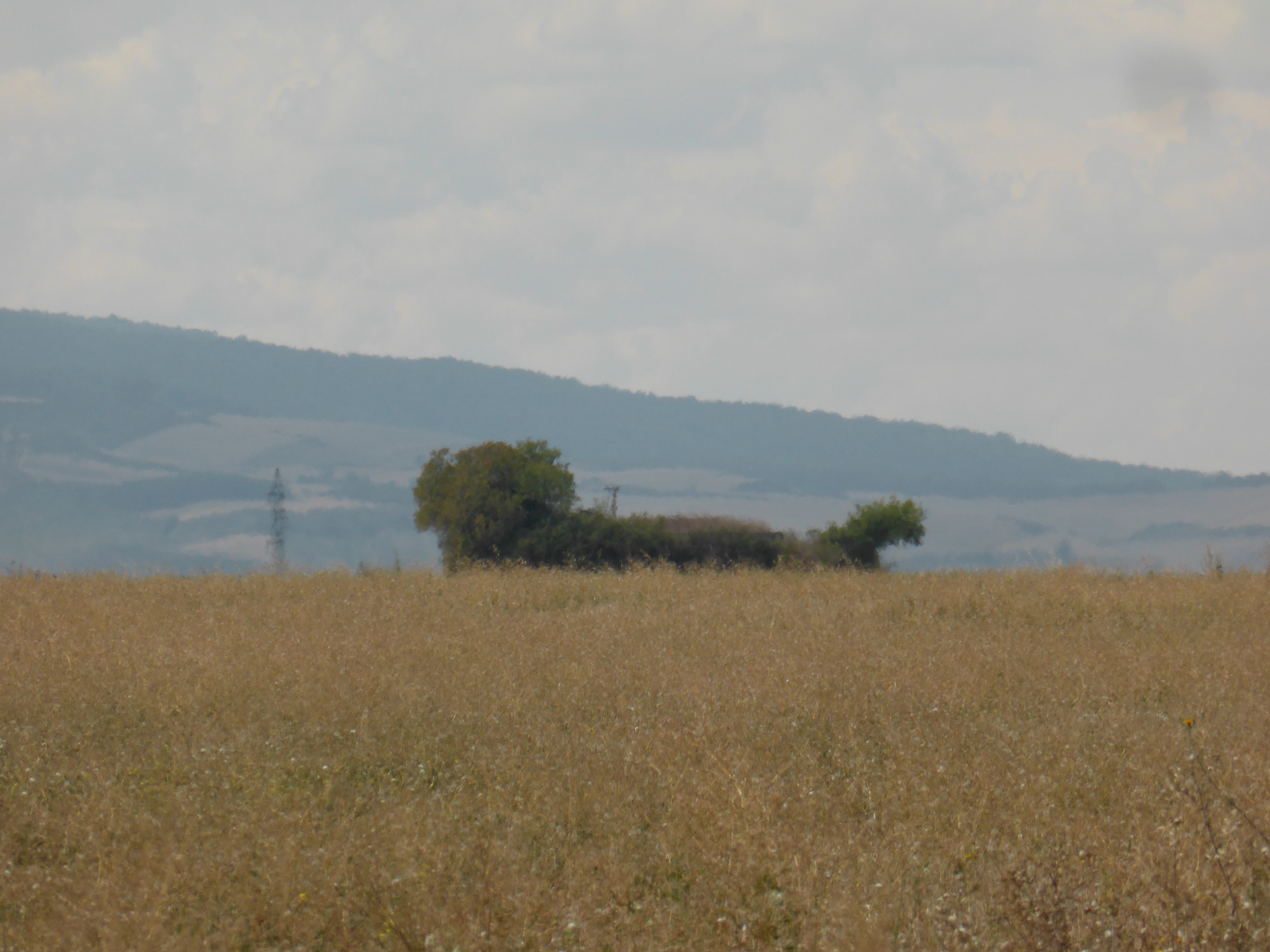
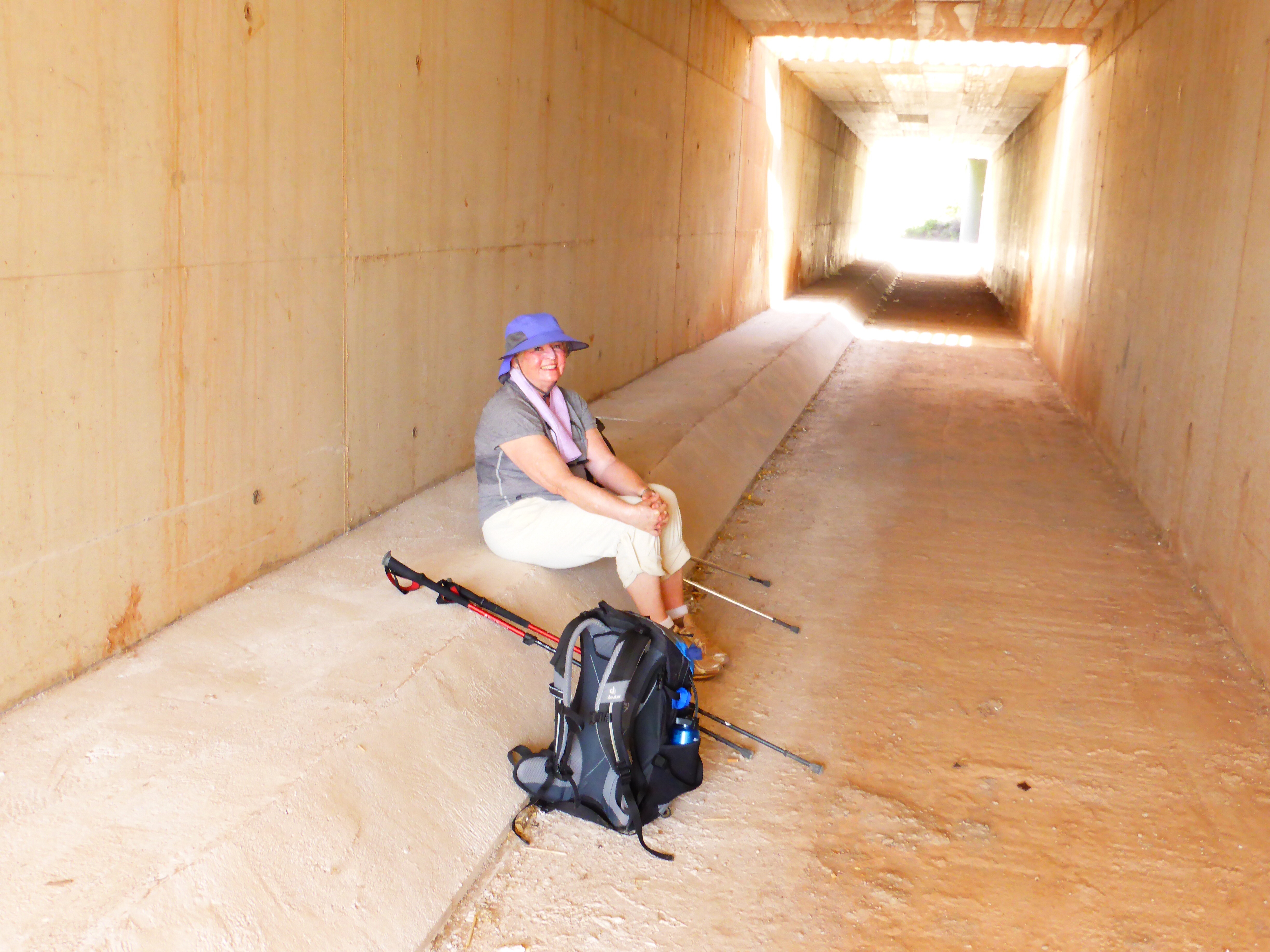
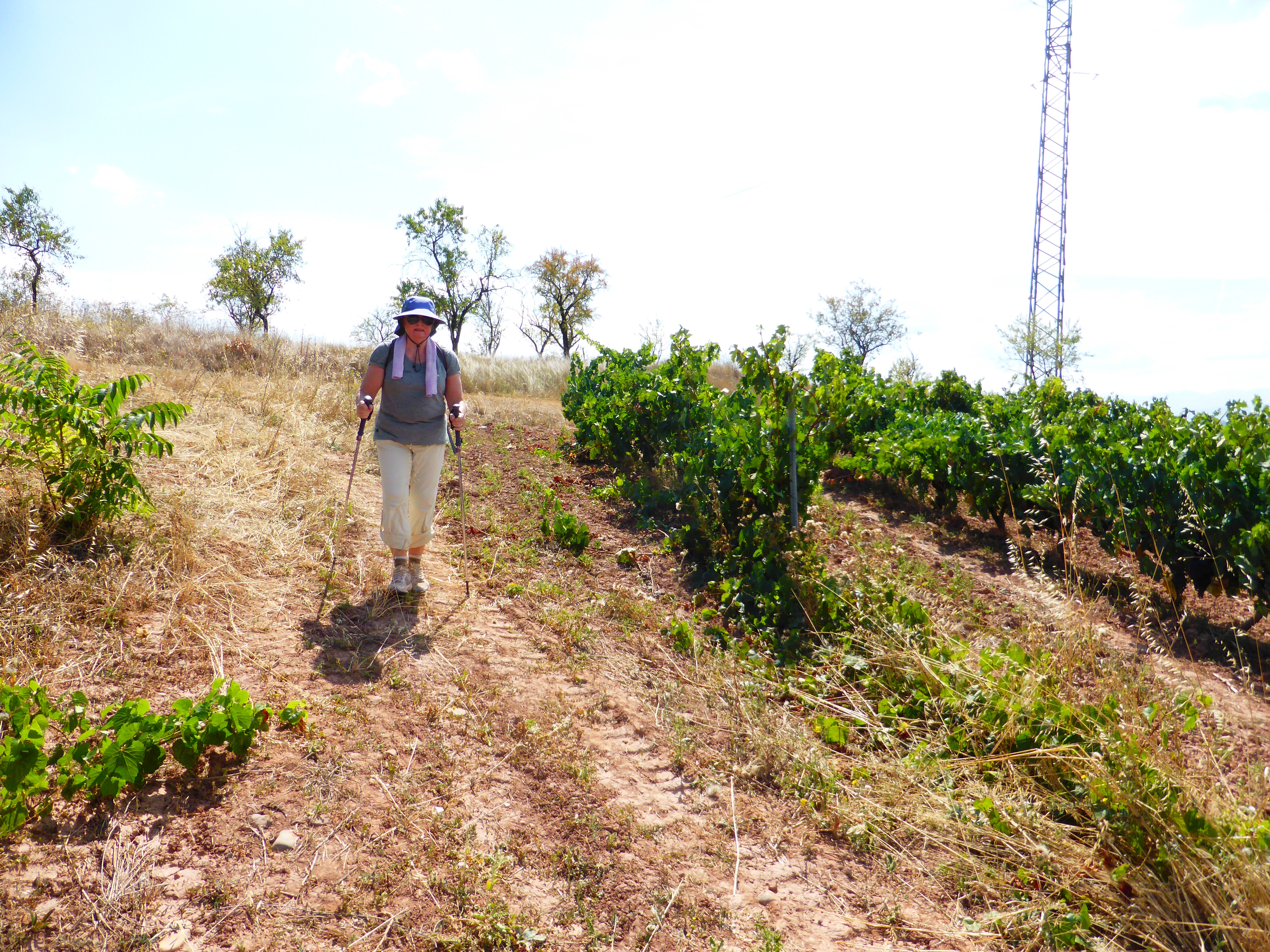
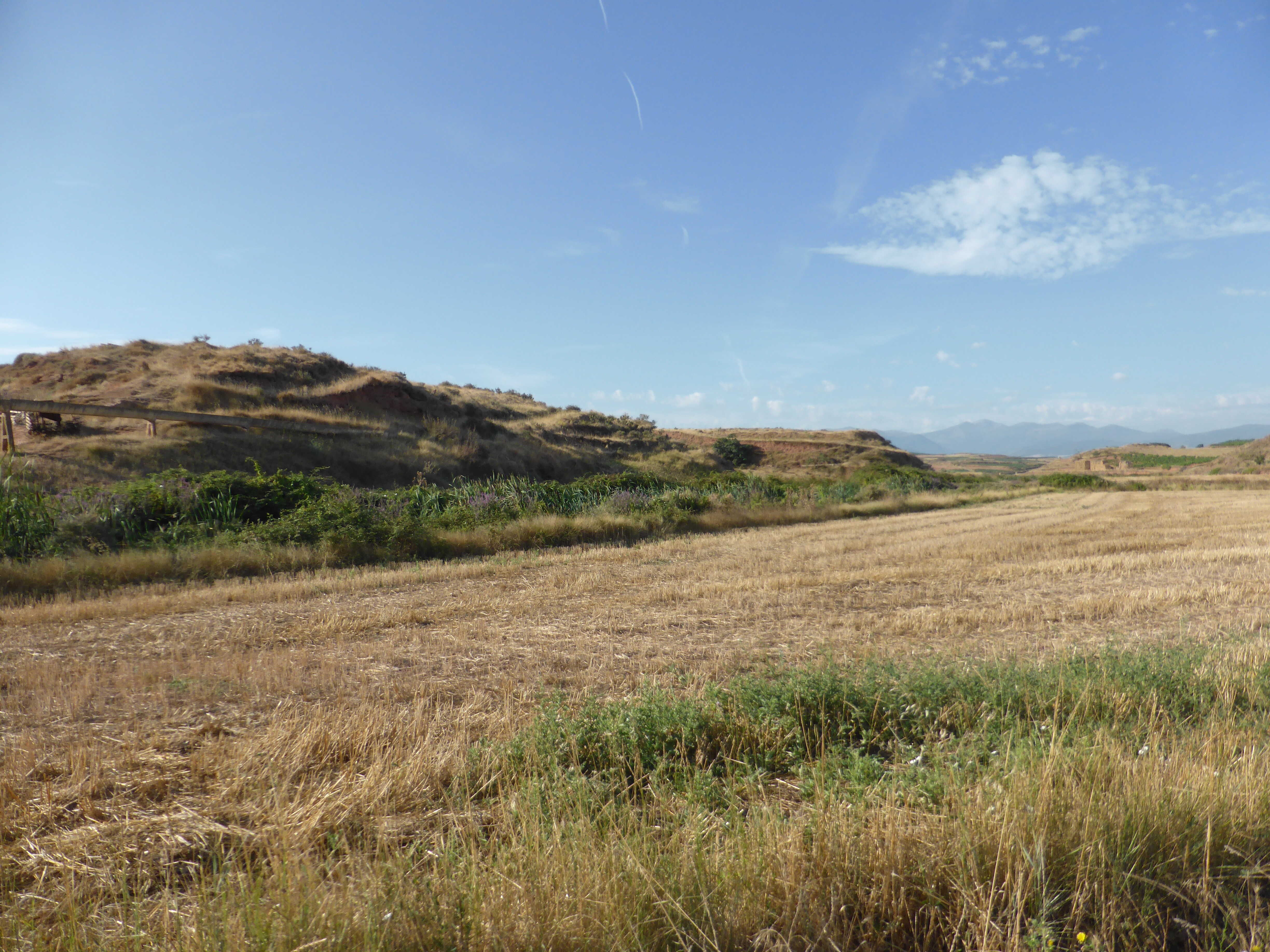
An example of the terrain changes. Here the bluffs behind the town of Najeta. Note how red the sandstone. This resulted in fine red earth soil but for only 20 km until we got back to the so very rocky soil that seems most suitable for the vineyards.Off in the distance, a rock built, igloo like structure that could house 10 or a few more. We understand that these are used to accommodate the seasonal grape picking migrant force from Africa.Many of you reading this will remember our beloved dachshund “Yeager”…. We felt for sure that this was our old buddy and not a tree line on the horizon.That’s not Mutti waiting for a bus… During our cross country jaunt we needed some rest and shade. We found cool protection in a water culvert tunnel.We did something a bit off piste today. Seeing that the Camino course was going to be longer and with a higher pass, we decided to cut out on our own. Part of our overland ( and dale) route took us through vineyards and really basic dirt paths. It was hot and dirty going. Don’t think we will try that again. If the proven Camino path is good enough for the hundreds of thousands before us, we accept that it is good enough for us.Pretty hard to see but there is a viaduct running across the hillside. Much of this area is served by an extensive interconnected cement viaduct system to distribute the valuable water
DAY 15: Sept 7 – Najera to Santo Domingo de la Calzada
We had a good walk today through the last of the vineyards. It has been very tranquil walking in the wine country and we will miss it. Just outside of Najera we noticed that the fields were much less rock laden and the soil a rich rust colour–much like the red dirt of Kauai. The explanation was that the cliffs of rock here are red sandstone but just in a small geological area. By the bounty of the gardens it is obviously nutrient rich soil. This is a good time to mention that the tomatoes in Spain are so delicious—the best we have ever tasted. For an hour we shared the road with a tall, handsome French fellow, who is studying to be a professional opera singer. His walking partner is a young English girl who just completed her PhD. in philosophy. She was very nice but as you might expect, our conversation with her was not small talk:-)—we tackled democracy and prejudice. Her points of view were very interesting. Today we exercised our minds as well as our bodies:>) At last I am able to fit in one of my very favourite Spanish sayings: ” El mundo es un panuelo”–the world is a handkerchief, as this young woman has a friend who lives on Gabriola Island!!
Our hotel is fabulous—–very Spanish decor whereas most of the others had been renovated and ultra modern They have all been exceptionally clean:-)
Dad is back from his search for ice (successful). He also found a “lavanderia” (laundromat) down the street.We are excited! Laundry can be an issue. Many of the paths/roads are dusty and just walking you get very dirty.
Although almost everything we have is that wicky stuff, it does not all dry quite as quickly as we need it to—especially as we are trying to dry it in the bathroom. All our accommodation has been right by the town church—not a good place to be stringing laundry out the window. I have no problem tying damp socks to our backpacks, but I think Dad would draw the line if I started tying undies to the packs:>)
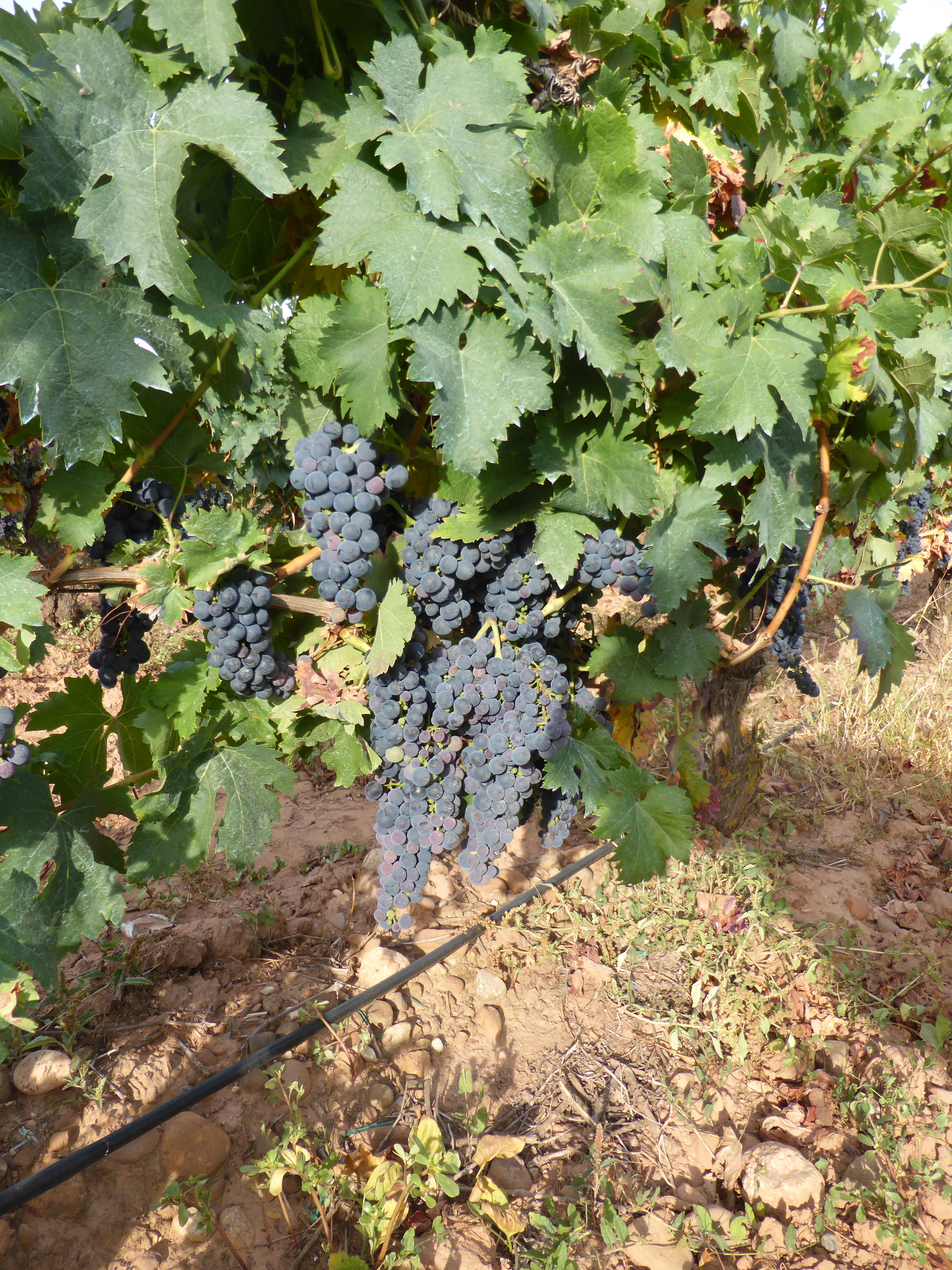
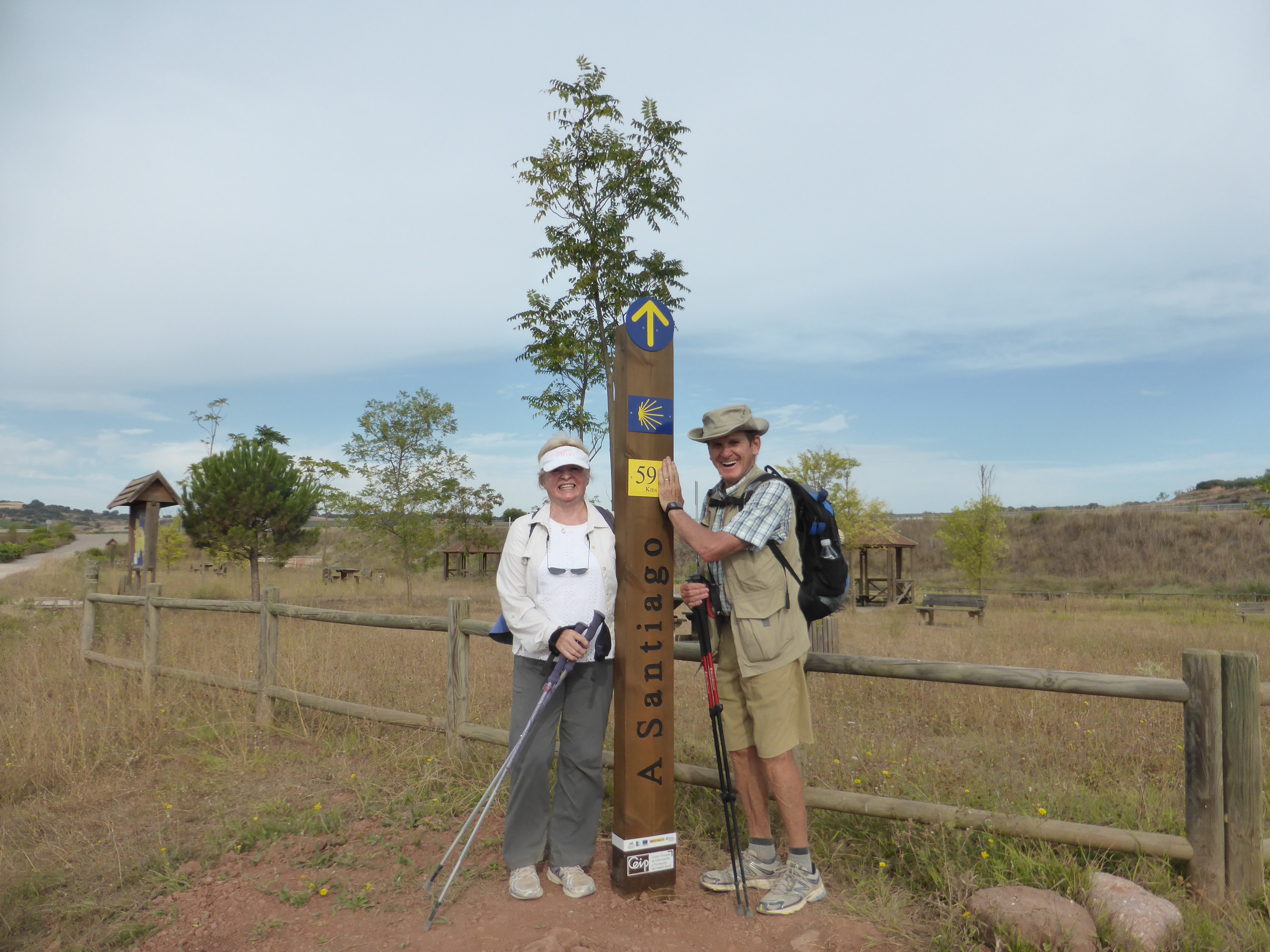
Grapes, grapes and more grapes. Interesting, rarely do the pilgrims even touch themA happy pilgrim having a snack in the afternoon sun after a hot dayBeautiful flowers everywherethe front of our little hotelIt was a busy trail this am, we met pilgrims from the US, Australia, Germany, Denmark, Spain and France. All here for the same cause, amazing how quickly you bond. There are no barriers, only a wish to share the CaminoLess than 600 km tonSantiago… it was over 825 when we startedAnd then there are rocks… this seems to be the worst soil in the world.
DAY 14: September 6 – Navarrete to Najera (19 km)
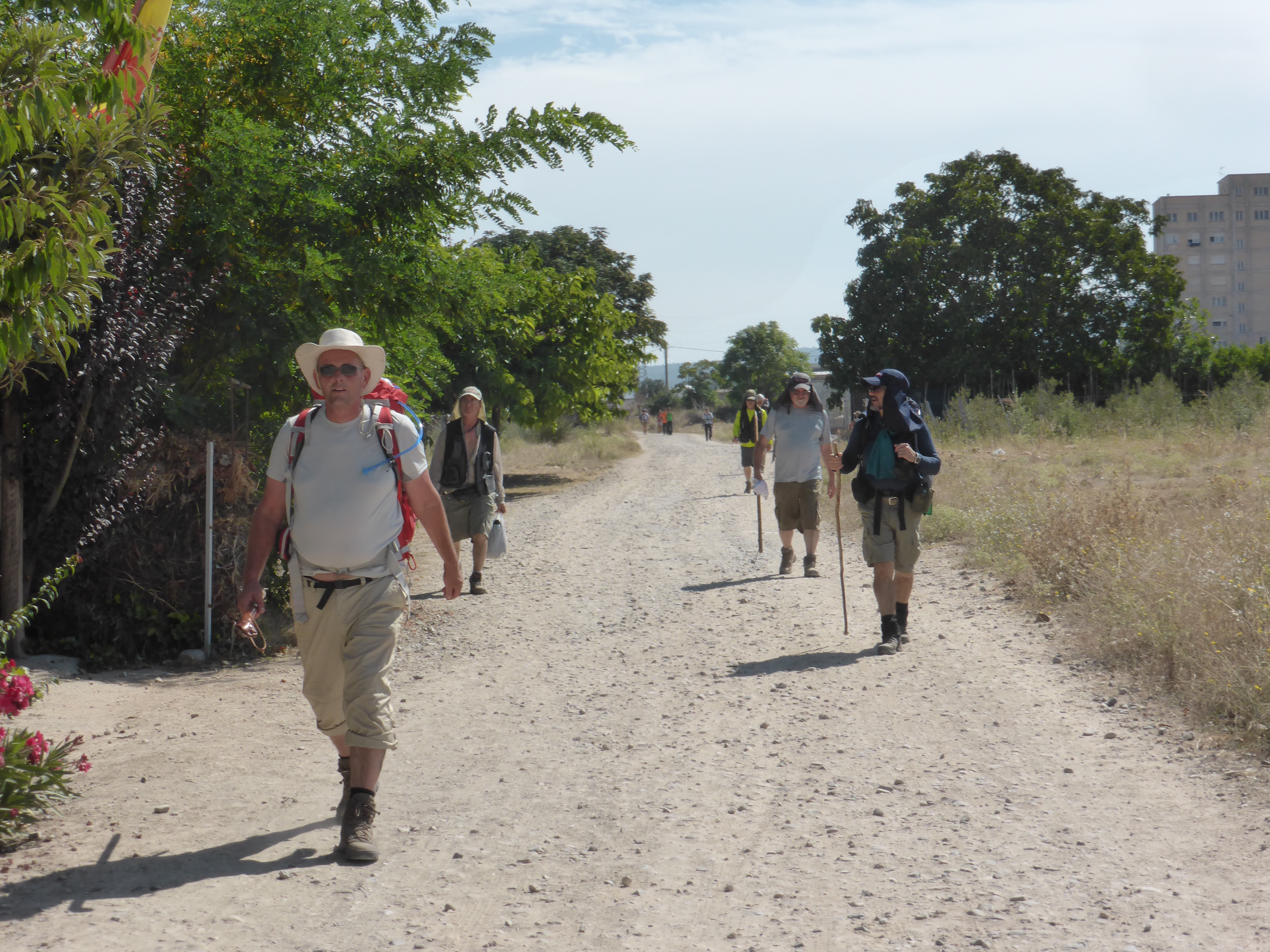
Today’s walk was one of the easiest yet. It was primarily through vineyards and there was very little shade, but we had a light breeze the whole time. We managed a good pace—5km/hr the first half and just over 4km/hr the second. Fellow hikers commented on our speed and we heard one say that we were from “the mountains in Canada”, which made us smile…and speed up:-) The only village near the route meant a 1km detour. We avoid detours if we can and as we had an orange and lots of water, we decided just to carry on to Najera. For some reason there were lots (maybe 2 dozen) other peregrinos with us today. Perhaps, it was because we got going earlier? Also, several were peregrinos who had chosen to start their Camino in Spain and not tackle the Pyrenees, thus arriving along the Najera route without our having encountered them before. At intervals we had the company of a couple from New Mexico, a fellow from Denmark, and a fellow who now lives in Leipzig but was born and raised in Heidelberg ( where we lived in the late 80’s). Although we prefer walking together without company the most, the others we meet along the Camino do truly enrich our pilgrimage. Each pilgrim has a reason for walking the Camino. The stories are often poignant; many are compelling and some are very sad. Something that makes the walk special is the unconditional acceptance of one pilgrim for another. We are from all over the world, different faiths and cultures but walking the Camino is an incredible bond. We are in a hopeful place and it feels very good.
Najera is Arabic meaning “between rocks” and it is nestled between two gigantic formations of red rock. (We are amazed it is not built on top of the rocks:-) The Rio Najerilla
runs through the town, it’s grassy banks a popular spot for picnickers this weekend. Along the riverside are also many pintxos bars where we stop for a snack….and a short nap.
Our hotel is right by the church again. We will have to set up a church bell serenade in order to sleep once we are back home. The church was built in the 11th century by a Spanish king, who hunting with his falcon, came upon a cave in which there was a statue of the virgin Mary, a glowing lantern and a bowl of lilies. On seeing these King Garcia ordered the construction of a church to house these findings. The site now has an ancient monastery but the church is still in use.
As we mentioned in an earlier writing, Najera is where the pickers are hired for harvesting the grapes. The pickers used to be men and women from southern Spain and Portugal, but now the pickers are from North Africa. That is real “out sourcing” but probably controversial with Spain’s high unemployment rate.
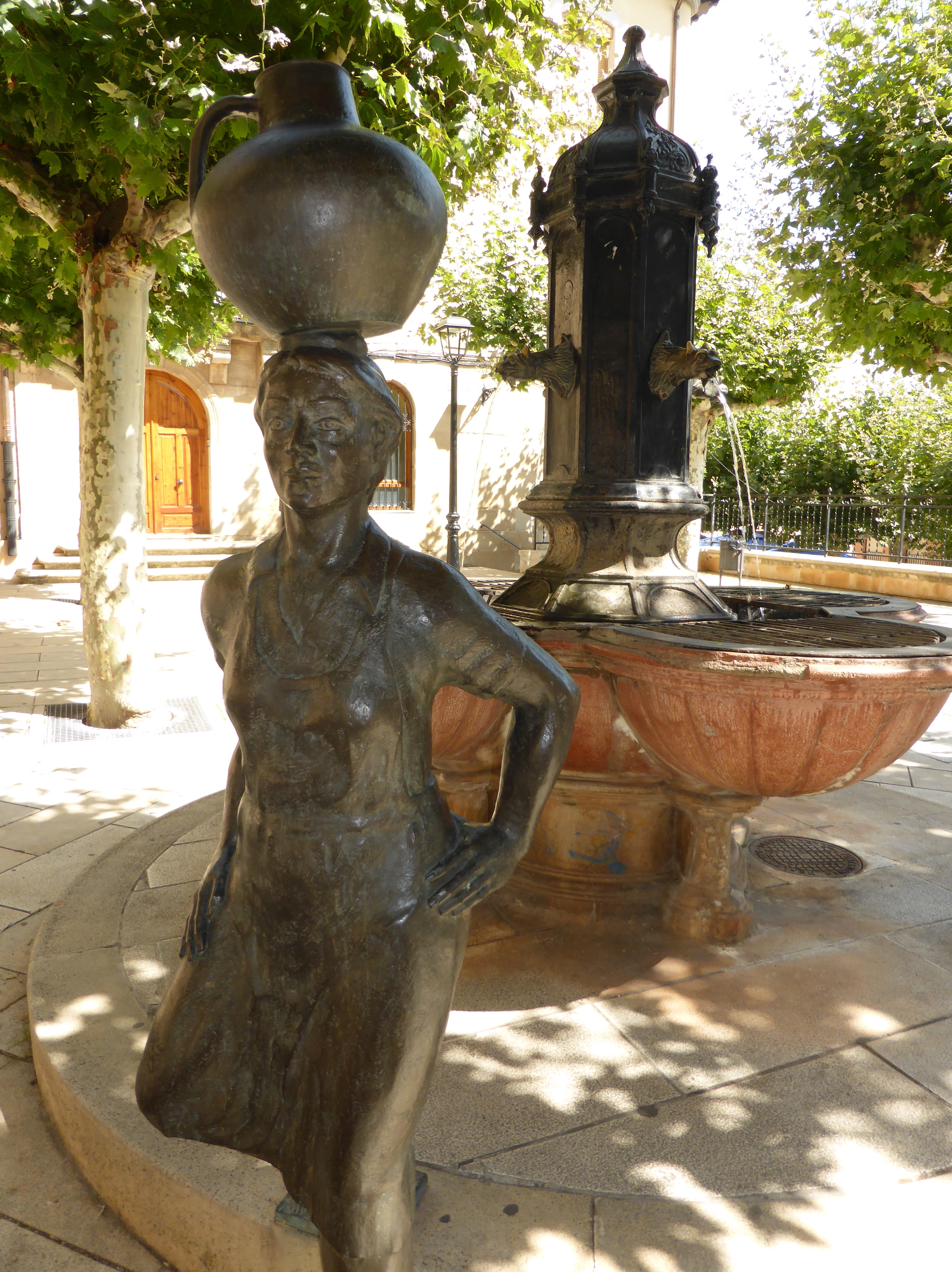
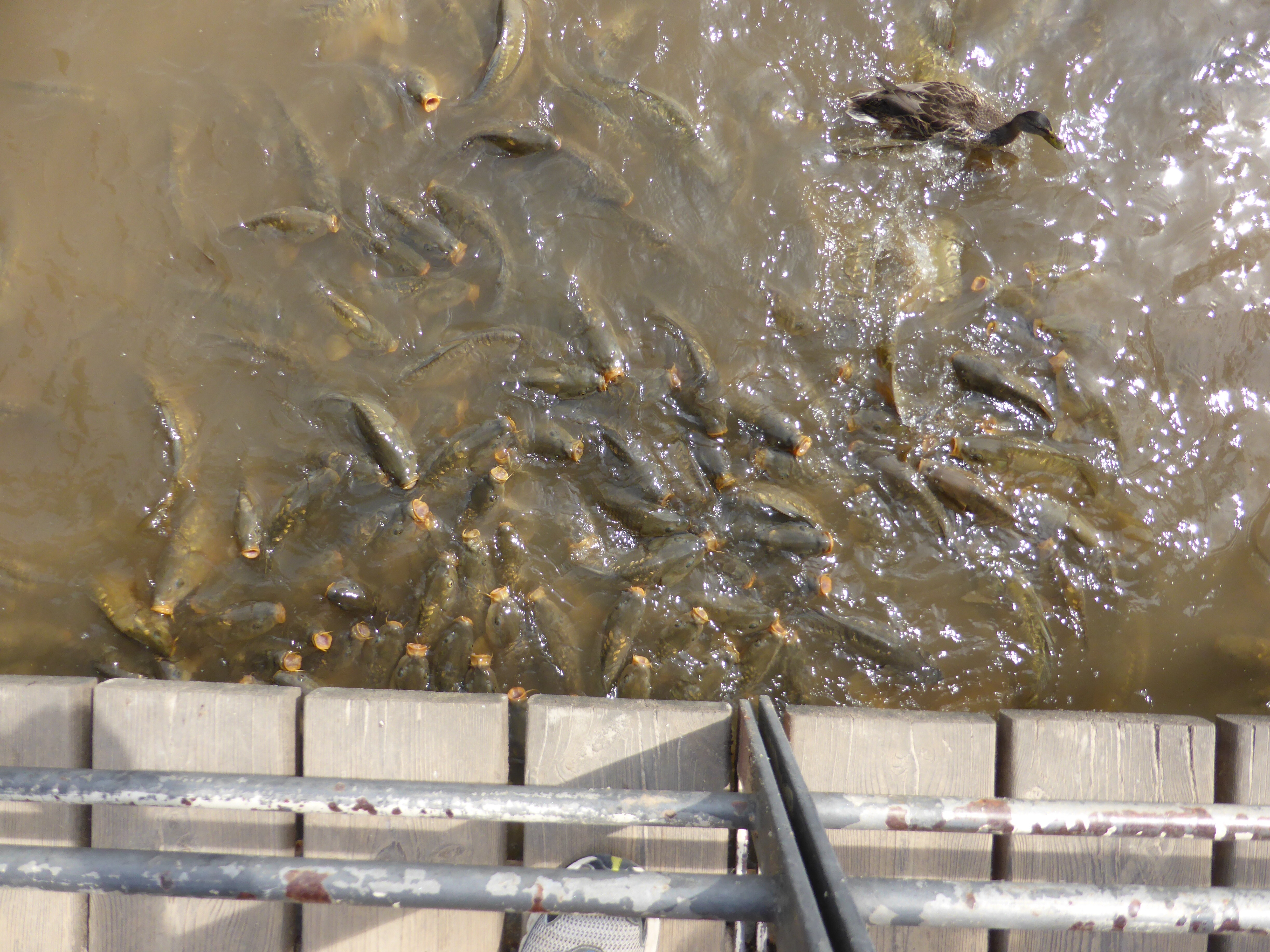
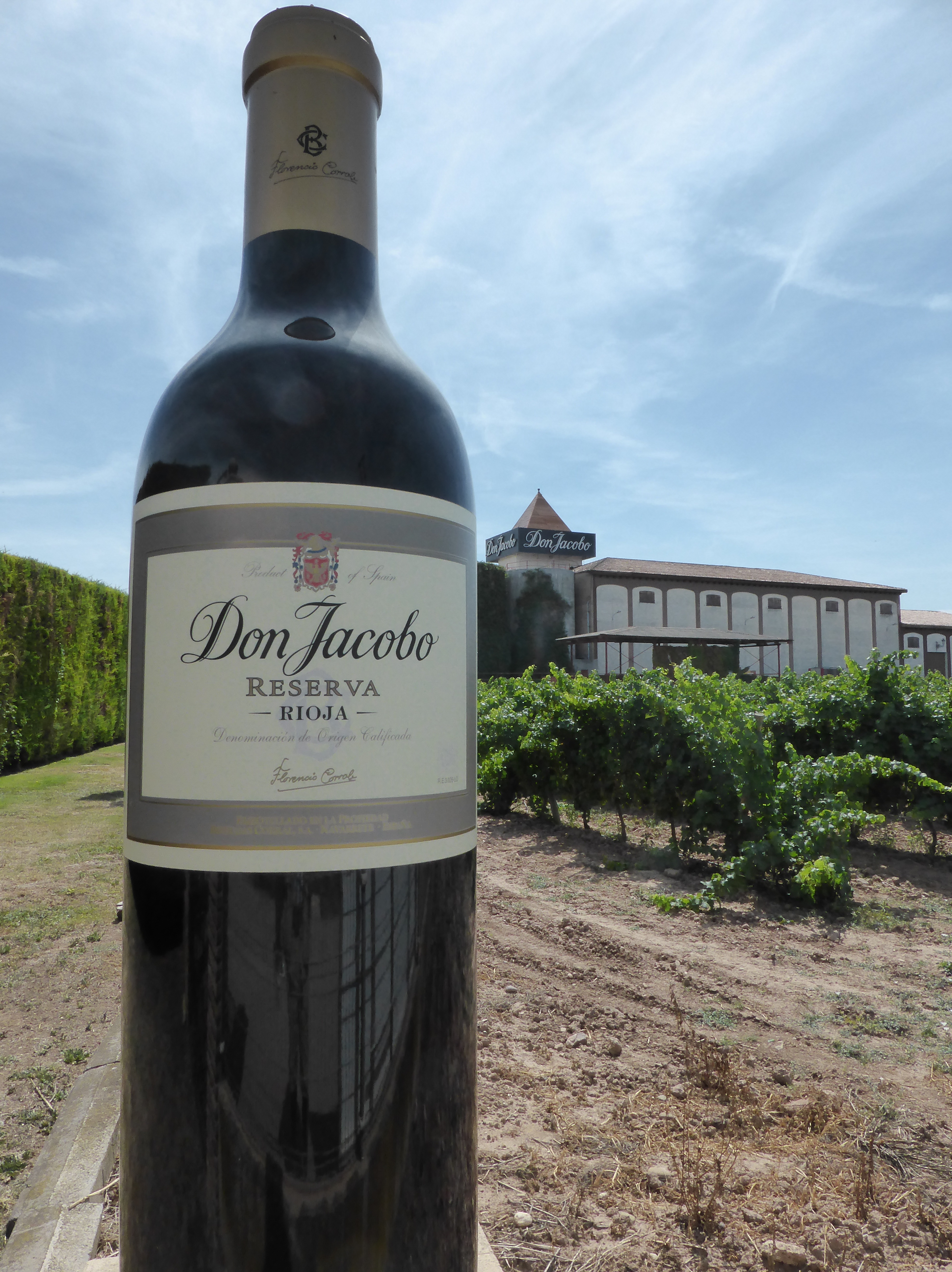
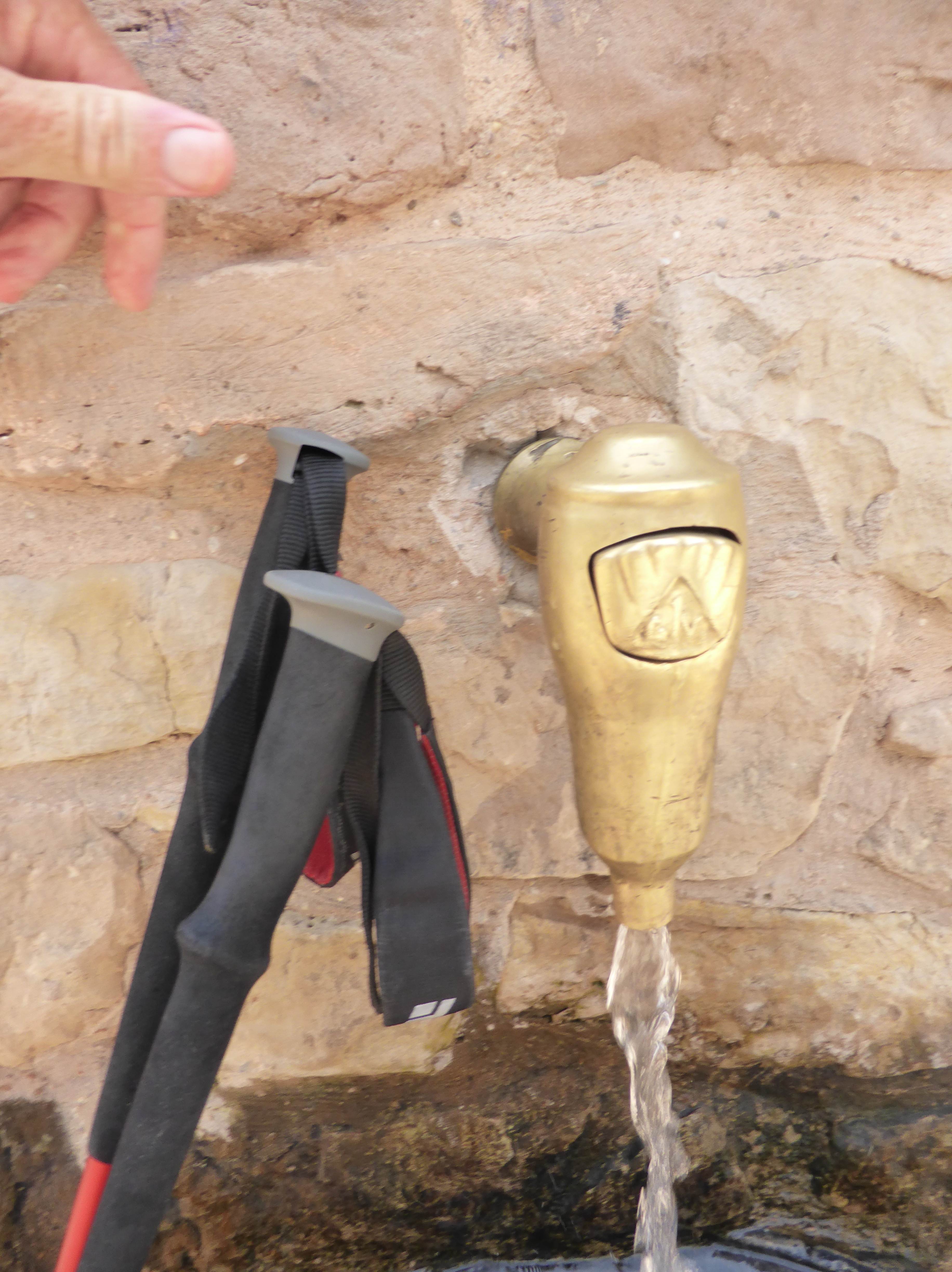
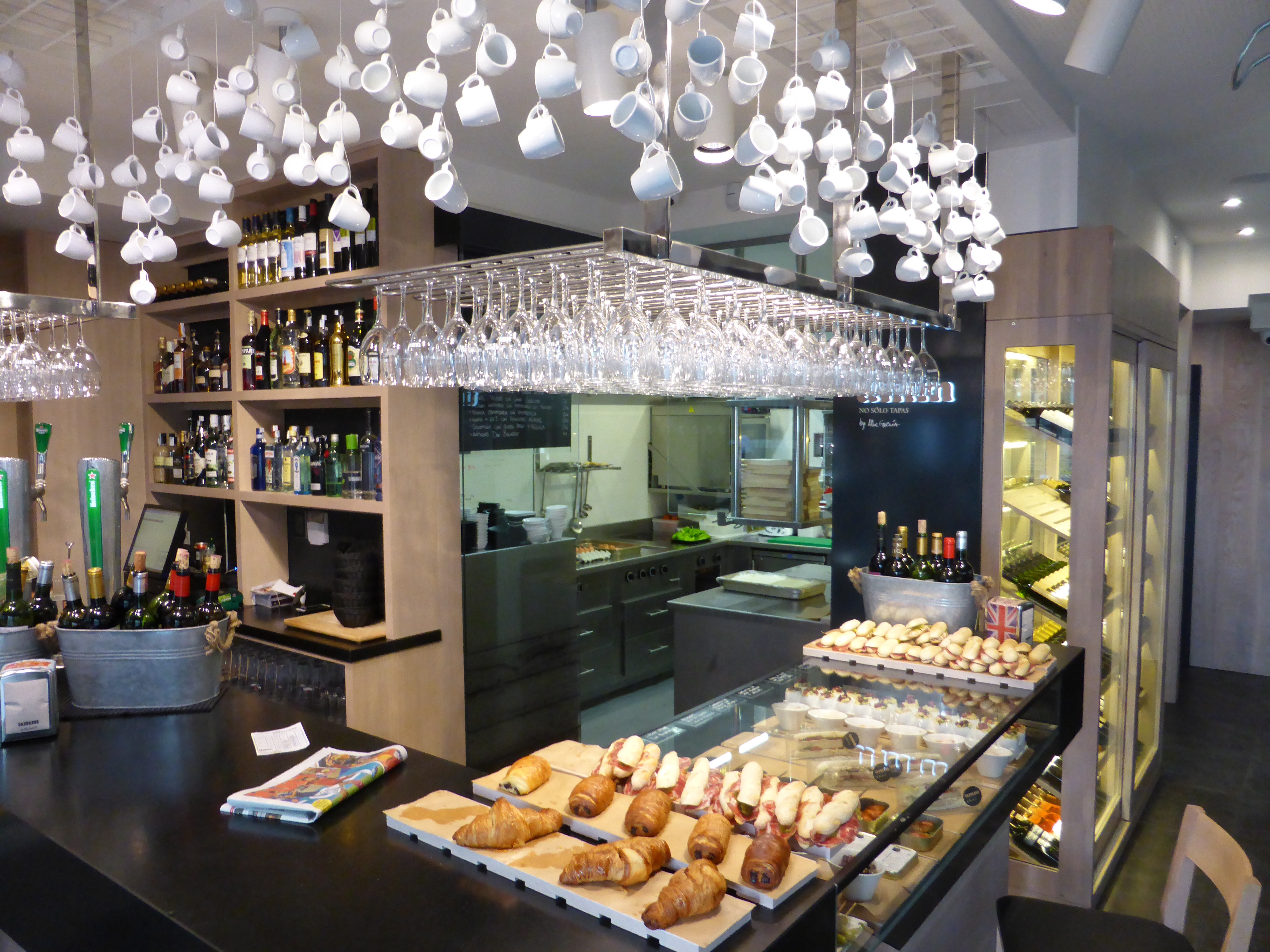
A statue in the town square – that’s a wine container on the bronzed statueThis is a funny one. This is a picture looking straight down into the water below a small bridge. Pictured are many carp, and a single duck, all fighting for the cookie crumbs that Rod dropped into the water.A giant stylized bottle of wine from the winery just outside the town we are in – Navarrete. A bottle of some of the local wines sells for as little as $3 – it is considered food and therefore not taxed!a Camino water tap… Rods poles beside. The poles are an absolute must. Makes for much easier climbing and safer descents. Thank you Heather!An upscale pintxos bar…(we know it as tapas- a diagonal slice of French bread with all sorts of different meats, cheeses, veggies, fish, you name it. Three is a meal.
DAY 13: Sept 5 Logrono to Navarrete ( 13km)
As we were looking to a relatively short walk today, we had a relaxing breakfast and departure. We enjoyed Logrono very much. It has balanced the past and the future well. Particularly impressive are the many green spaces and parks everywhere. When you live in a land of hot sun it seems you value the shade of trees. When we are walking we feel the difference immediately once we are shaded. After walking to the outskirts we found ourselves on an easy walk through parkland. We stopped at a recreational area, Grajera Park built around the reservoir which marked the half way point for today. Our destination, the village of Navarrete is like all our destinations —on top of a hill:-) It is not a difficult climb and since most of our walk has been through parkland and vineyards we feel lucky! The vines are heavy laden with the most beautiful grapes. They are soon ready for picking. At a town we will visit in two days, pickers from North Africa are being hired right now.
It is interesting to note that almost all the Camino after the Pyrenees is through orchards and vineyards which are very accessible from our path. There are no signs prohibiting picking the fruit and yet no one does. This respect is encouraging to see.
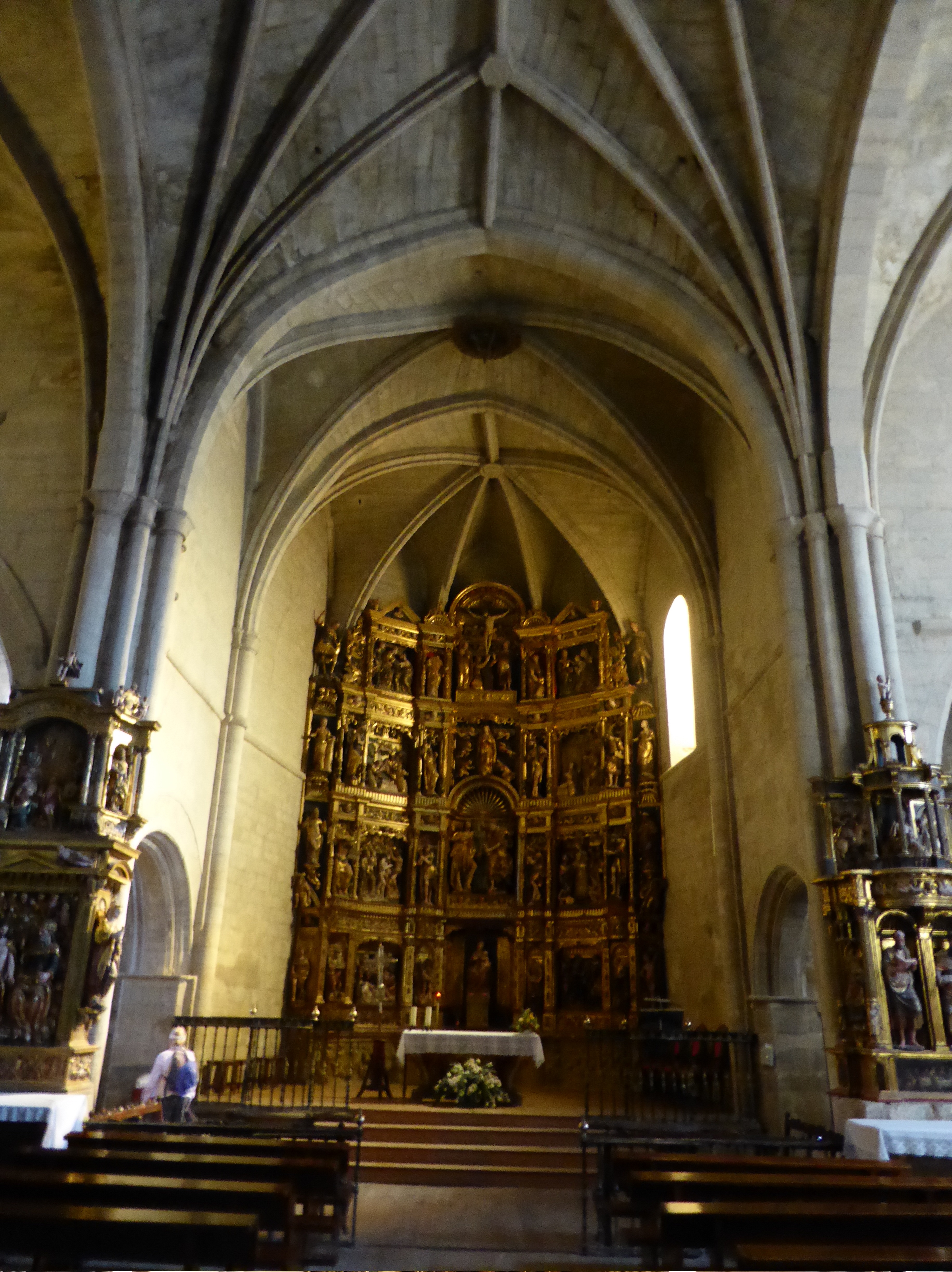
Navarrete is a small but beautiful village. It is a centre for wine making with several large vineyards nearby. The parish church, Iglesia Parroquial de la Asuncion de Marie, is famous (or infamous) for having the most bling-bling altars on the whole Camino. They are something to behold. Our personal comfort is the simplicity of our home church in Ladysmith. Navarrete also is noted for pottery but we could not find any shops. Perhaps it is sold somewhere else…The thunderstorms did not come today. We would not mind a little cooling rain.
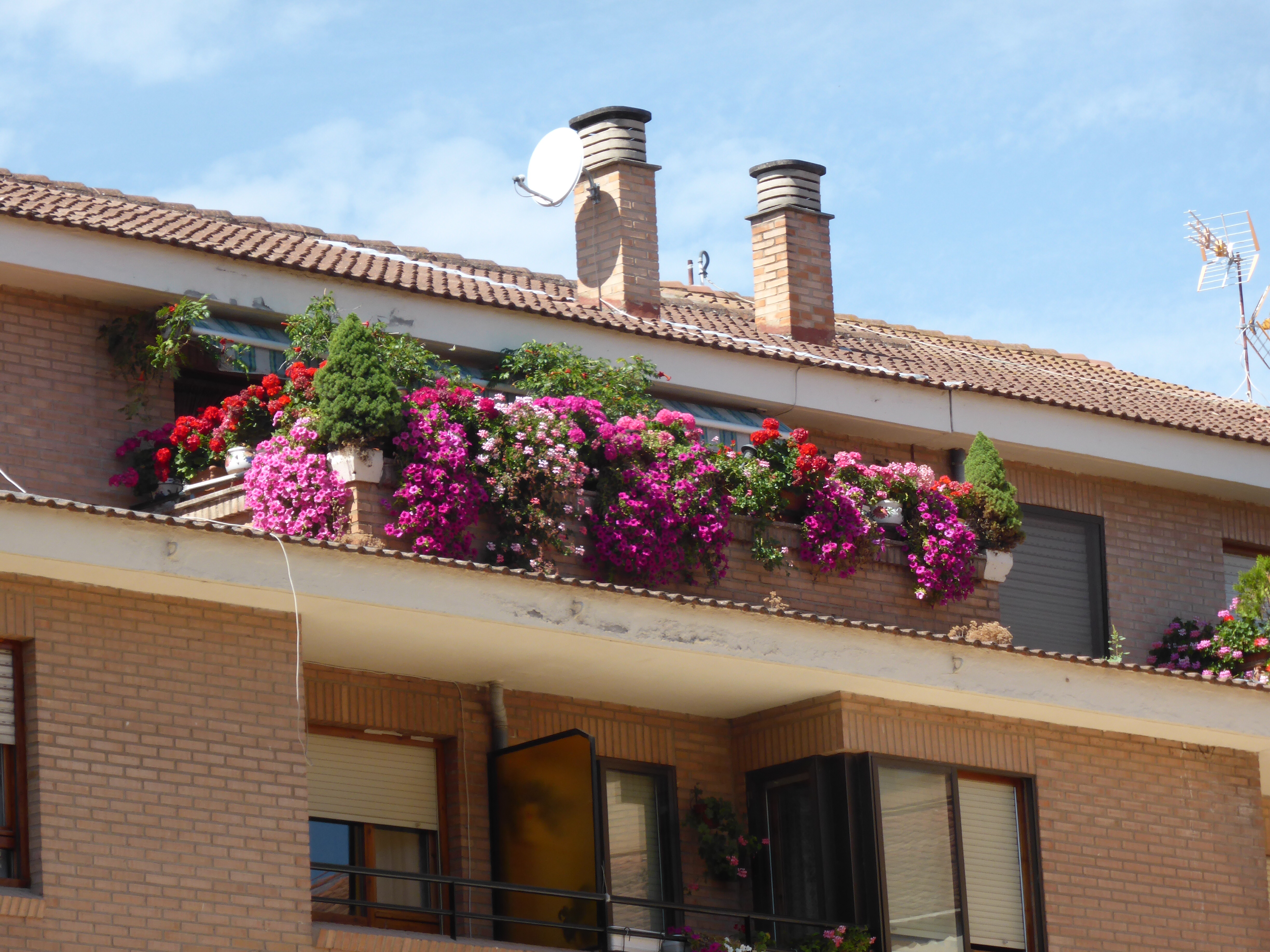
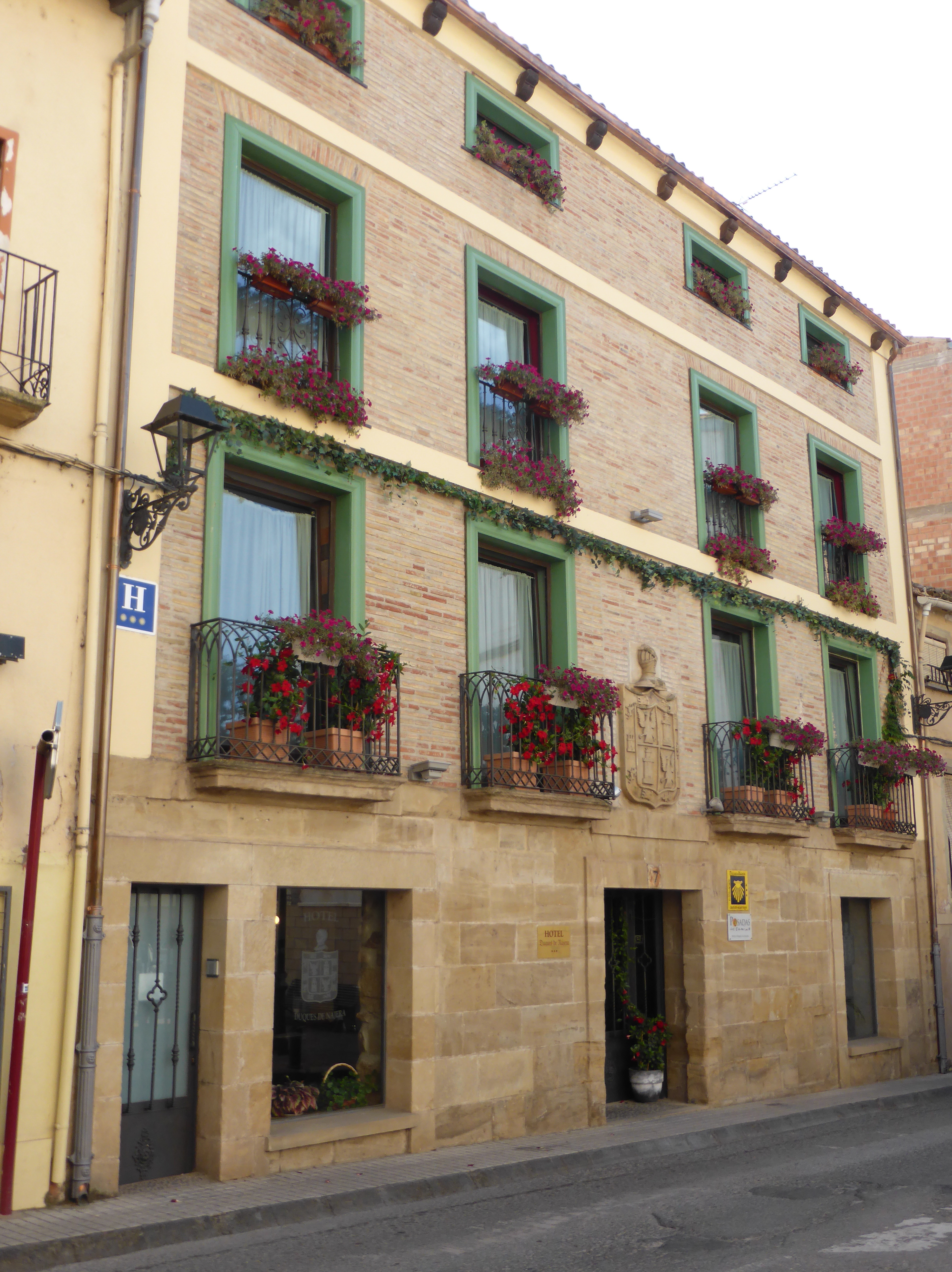
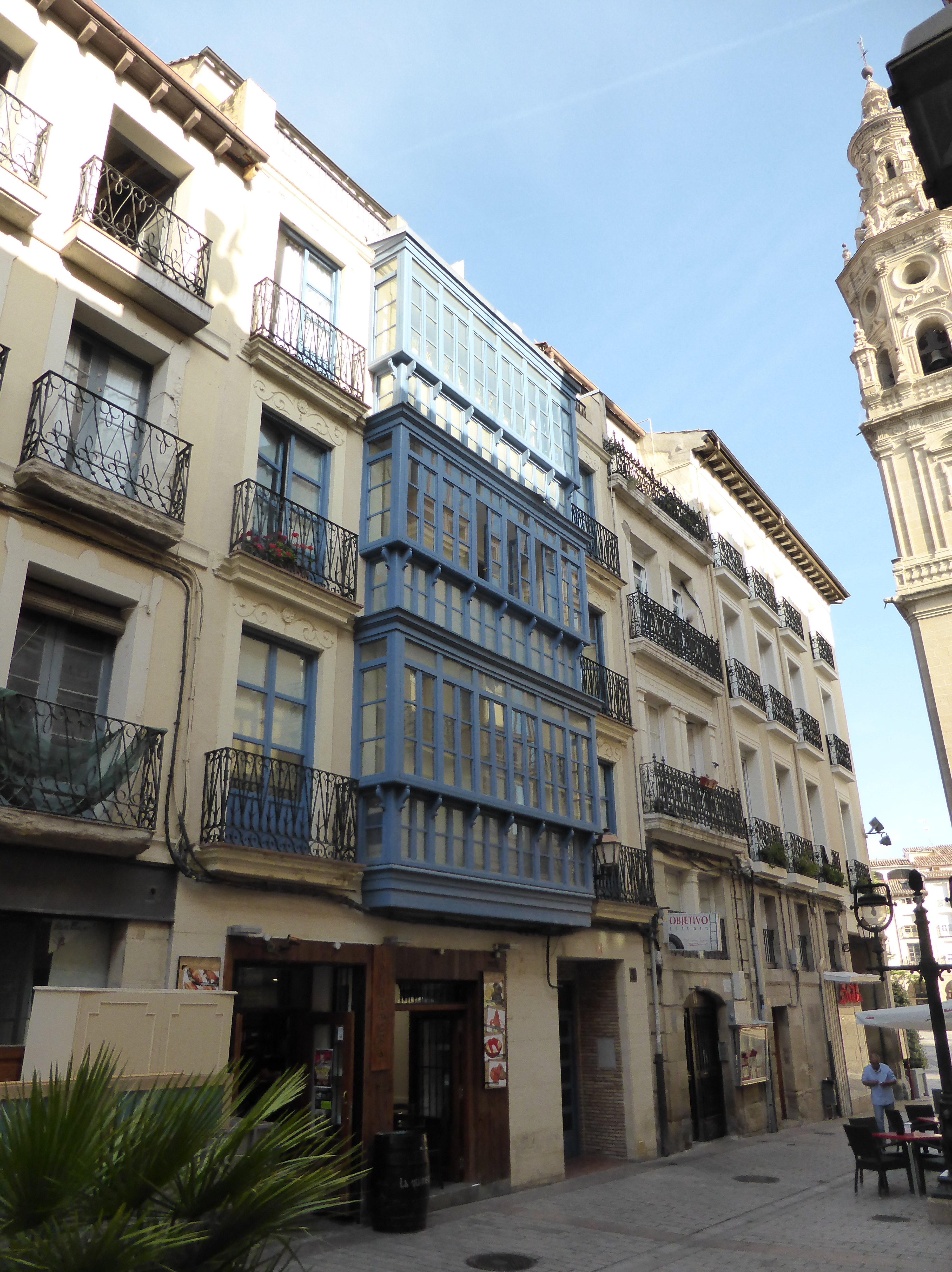
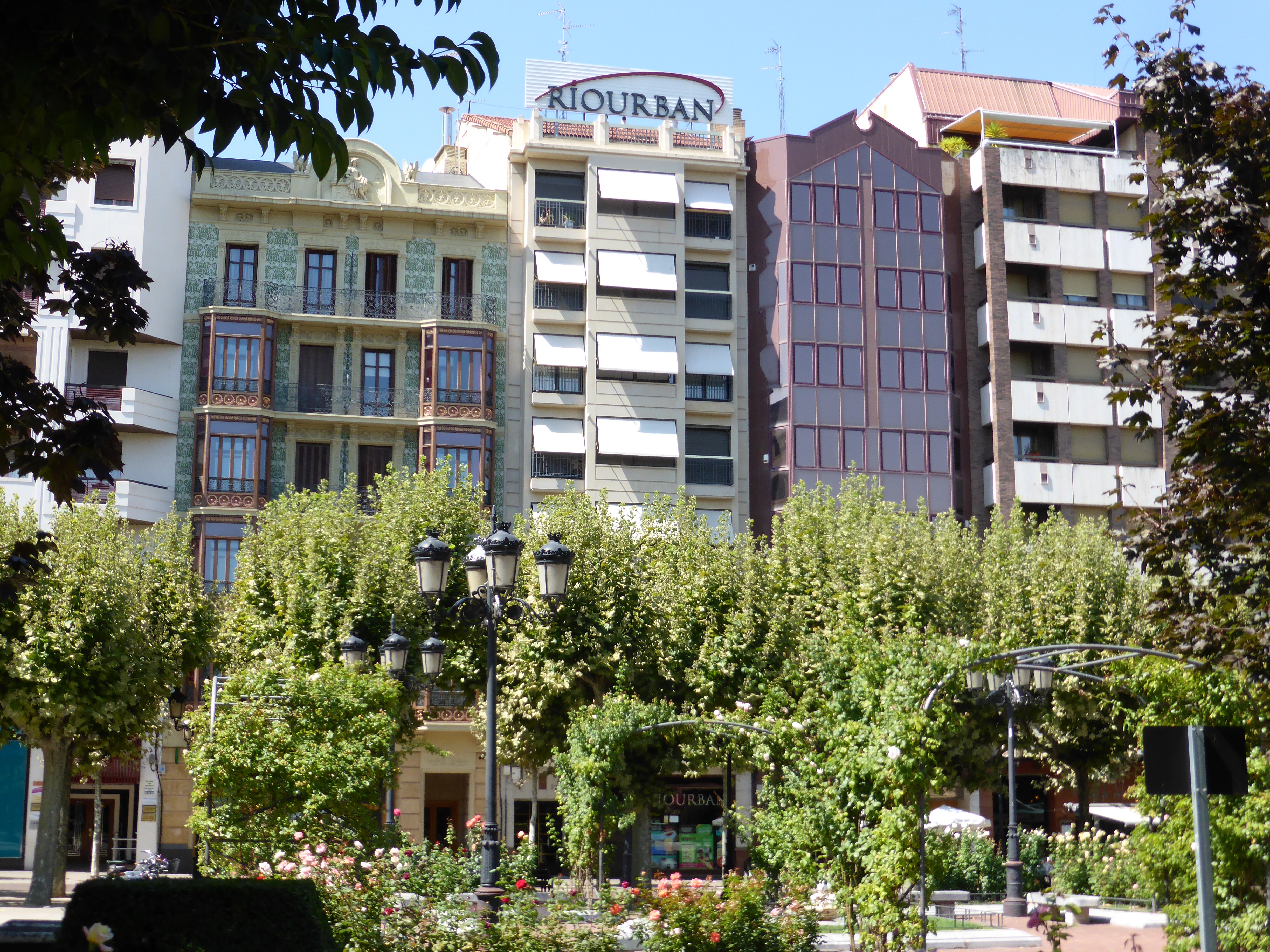
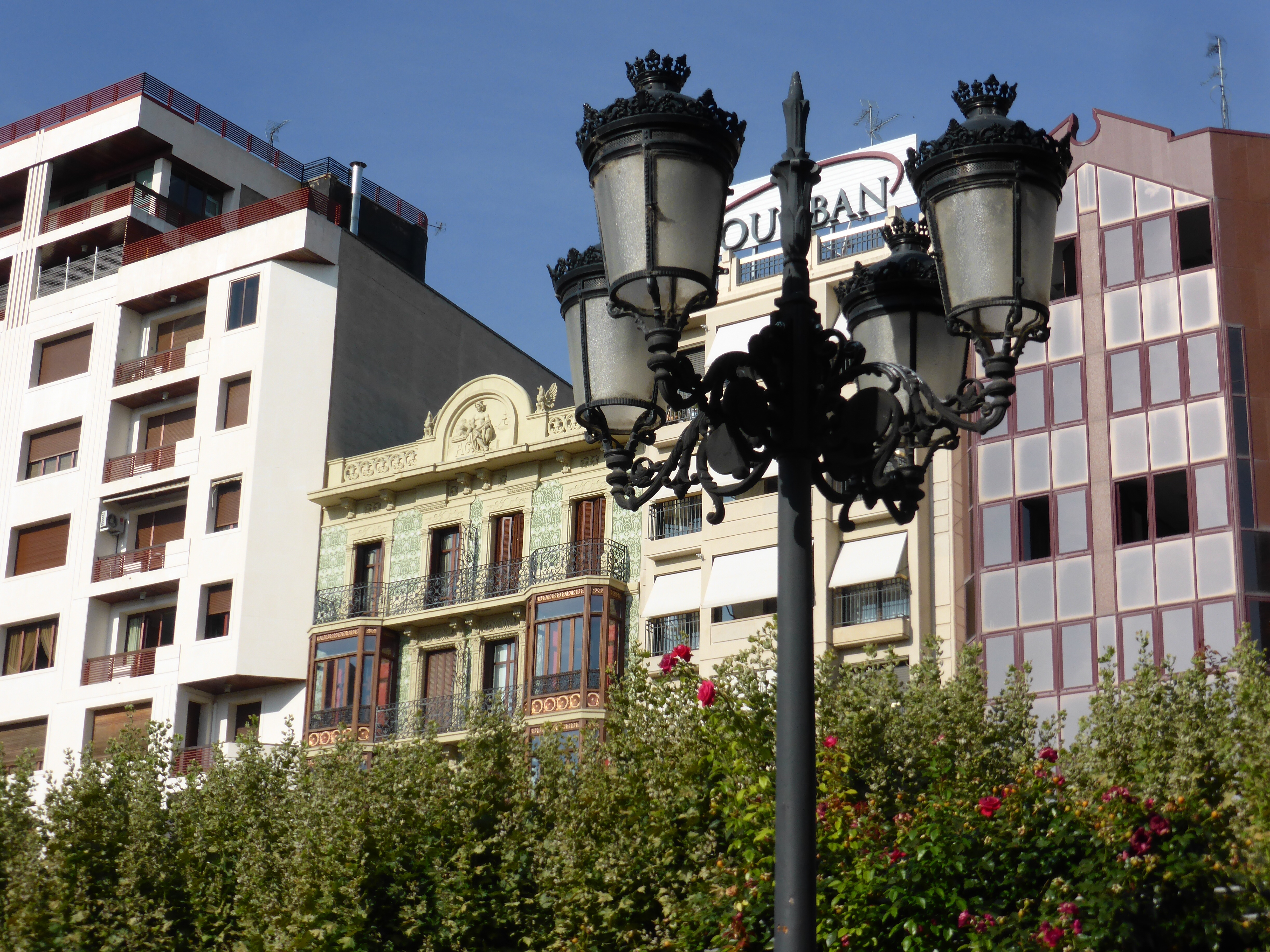
See how the balconies have been extended and enclosed. Most have windows that open. Makes for a very beautiful exterior. Other pictures follow.Looking across a beautiful park towards the tall 5 and 6 story renovated apartment buildings, most a few hundred years oldLook at the beauty of the green and gold combination
DAY 12: September 4 REST DAY IN LOGRONO
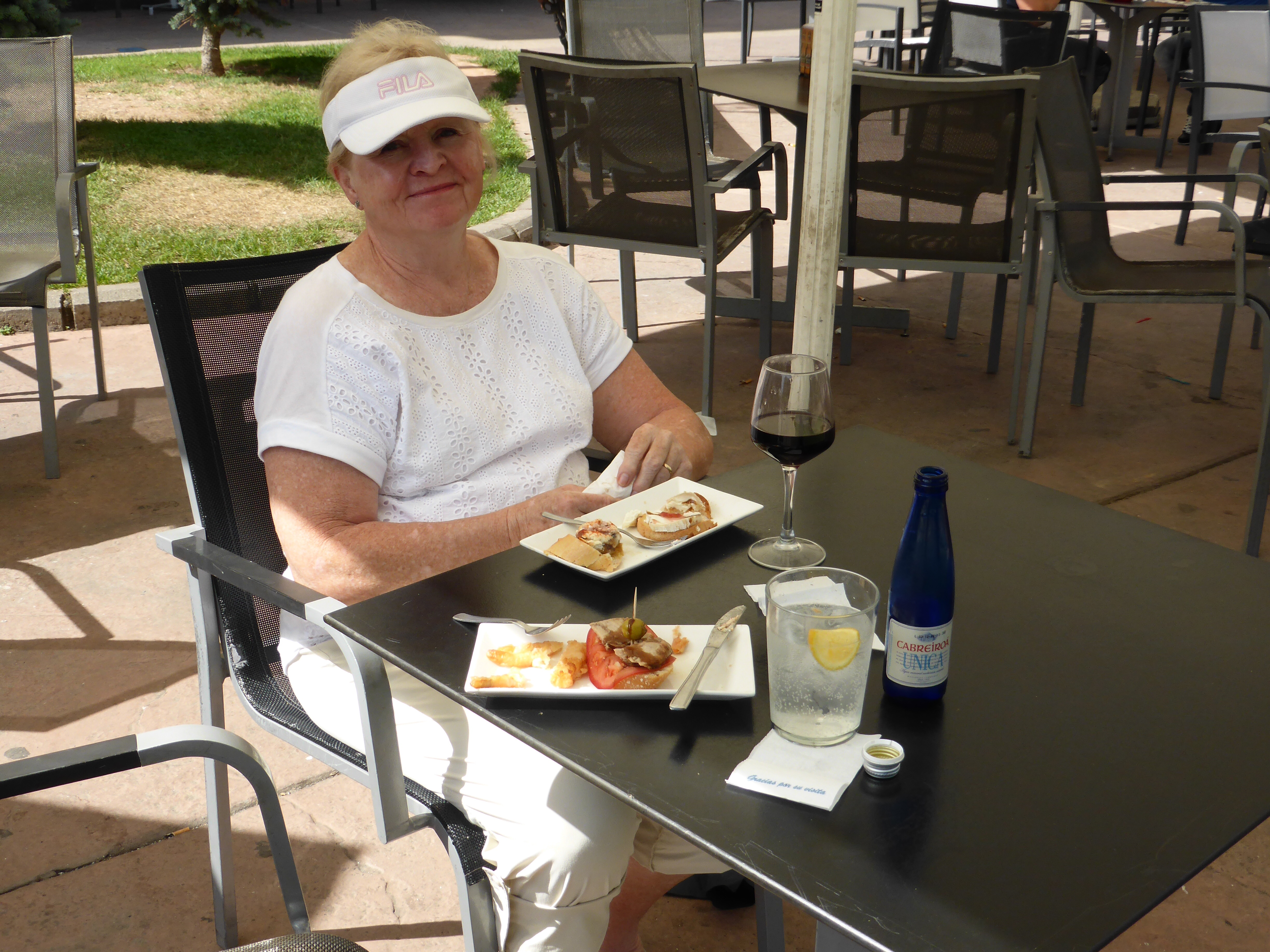
Our day begins with a nice, easy morning, dawdling over breakfast:-) Our regular breakfast at the hotels is usually a selection of yoghurt, breads (croissants, included), orange juice, cereals, boiled eggs (cold), plates of cheese and meats, potato pie and excellent coffee. We may have as much as we wish. Often we have no need of lunch while we are walking —just beverage breaks. Later in the morning we try to catch up on our blog. Dad has organized a picnic so we head out to a lovely park by the Rio Ebro. We have a very nice time. Logrono is a large town ( 153,000) with a university. It us the capital of la Rioja region famous for some of the world’s best red wines. The wine is served icy cold and is delicious. As with many of the towns along the Camino the streets are lined with London Plane trees which offer welcome shade. They are pollarded to keep them shorter and bushier, thus providing more shade. Logrono is a gardener’s delight. It has many parks with rose gardens and oleander blooming. There is a distinctiveness to the architecture, too. Small balconies large enough for only a row of plant pots are framed in windows of various shapes and sizes. This offers a sense of spaciousness and has a nice effect. We have heard of the game of “Goose” related to the Knights Templar who supposedly protected traveling pilgrims. Outside St. James Church there is a giant “Goose board”. There are legends about the game having cabal ties and being a way to pass secret messages….
There are several large churches in Logrono —Iglesias de Santiago el Real ( mentioned above in English) depicts St. James appearing from heaven to help the Christians defeat the Moors in this spot, thus ending Muslim rule in Spain.
After a delicious pintxos supper at a nearby outdoor spot we ready ourselves for the day to come. Thunderstorms are forecast so we dig out our rain gear.

 walkingthecaminotogether