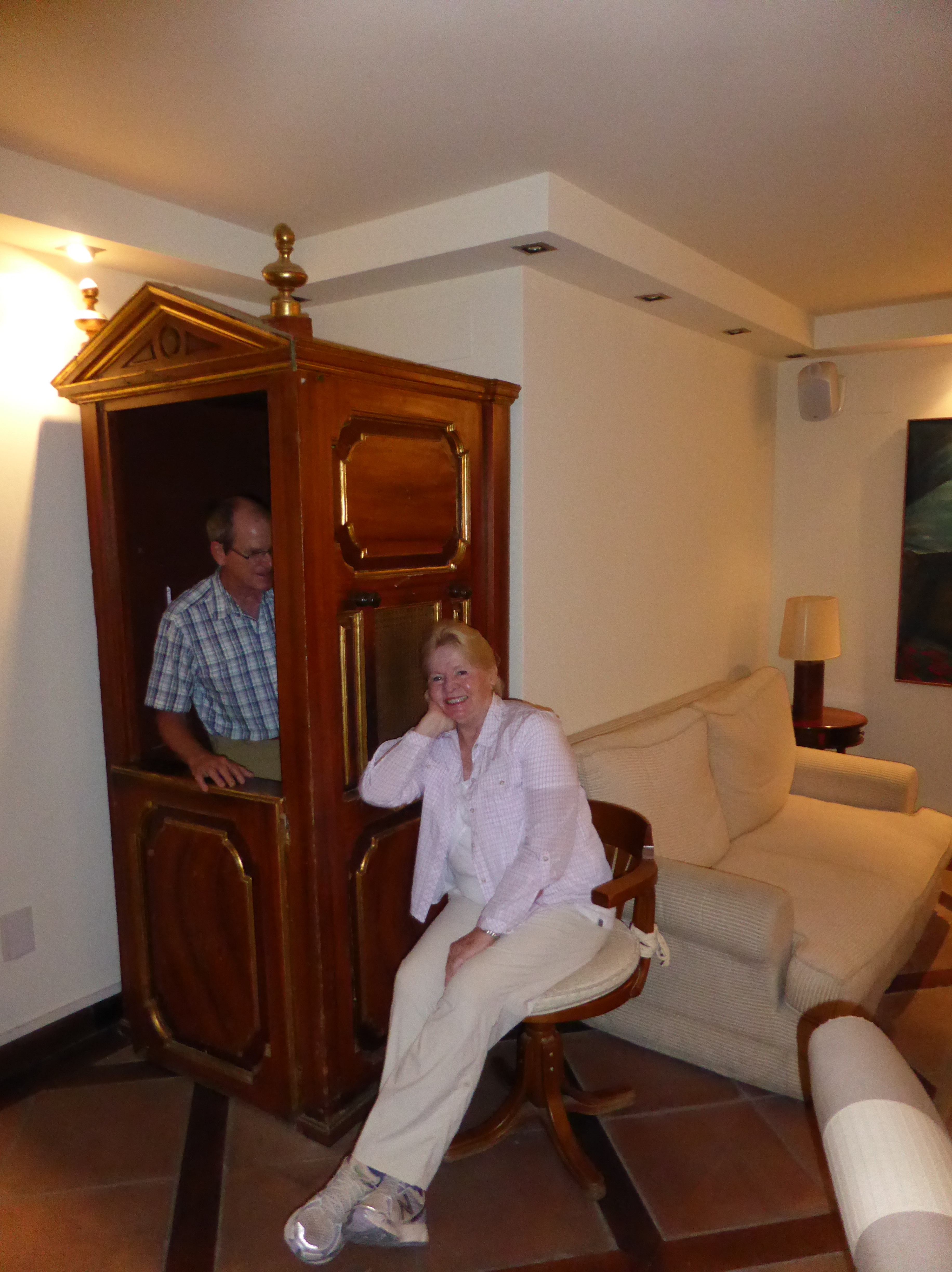
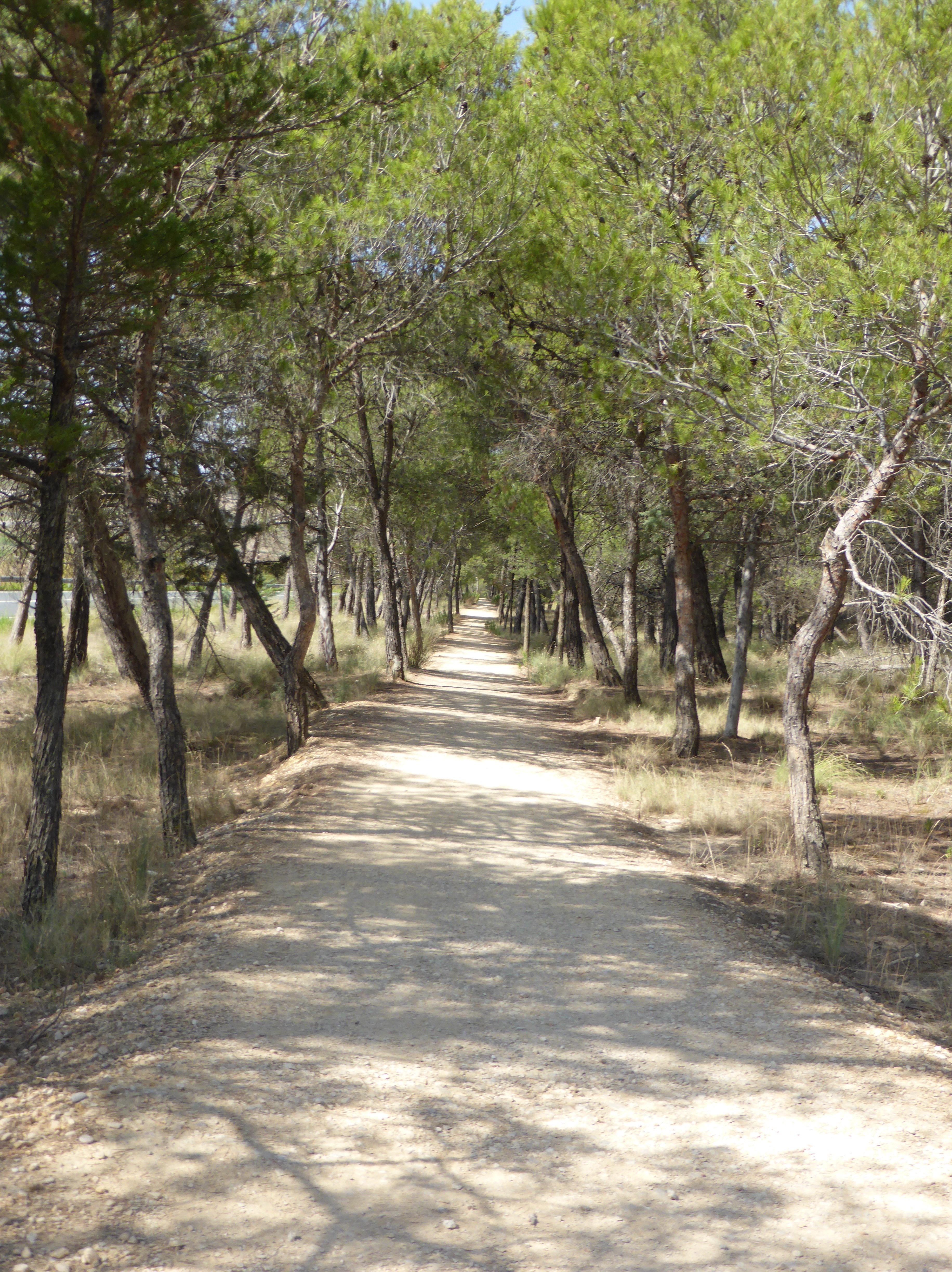
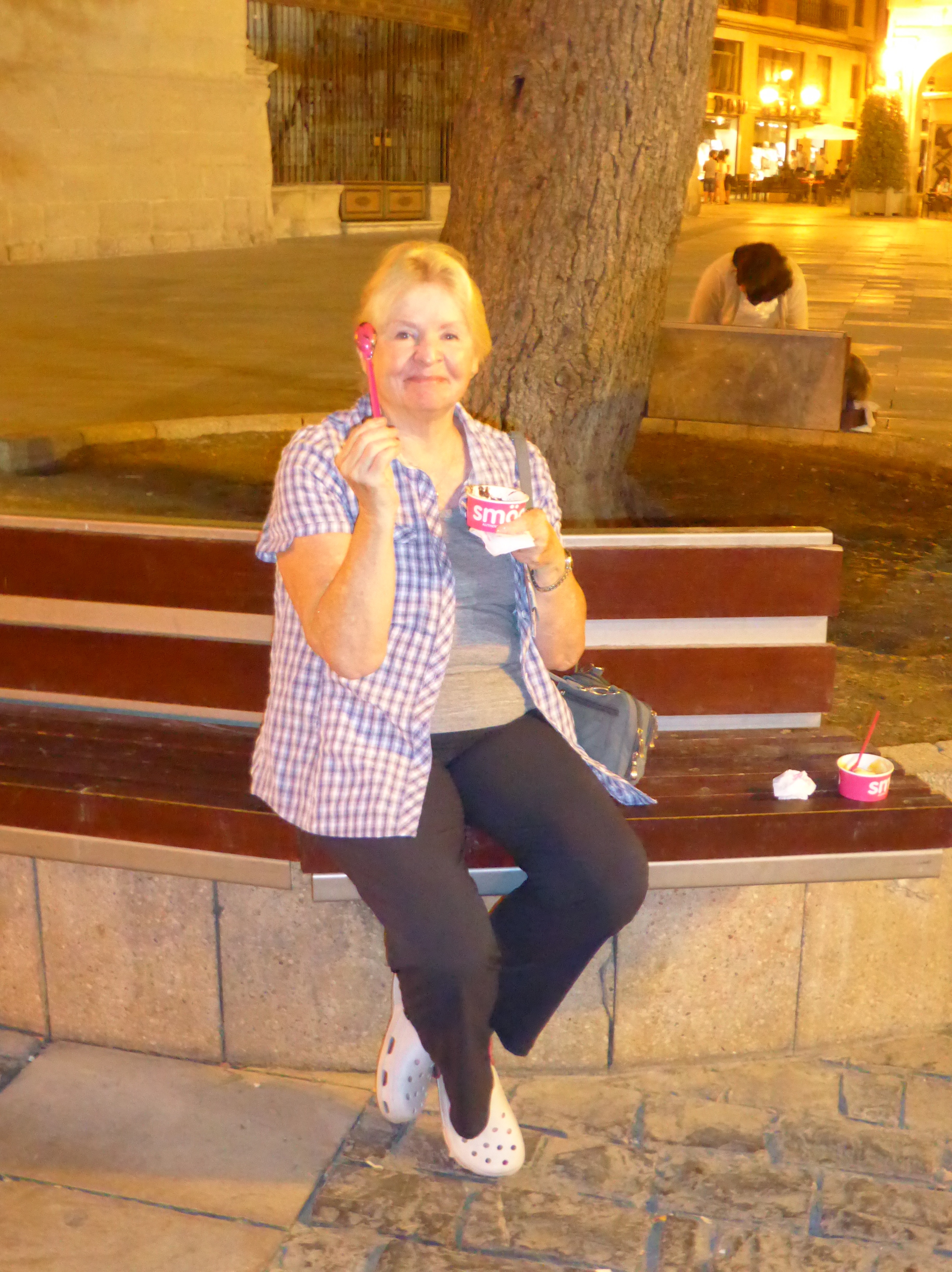
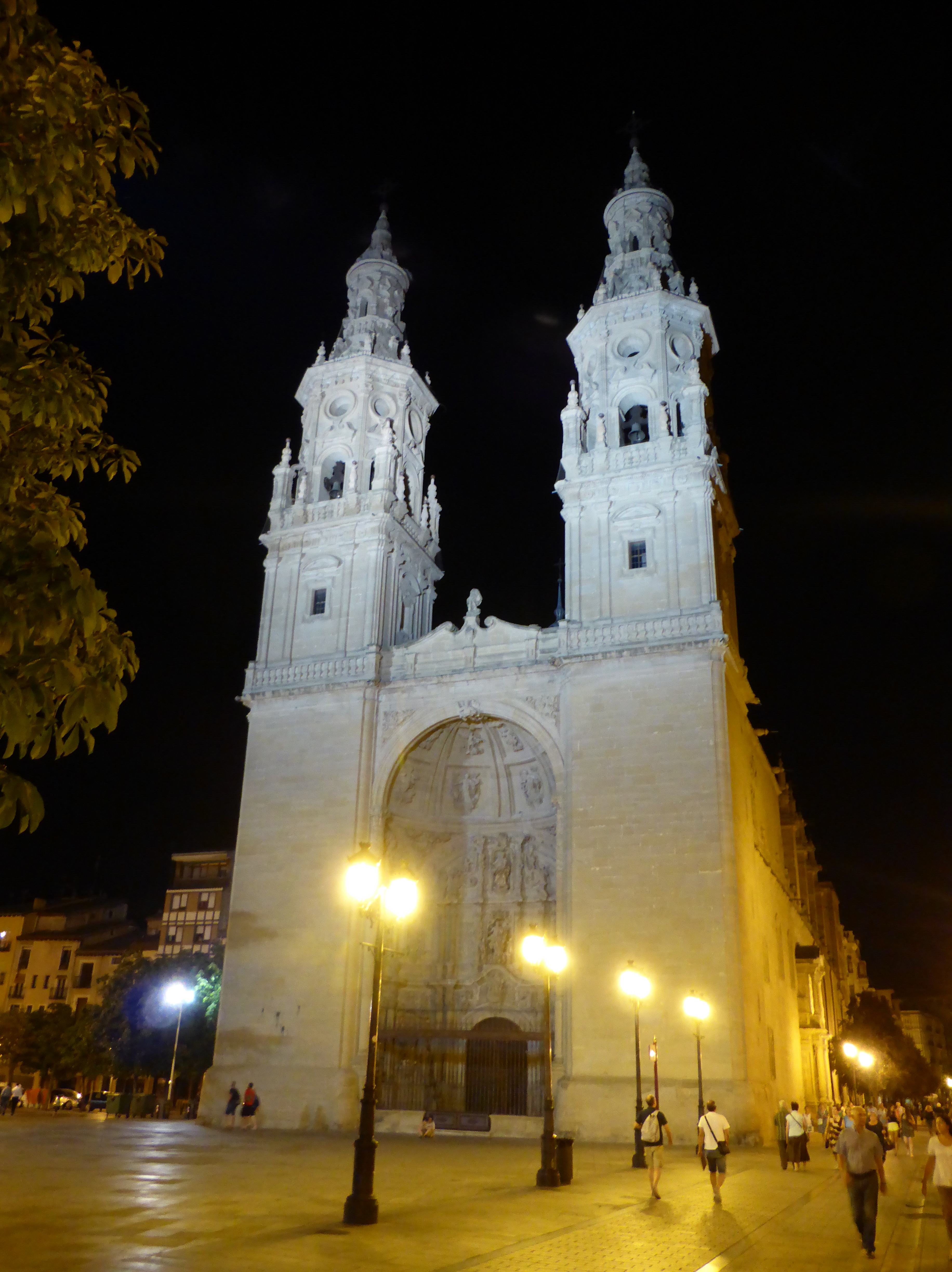
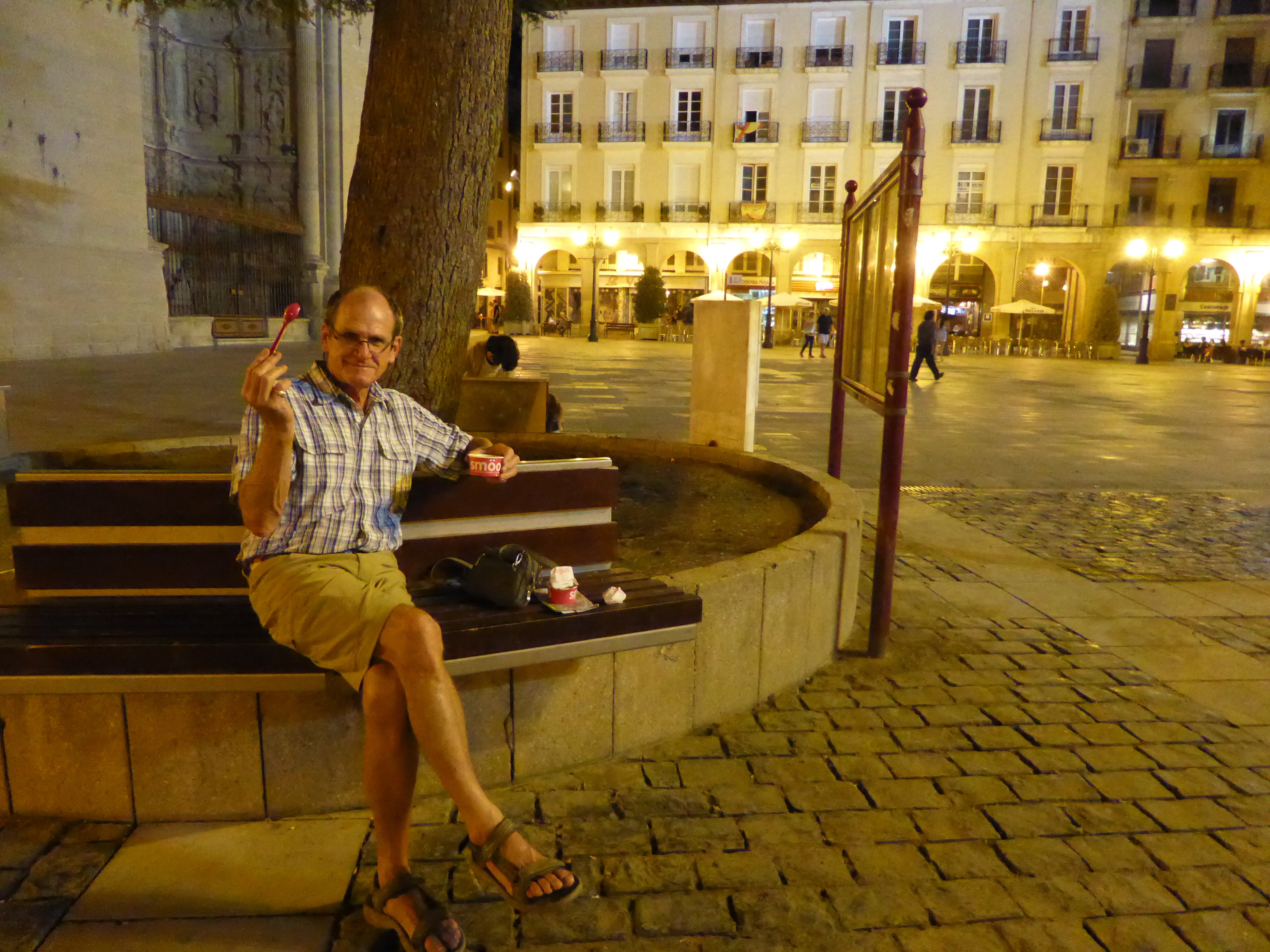
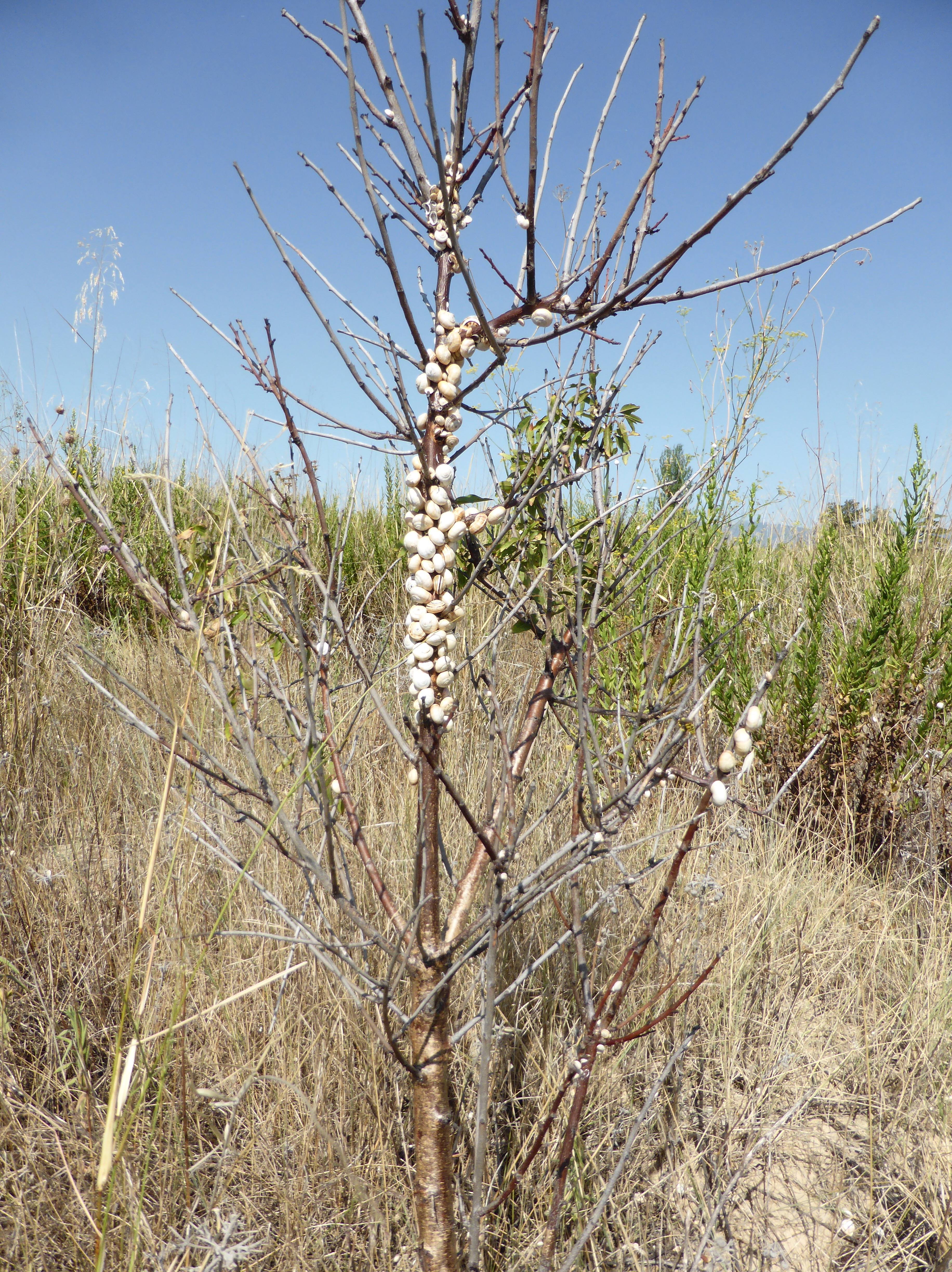
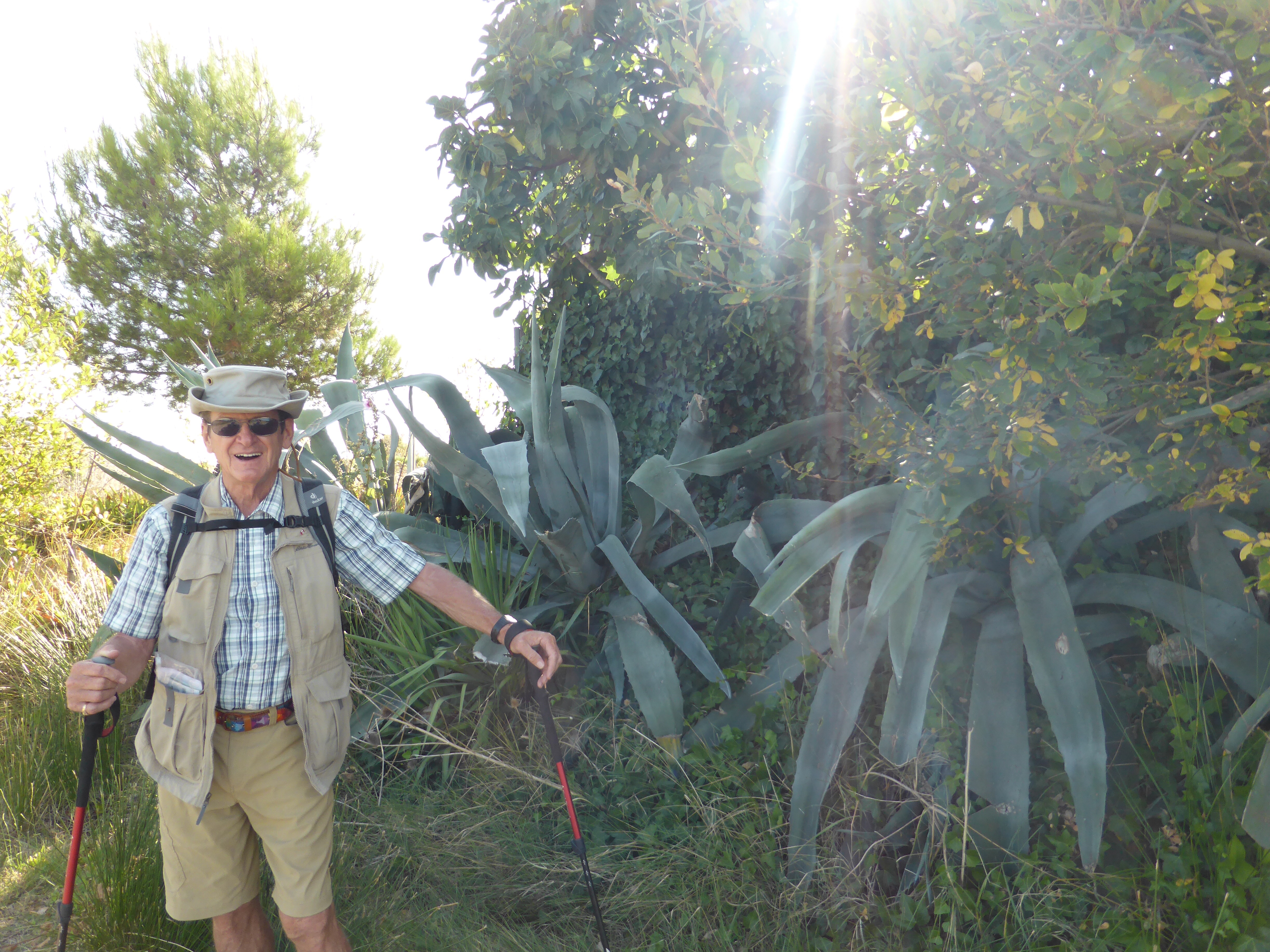
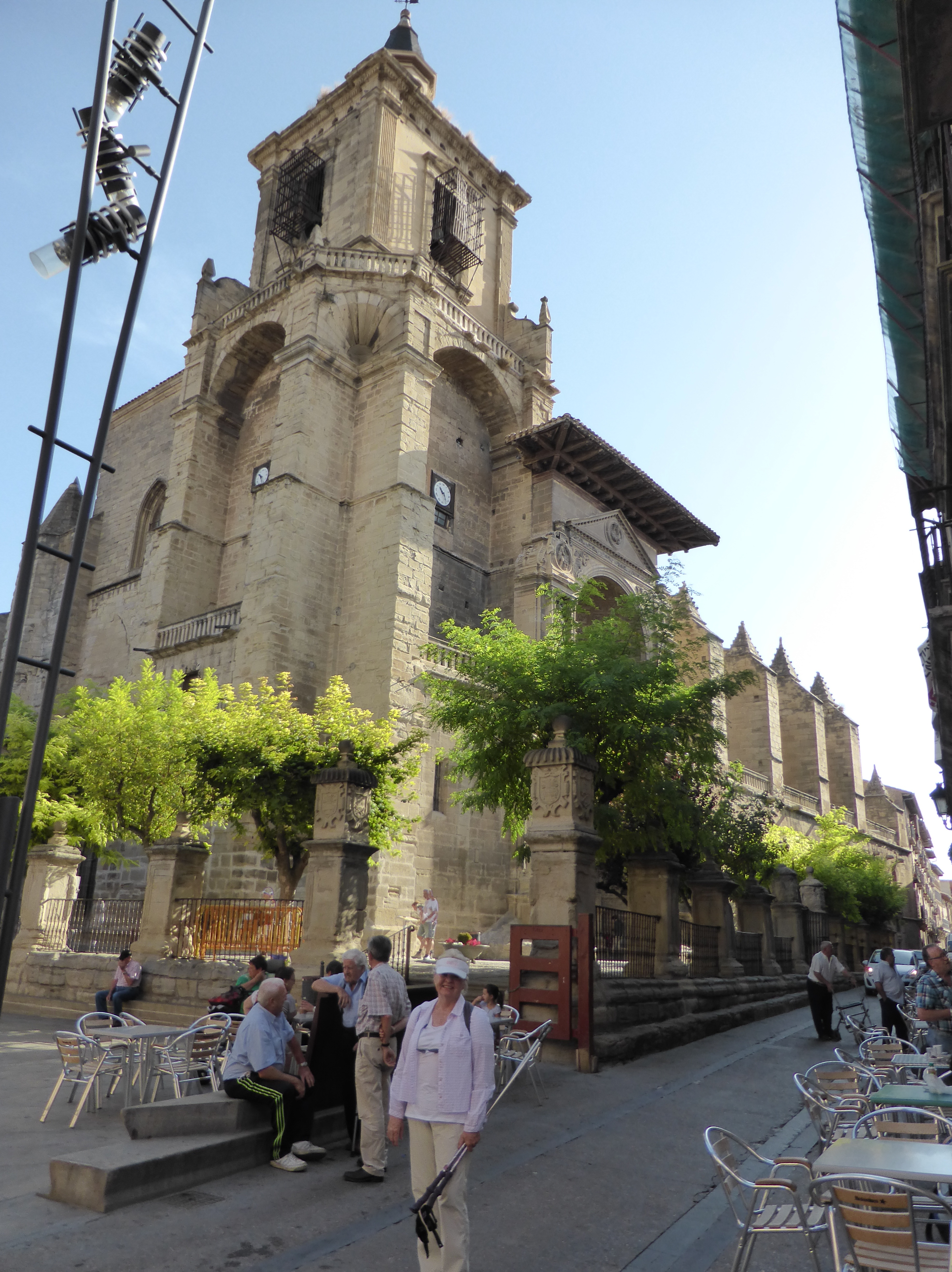
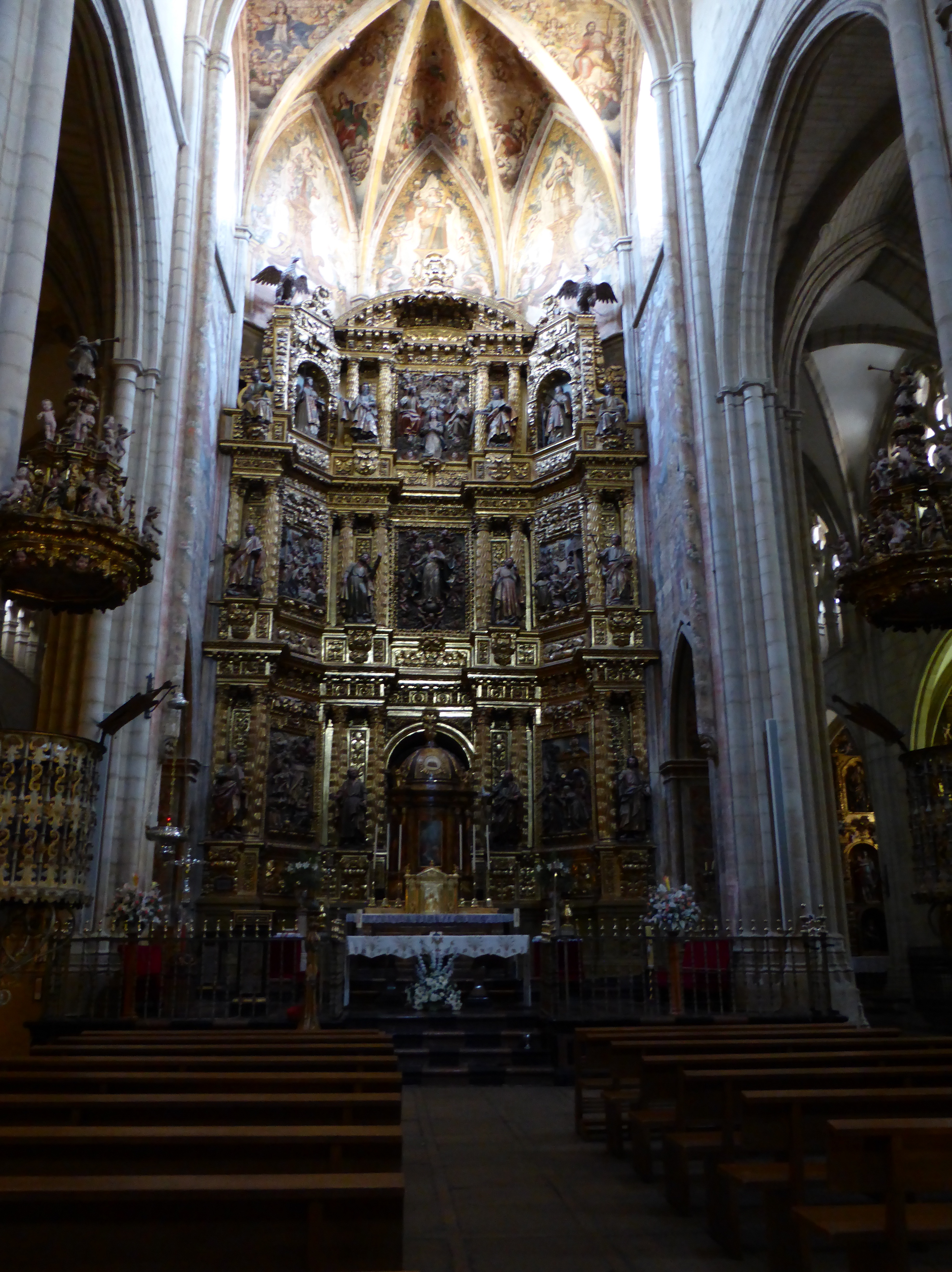
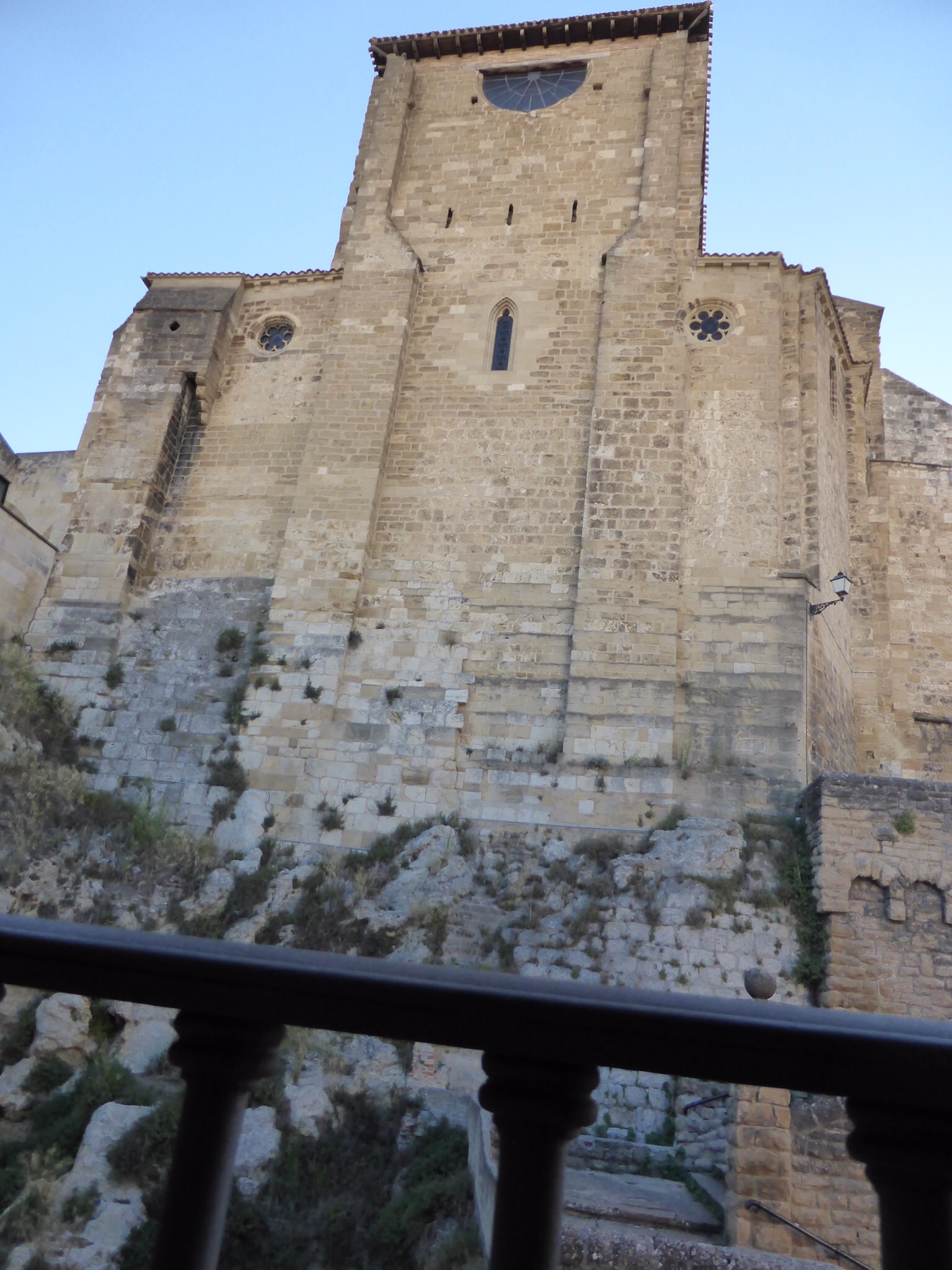
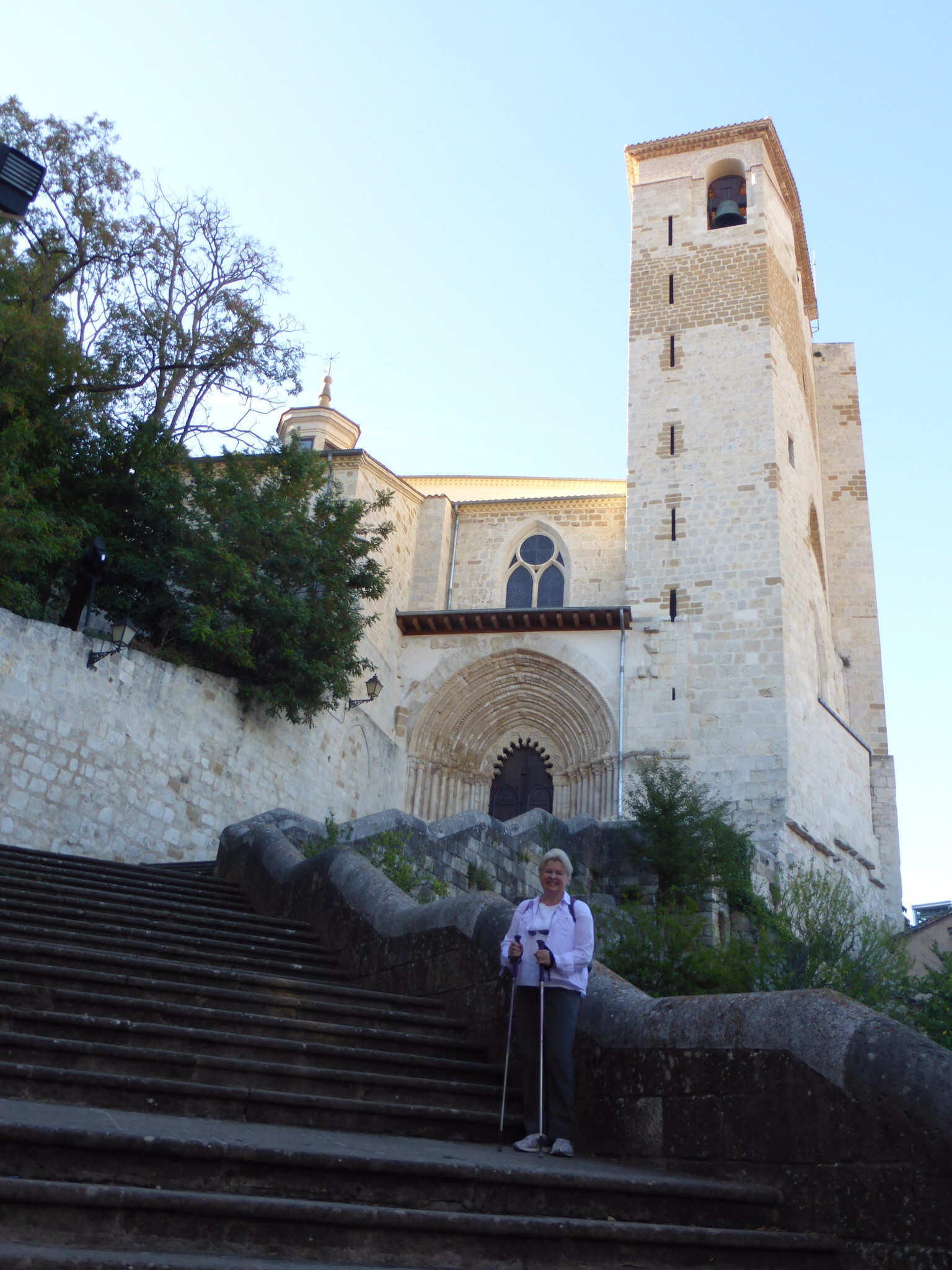
From yesterday’s written entry “Our hotel Palacio de Pujadas was once a family palace. It exhibits many artifacts from centuries ago, including the family confessional.” So on our way out of the hotel we tried it out!!A rare sight – straight, flat, even surfaced and in the shade! Wow happiness is!!!If anyone thinks that Dad likes frozen yogurt, take a look at the expression on Mutti’s face… Great end to a super day!La Redonda – cathedral in Logrono, just next door to our hotel. Thought it looked so beautiful at night.Frozen Yogurt …. ahhhh feels so good at the end of a hot day!Those are very small snails – behaving like parasites on plants that look like dandelions. They seem to be the only ones they attack.Dad didn’t want to stand beside this plant (alo vera) but Mutti wanted the picture…Just down the street from our hotel was another church, another large but beautiful one.That is probably 50 feet high – all gold gilt.
DAY 11: September 3 Viana to Logrono (10 km – thats right just 10!
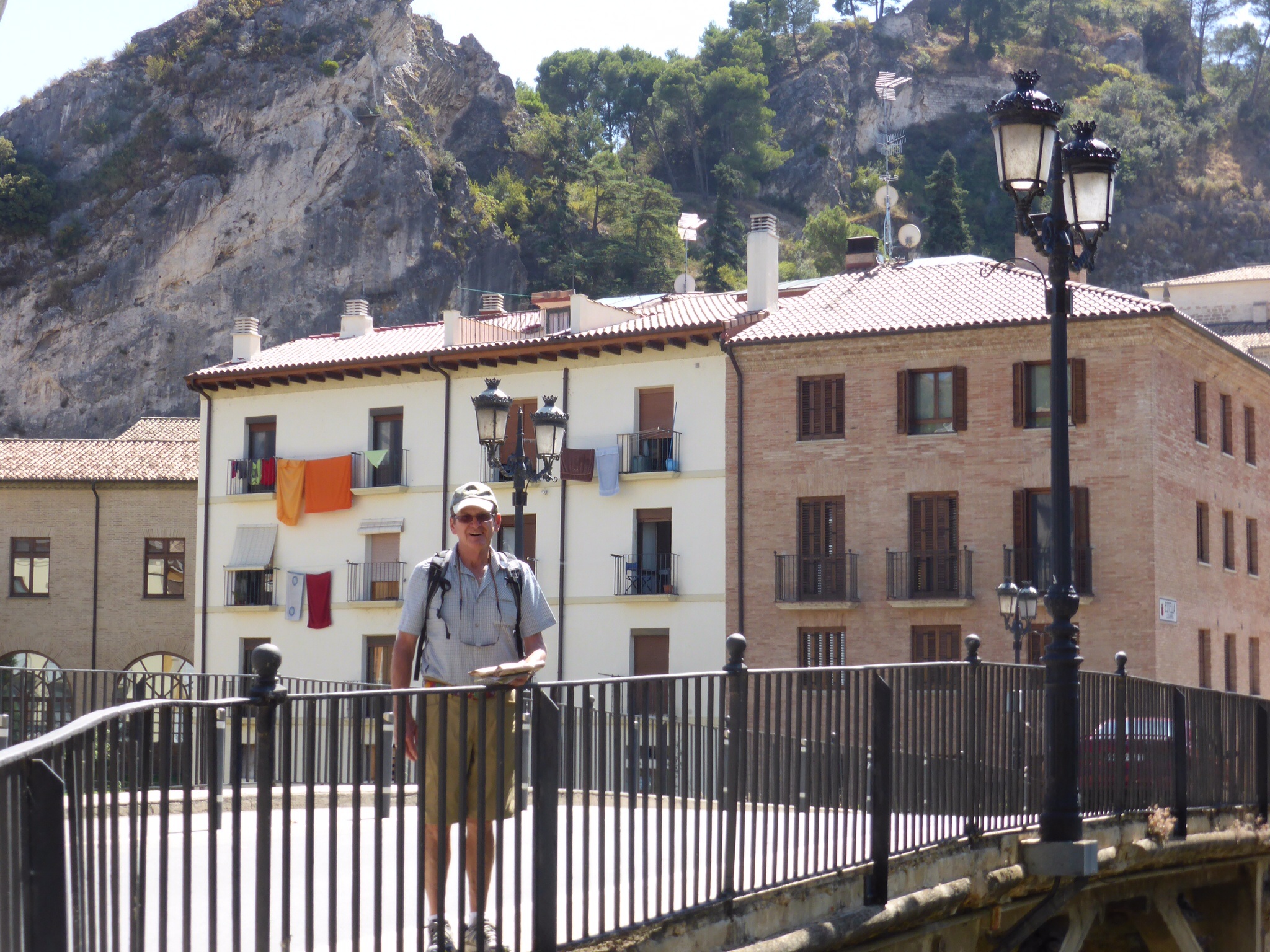
We sleep in a wee bit as today we have a lovely short walk—a stroll really. This day we leave the Navarre area and enter the Rioja area. Much of the time we are paralleling the main road with all the traffic noise. Also, to reach the historic part of Logrono we must first walk through a large industrial area. The time is short and even the industrial area is interesting to us. Along the way a fellow pilgrim has generously set up a tapas and wine stop for us. The Rioja wine is ice cold and delicious. We offer a donation but she does not wish payment. Another random act of kindness.
We check into our hotel early afternoon, get our laundry organized and go out to see the town. It is nice to have a lazy day:-) Later we wander to a street renowned for pintxos for our supper. We run into two Canadians from Timmins whom we had met back in Estelle. It is nice to cross paths with them again.
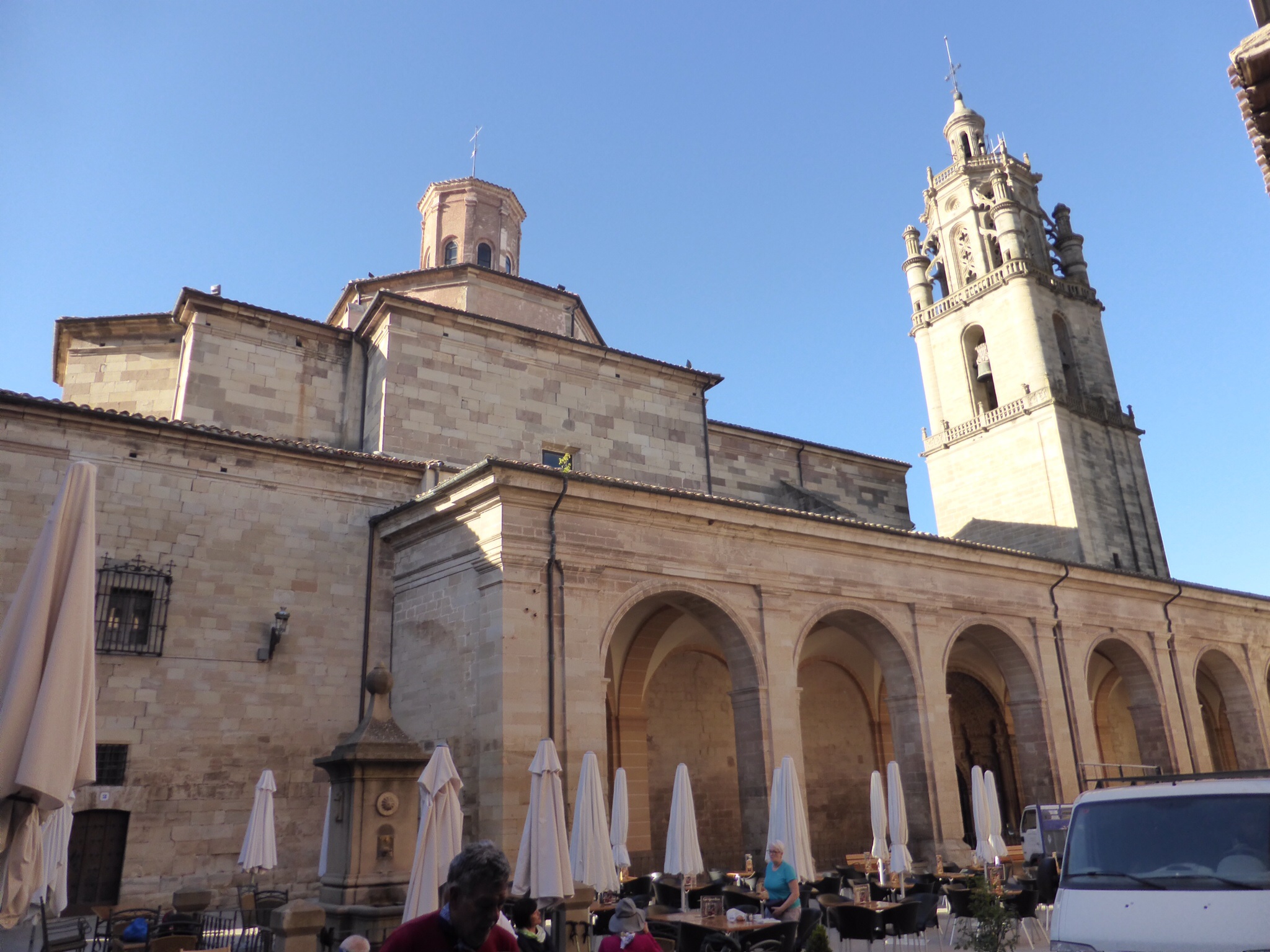
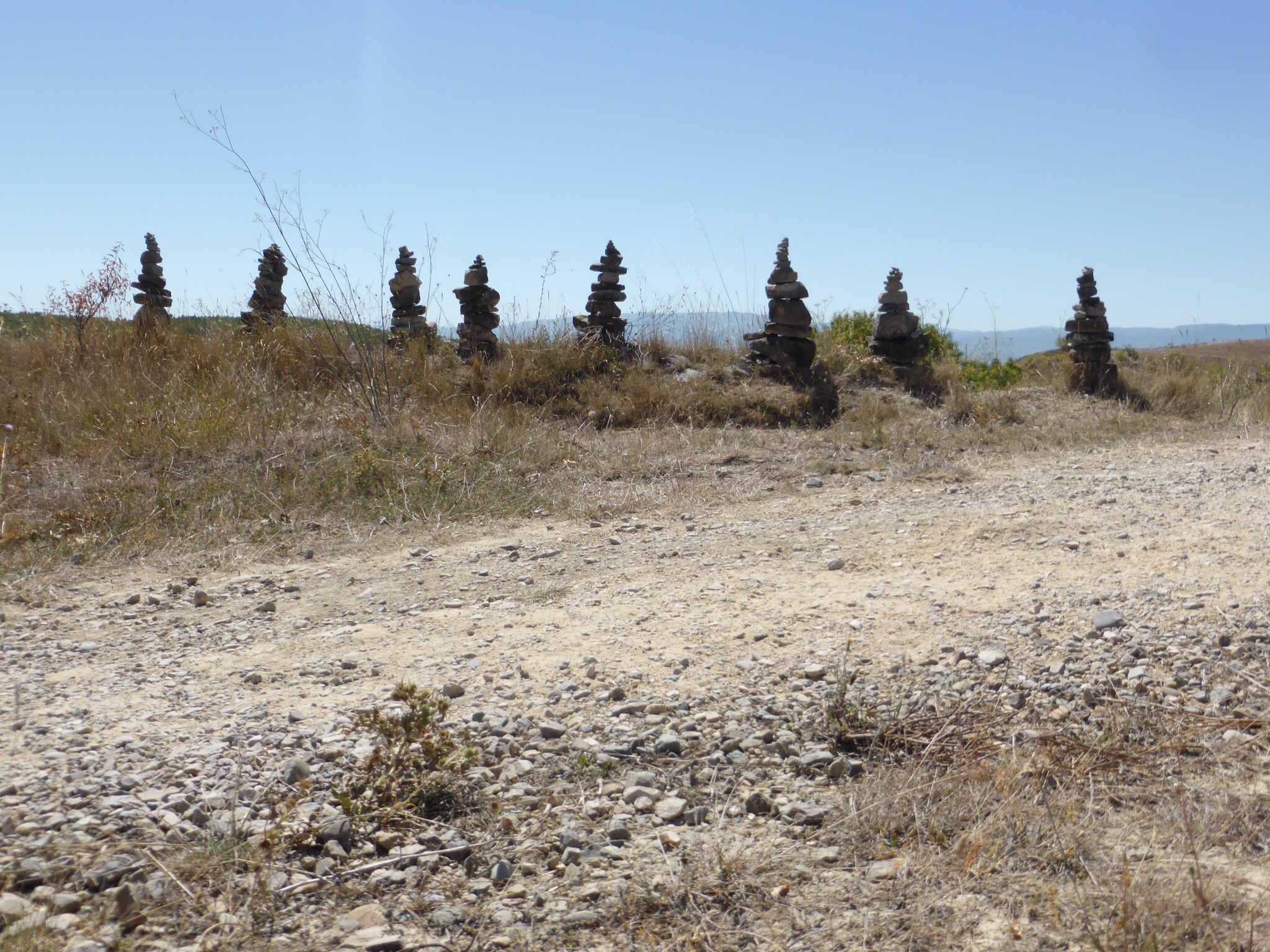
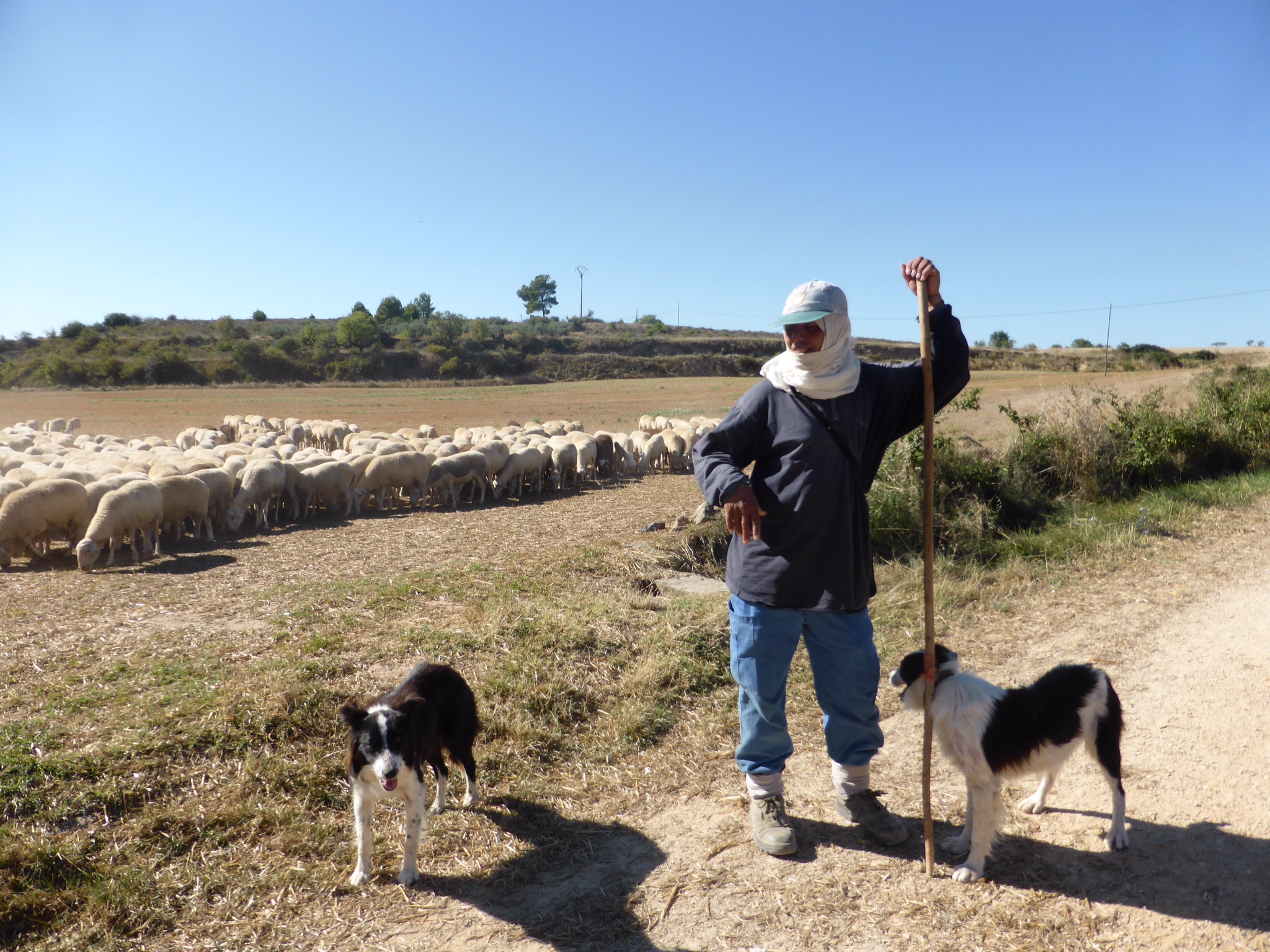
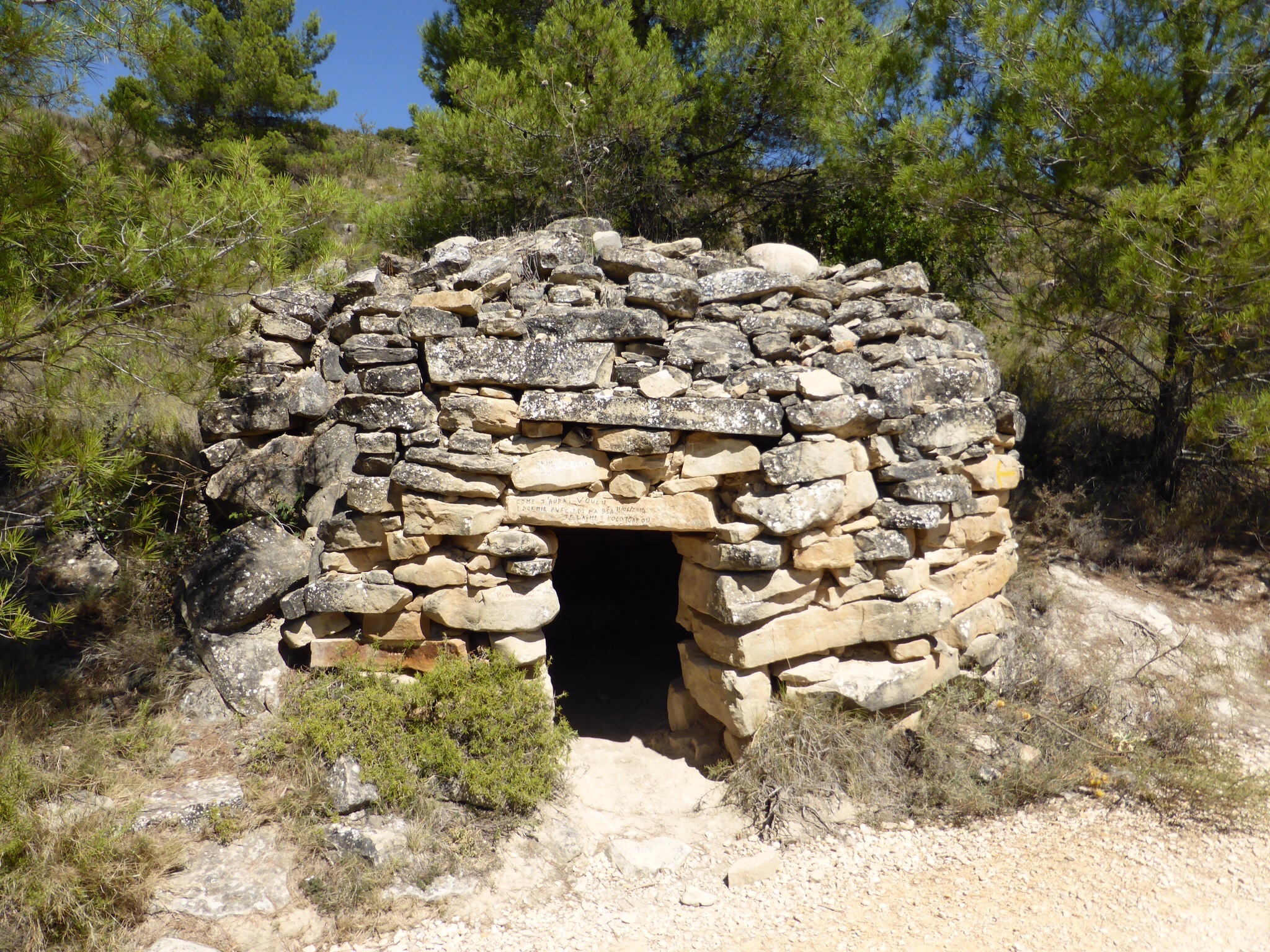
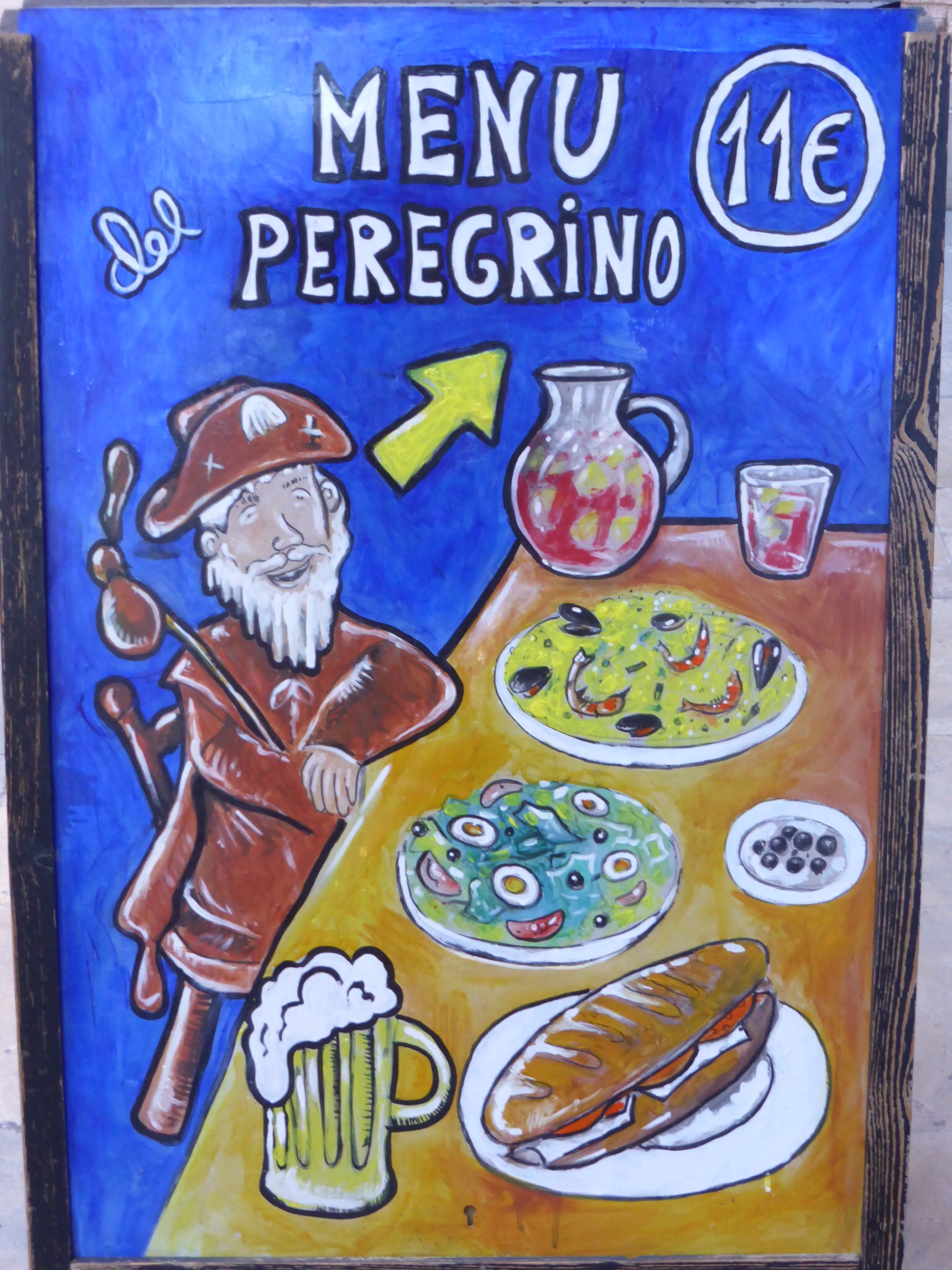
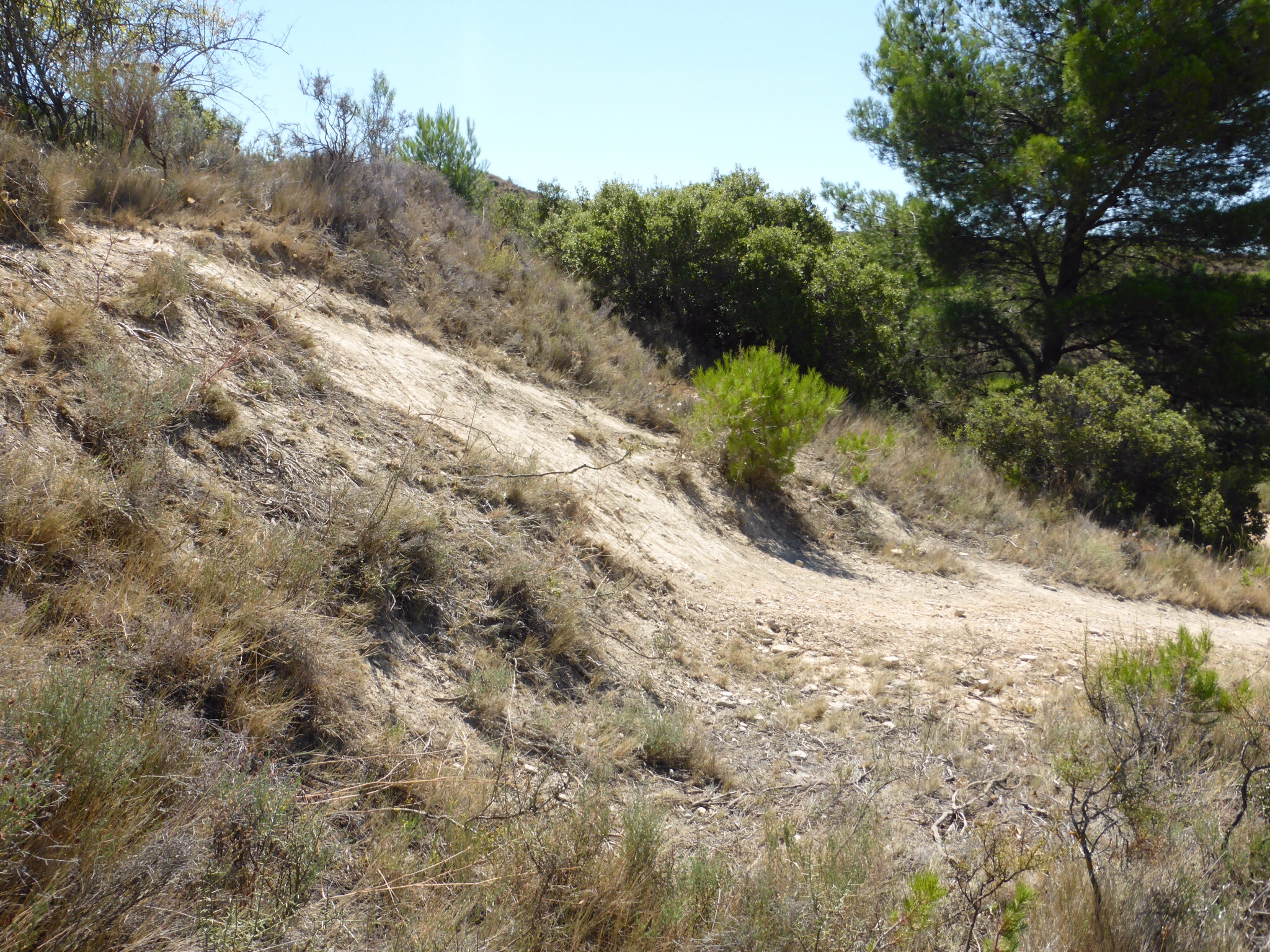
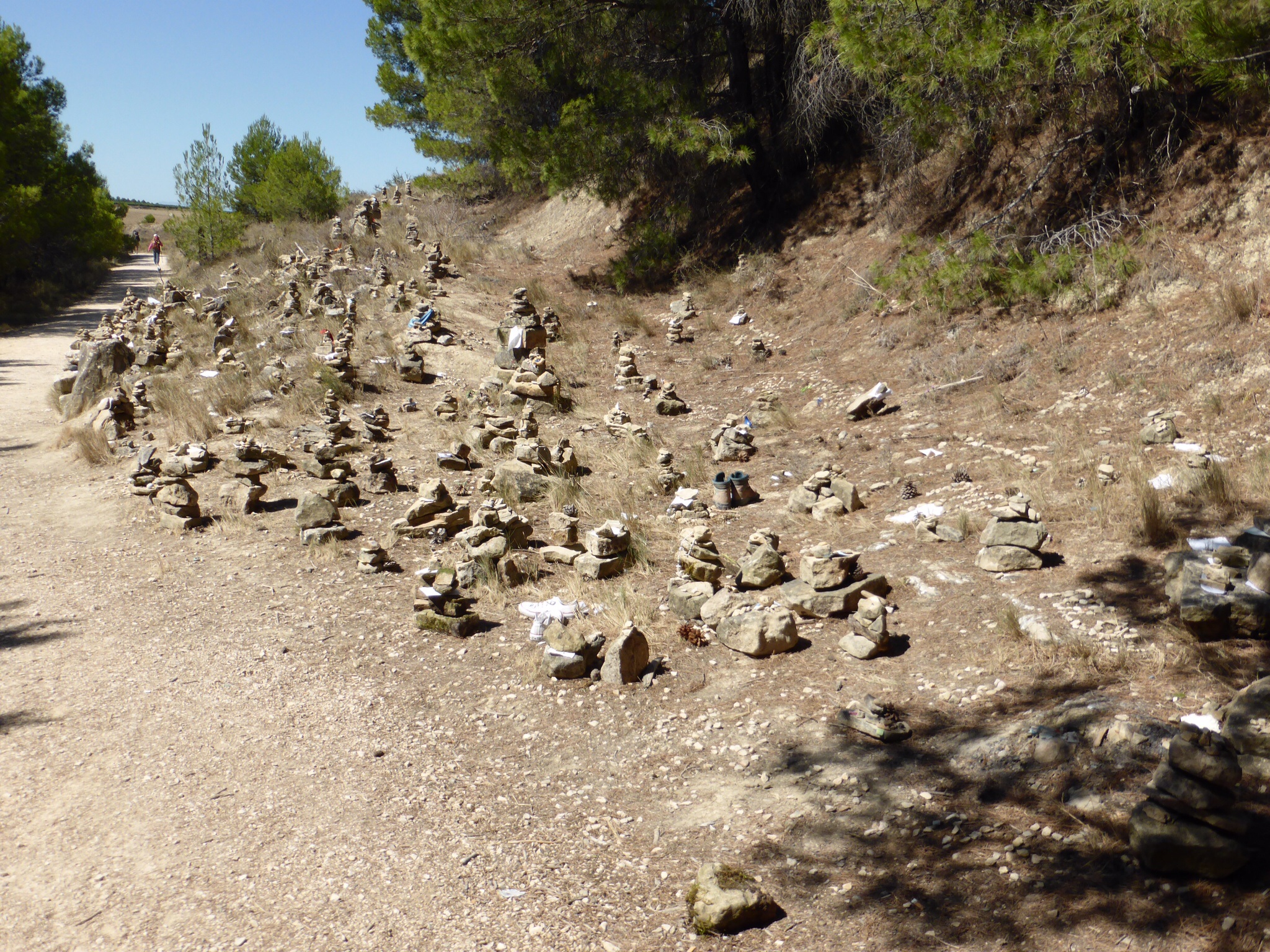
Typical small town, perhaps a few thousand people with 3 or 4 huge (and beautiful) churches like this!One of Dad’s favourite picturesYet another collection – these about 2 feet highA sheep herder and his two working dogs – took bus to get to his herd. He also spoke four languages!A pilgrims shelter, we have seen these in long stretches between any areas of habitationAll along the Camino there are inexpensive “Pilgrims Meals” – a soup, a meat dish, some vegitables, desert and a bottle of wine for 9 – 11 Euros (about $15)An idea of the slope of some areas. This would be really difficult in the rain!As we have pointed out before, inukshuks (milladoiros in Spain) are a common sight on the Camino – but this was the largest collection yet. Many have a note (sometimes plasticized) paying tribute to a lost loved one or a note of successfully dealing with an issue
DAY 10: September 2 Los Arcos to Viana (18.5km)
As we were in no condition to do any sightseeing we did not visit many of the buildings of Los Arcos. What we did learn is that it is another village of the Navarre region built in the Middle Ages for the pilgrims to Santiago de Compostele. The town name refers to the prowess of its archers. The capability to defend itself was important as Los Arcos is described as a “frontier town” of those days. It is now a quiet hilltop retreat.
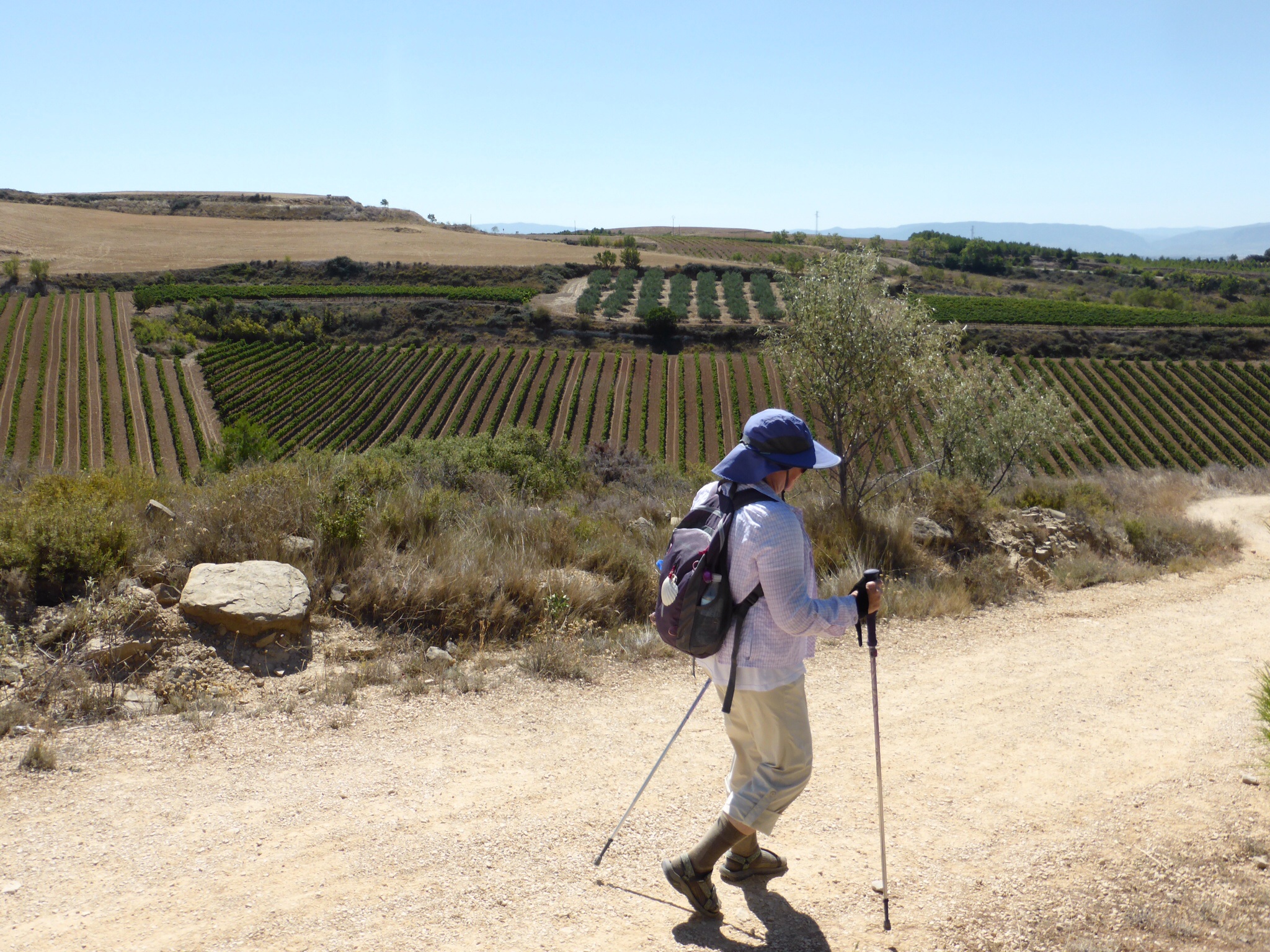
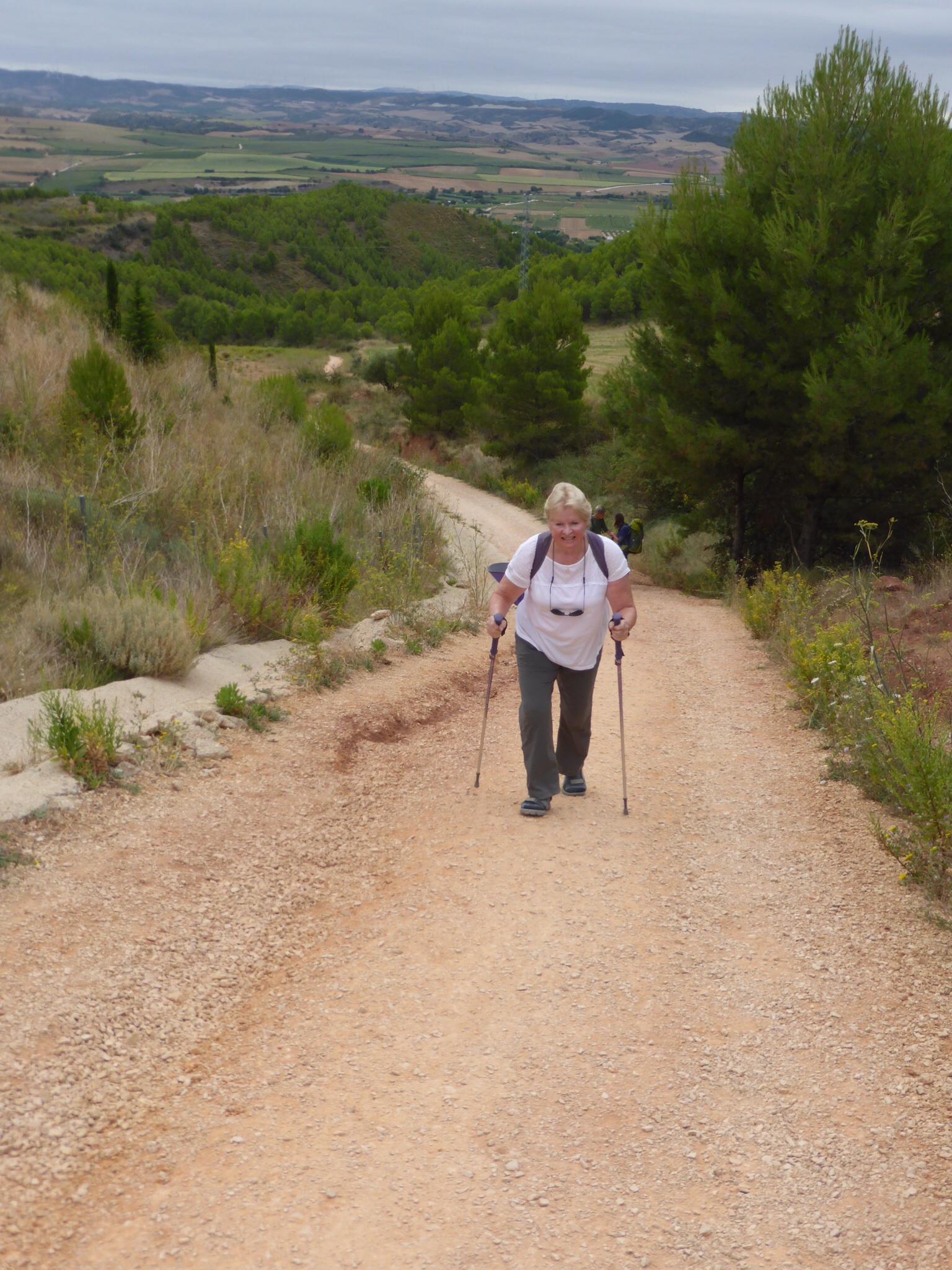
The walk for today was described as “hilly with many ups and downs—harder than it appears on the map”. The first 14 km were a series of deep ravines with an occasional hill. We were relieved to finally reach some gravel road with Viana in sight. Fortunately the day was made more comfortable by a cooling breeze. Also, walking alongside olive groves, vineyards and farmland is very peaceful. A young teacher from England shared some of the walk with us. He was good company.
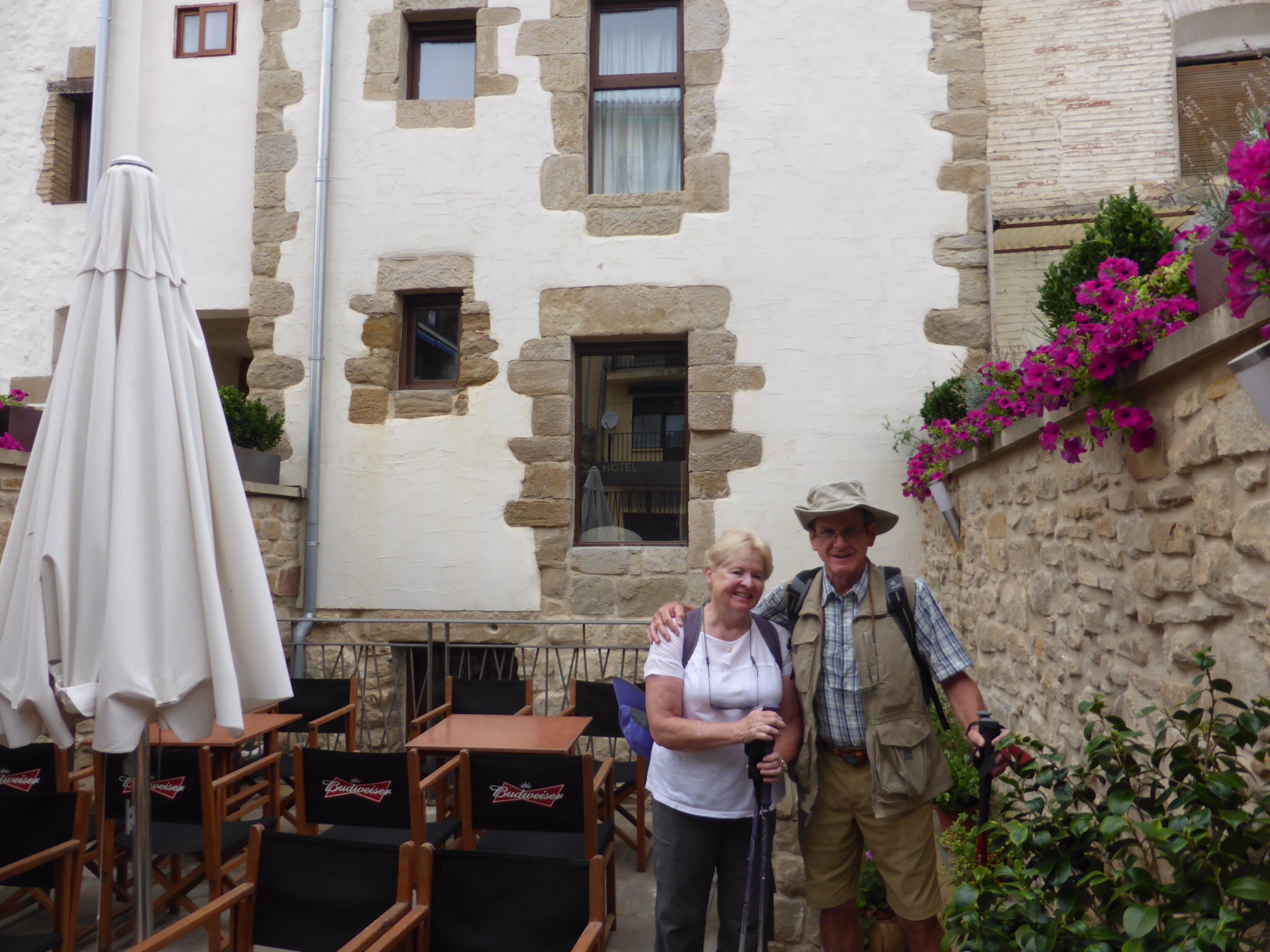
Viana is another pilgrim town built by King Sancho and the last in the Navarre region. St. Mary Magdalena ( Mutti’s name saint) is the patron saint of Viana. She stopped the Black Plague here so is celebrated every July 22 with a festival. Our hotel Palacio de Pujadas was once a family palace. It exhibits many artifacts from centuries ago, including the family confessional. The artifact we were most happy to see was a tub. Soaking our tired feet is a joy.
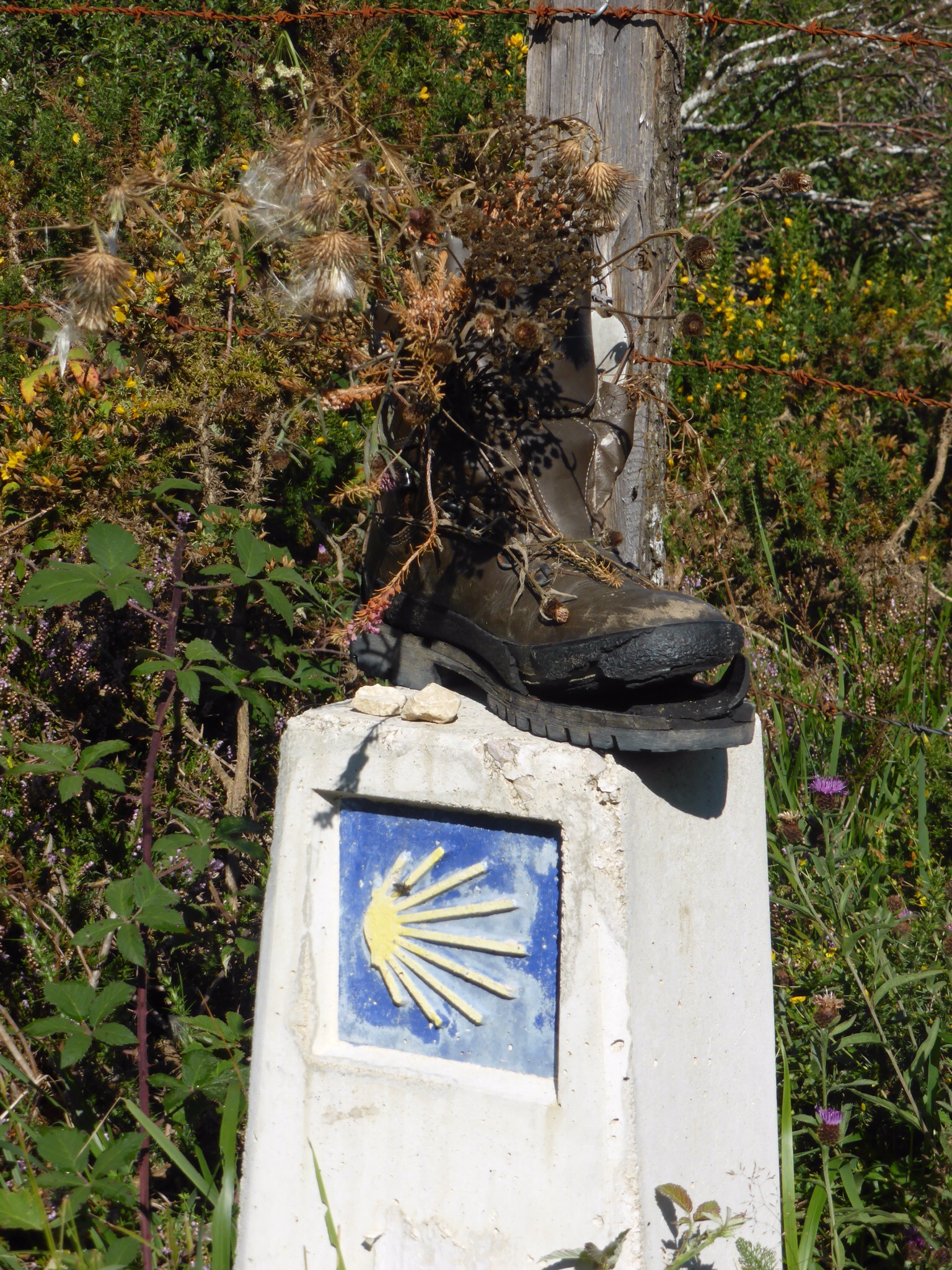
After this pilgrimage we will never again take our feet for granted. Sore feet are the bane of most pilgrims. It hurts to see them hobbling along. Discarded hiking boots along the way are a testament to their pain. So far our feet are holding up. We are very careful to carry a change of footwear in our packs in case a “hot spot”develops. Also, we are pretty adept with moleskin now. This a miraculous product!
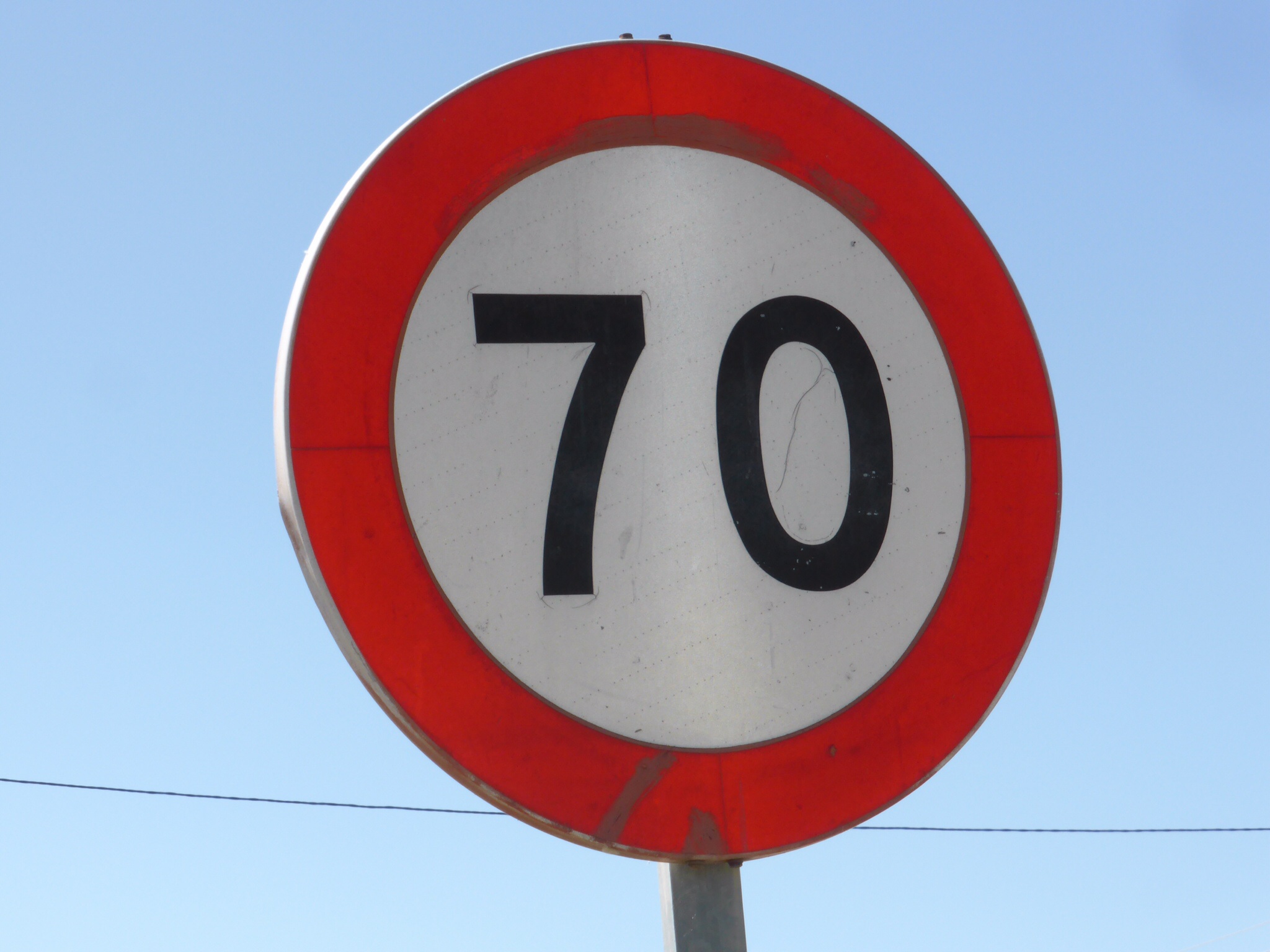
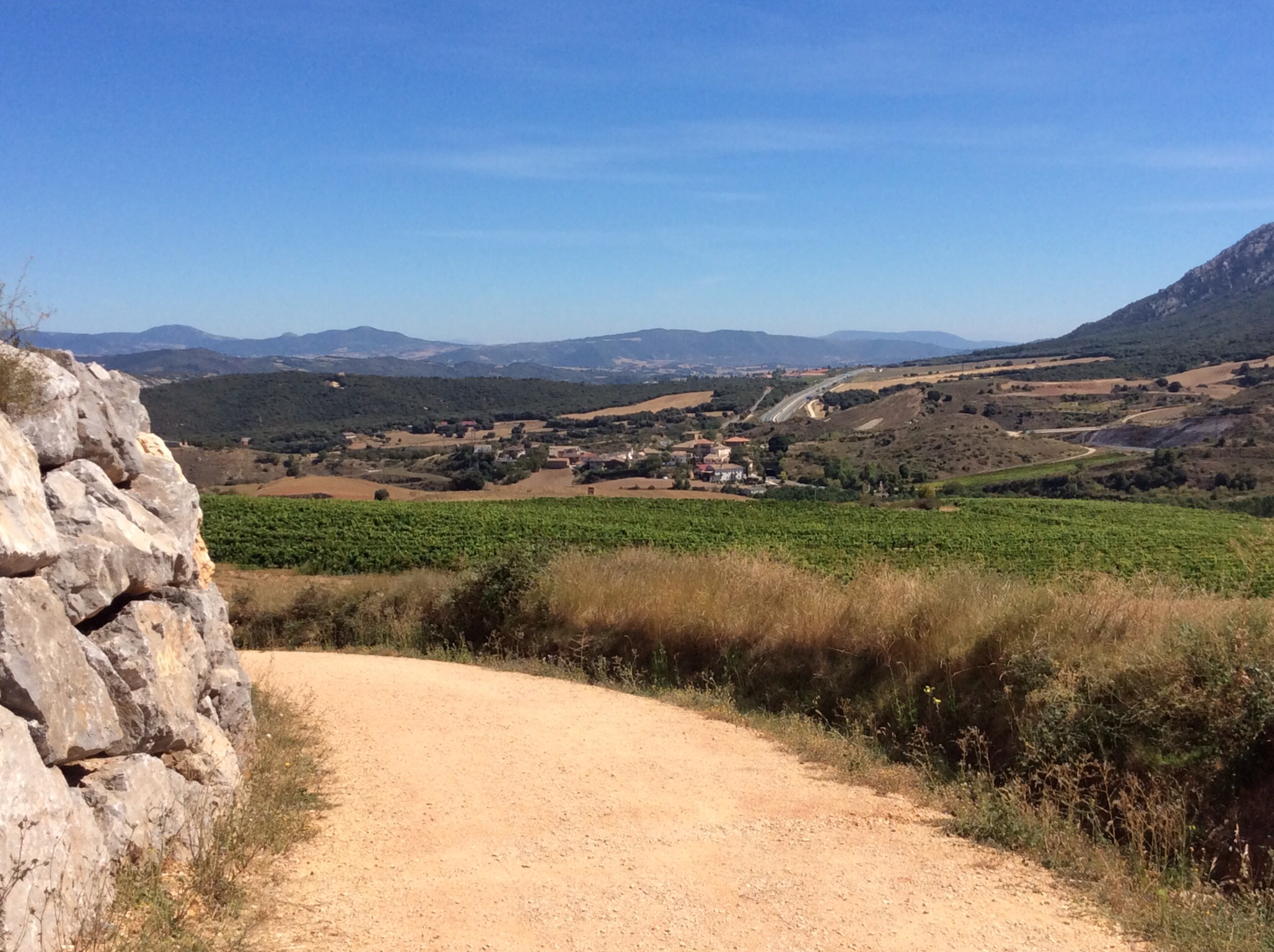
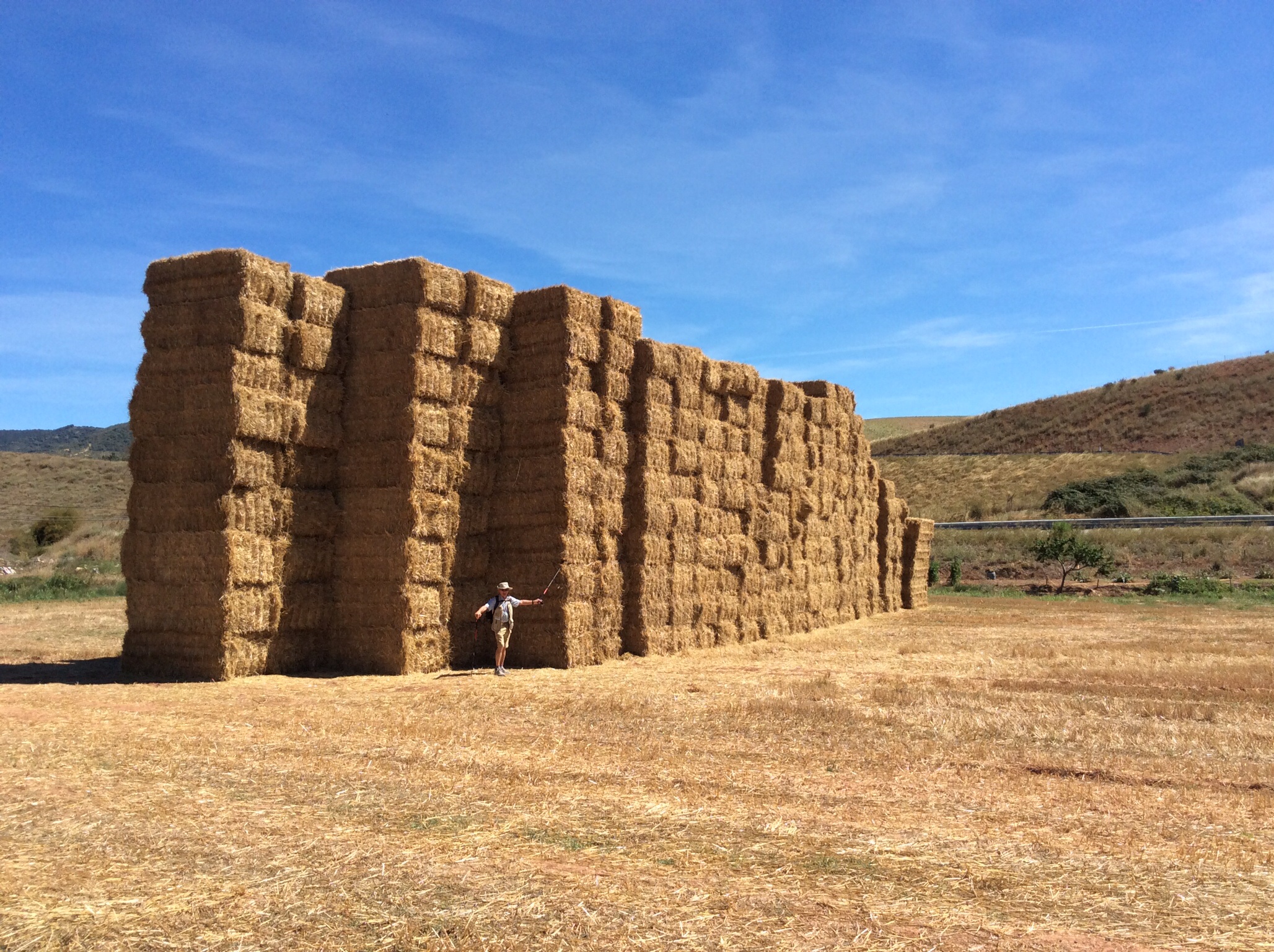
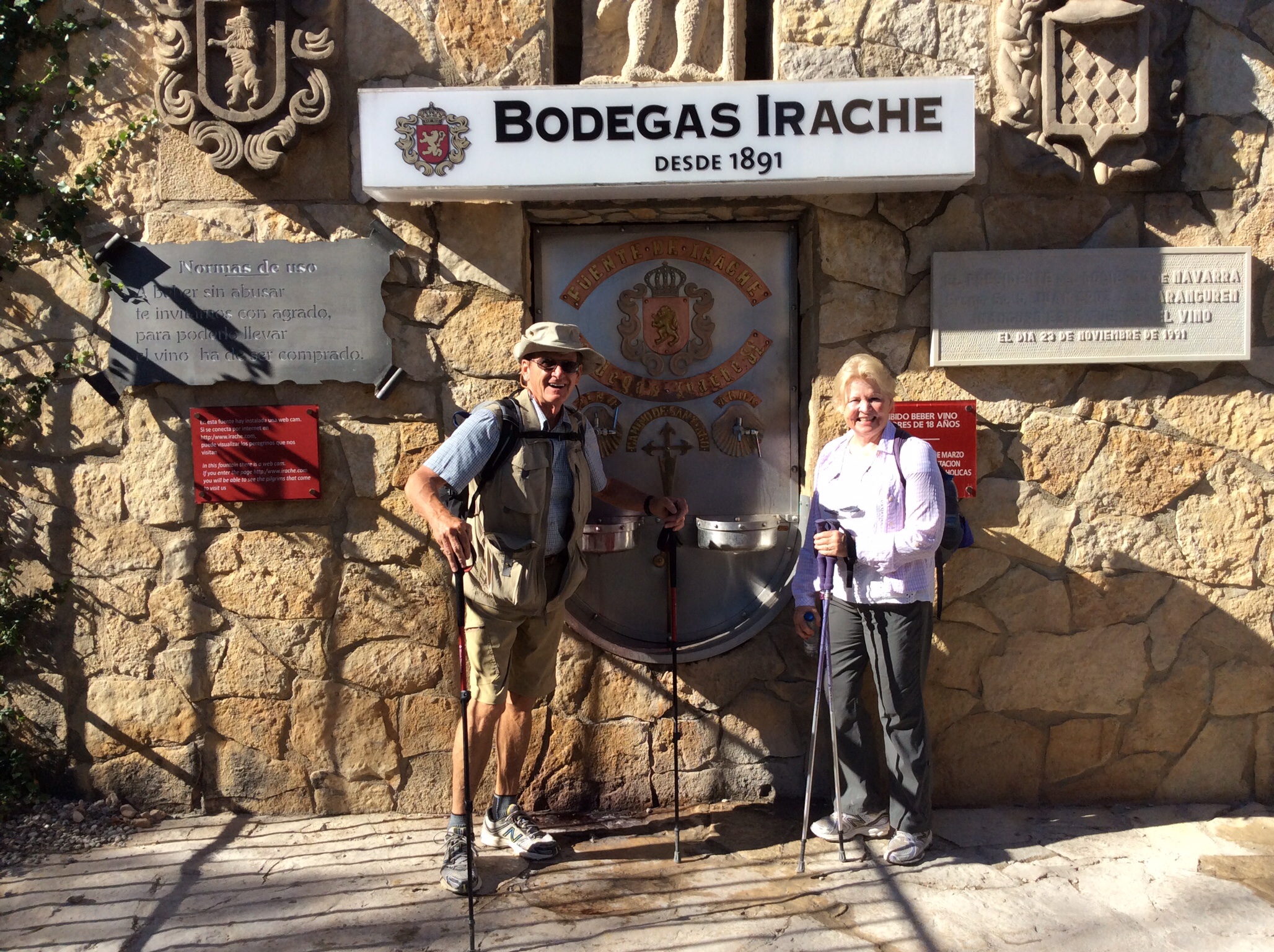
Walking the Camino is much about attitude. We found great support in our interpretation of this sign, to us it says ‘THIS ROUTE IS OPEN TO ALL 70 OR OLDER”To give you an idea, it is just after 1 pm. See the second hill top from the left (about a third of the horizon from the left side), now come down from that green hill side and it looks like a brown valley – that is where we started this morning. A good but hilly – up and down, walkThat is a lot of hay! We had never seen such large rectangular bales of hay, each about 3′ x 5′ x 8′The “Fuente del Vino” monastery winery serving wine or water to the pilgrims
DAY 9: September 1, Estella to Los Arcos (23km)
We cross the Rio Ega leaving Estelle on our way to Los Arcos. Just a few kilometres down the road we stop at the monastery and winery, “Fuente del Vino” of Bodegas de Irache. The attraction is a double fountain which delivers cold water from one spout and very good wine from the other. You can fill up your bottle with either at no cost—a little pilgrims’ privilege. Despite it being morning, Mutti tries the wine but does not fill her bottle with it…..The walk is not too arduous, the least vertical so far. However, the day is hot and there is not a breath of a breeze. At 9 km we reach the last village enroute until our destination which is still 14 km down the road. The temperature is 33°C. We buy drinks and replenish our water supply and reapply our sunscreen and head into the unknown. Out of nowhere we hear English being spoken and a young (50’s) couple appears. They are delightful despite his feet being a mess of blisters. The final 14 km pass quickly, the good conversation diverting us from thoughts of the distance yet to go and the heat. This is the special companionship of the Camino. For a moment in time you share of yourself and what you have. Even though we are not staying in the albergues, which does exclude us from some of the camaraderie of the Camino ( we are also excluded from bedbugs, no hot water, lack of privacy and snoring:-), as pilgrims we are still a part of the grand journey. When a pilgrim stops to rest others passing offer a greeting and inquire as to their well being. This concern of strangers for strangers is quite wonderful. Sharing and help are unconditional along the Camino. It seems to bring out the best in people.
We arrive in Los Arcos —Dad is weary. Mutti is exhausted.
Our companions along this way were marathoners and the pace we walked with them was probably too fast for us. Our few hours with them enriched our lives, so it is all good.
We will sleep well tonight!
Wandering about the town. The height of the cliffs behind the buildings gives you an idea of the terrain.The view out our hotel window. Front row seats as the bells chimed every quarter hour. Funny – you get used to it – an occurrence in every town.Different view of same church.
DAY 8: August 31, REST DAY IN ESTELLA
Mutti was particularly looking forward to this village as in the guide book it was described as the “embroidery centre” of Spain. However, no one we asked seemed to know this. Even those who had lived in Estelle all their lives looked askance. Undeterred we searched the shops in town but being Sunday very few were open. So the secret embroidery cartel of Estelle remains undetected. After attending to our chores (laundry and email) it was pleasant to sit in the town square (Plaze de los Fueros) with our cafe con leche and watch the townspeople. These gatherings in the “plaza” are a great part of the way of life in rural Spain. We enjoy even being on the periphery.
Estelle was founded in 1090 for pilgrims by King Sancho who granted a tax dispensation (fueros) to those coming to live in the town to provide for pilgrims. It is very pretty with its cobblestone streets demarcated with marble—as our concierge said, “from a more prosperous time in Spain”. Our hotel was right across from the cathedral—which is huge and it was all we could see from our window:-) Estelle is known as “Estella la Bella” and it truly is.
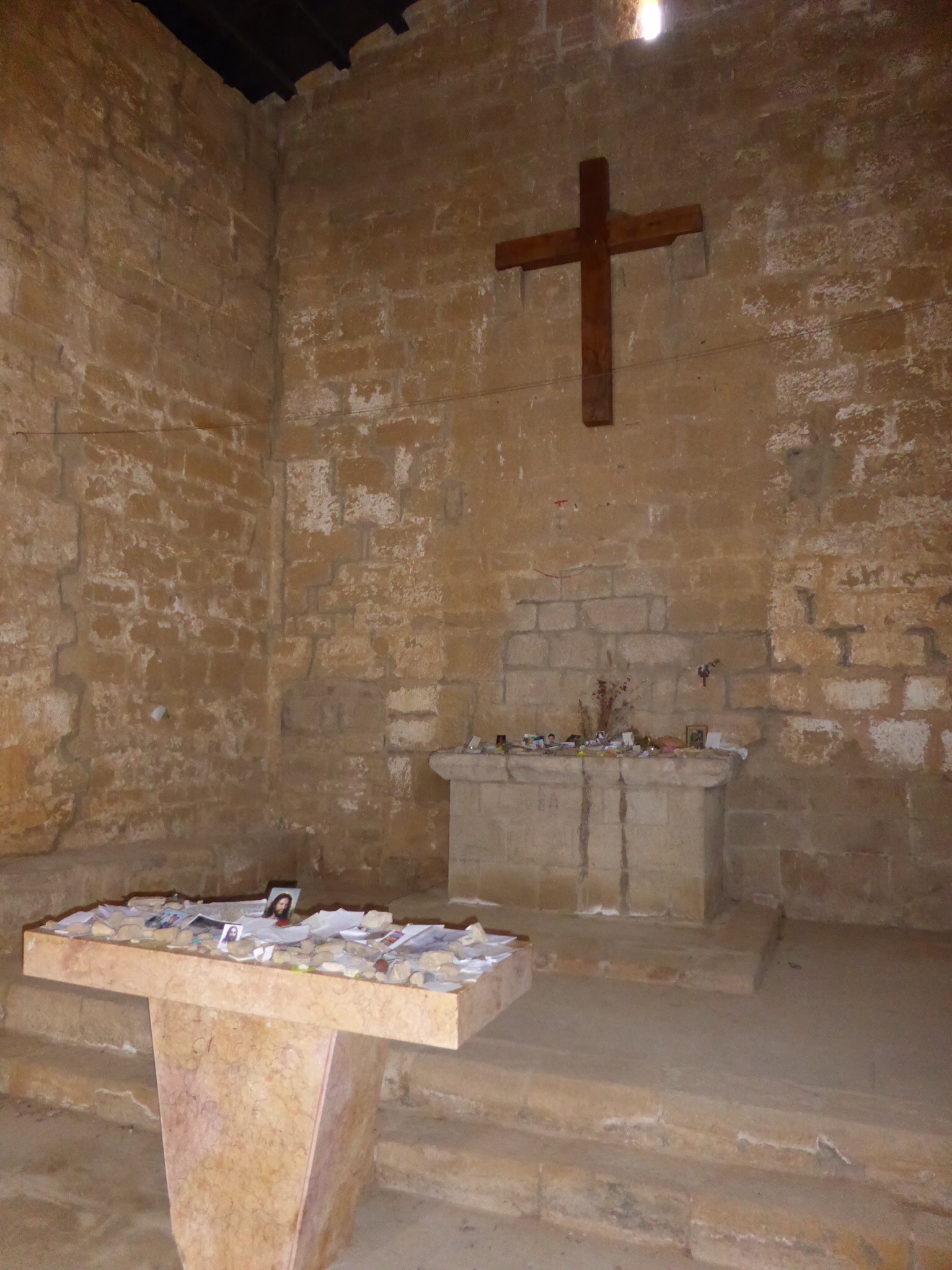
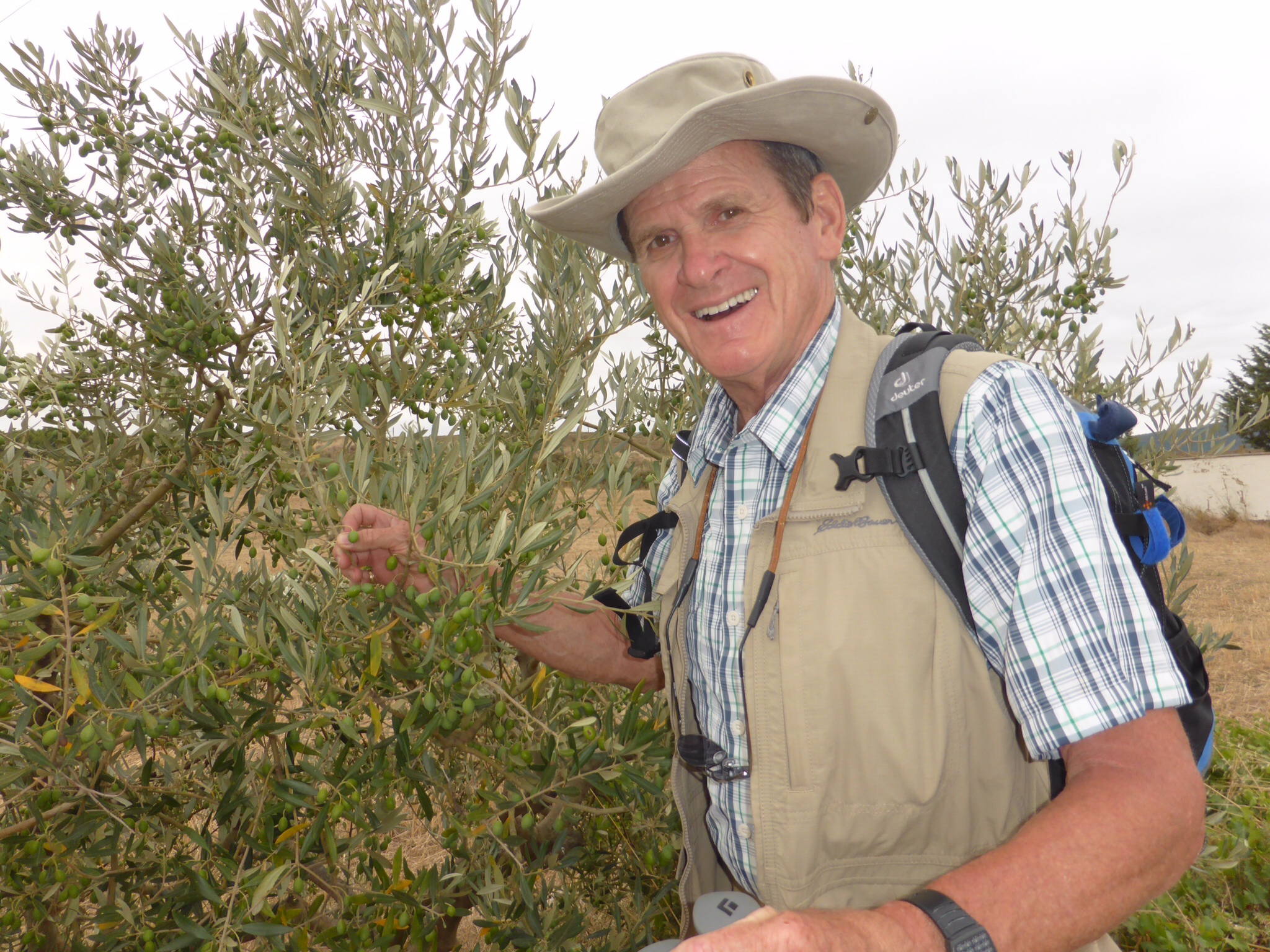
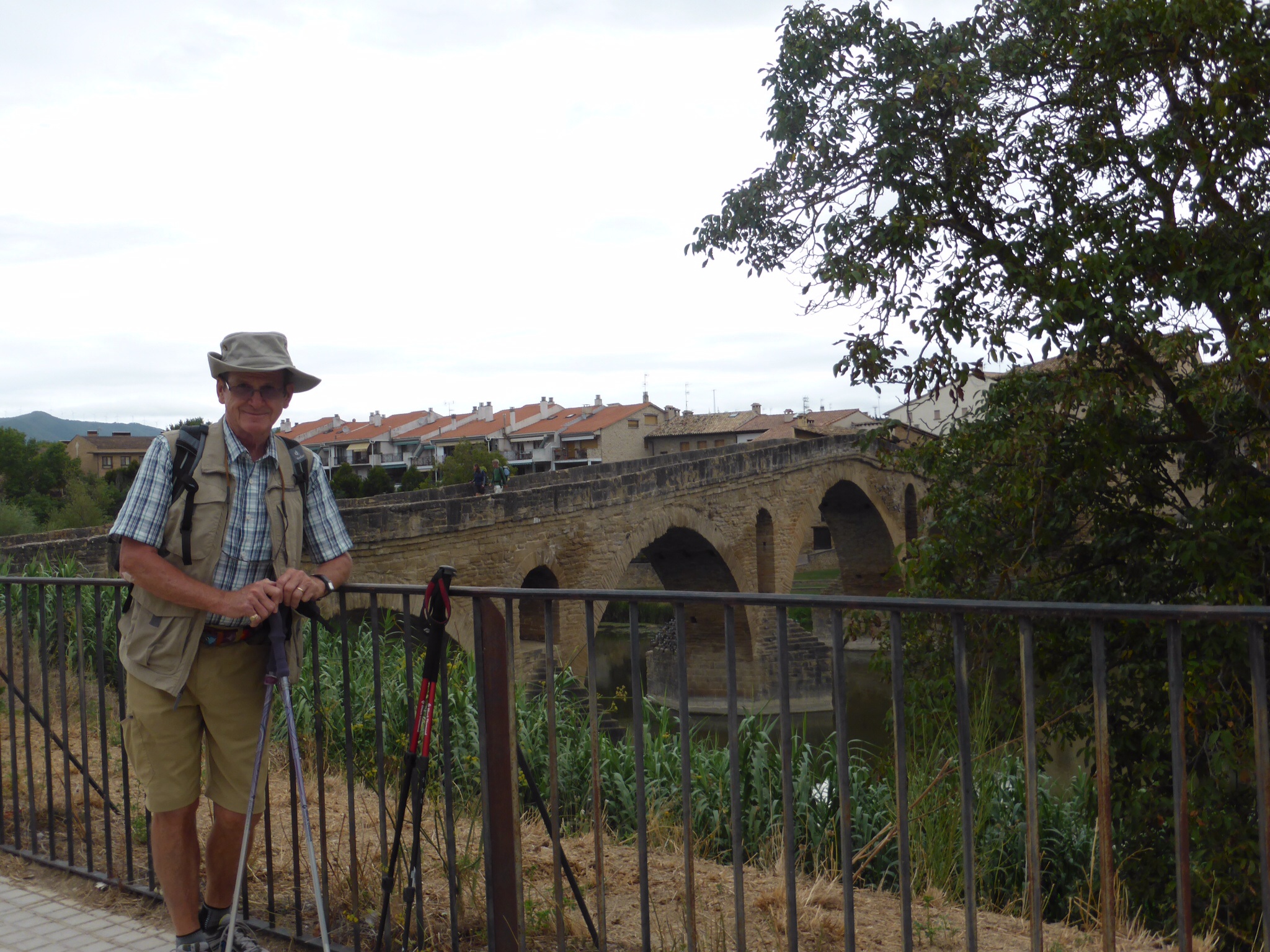
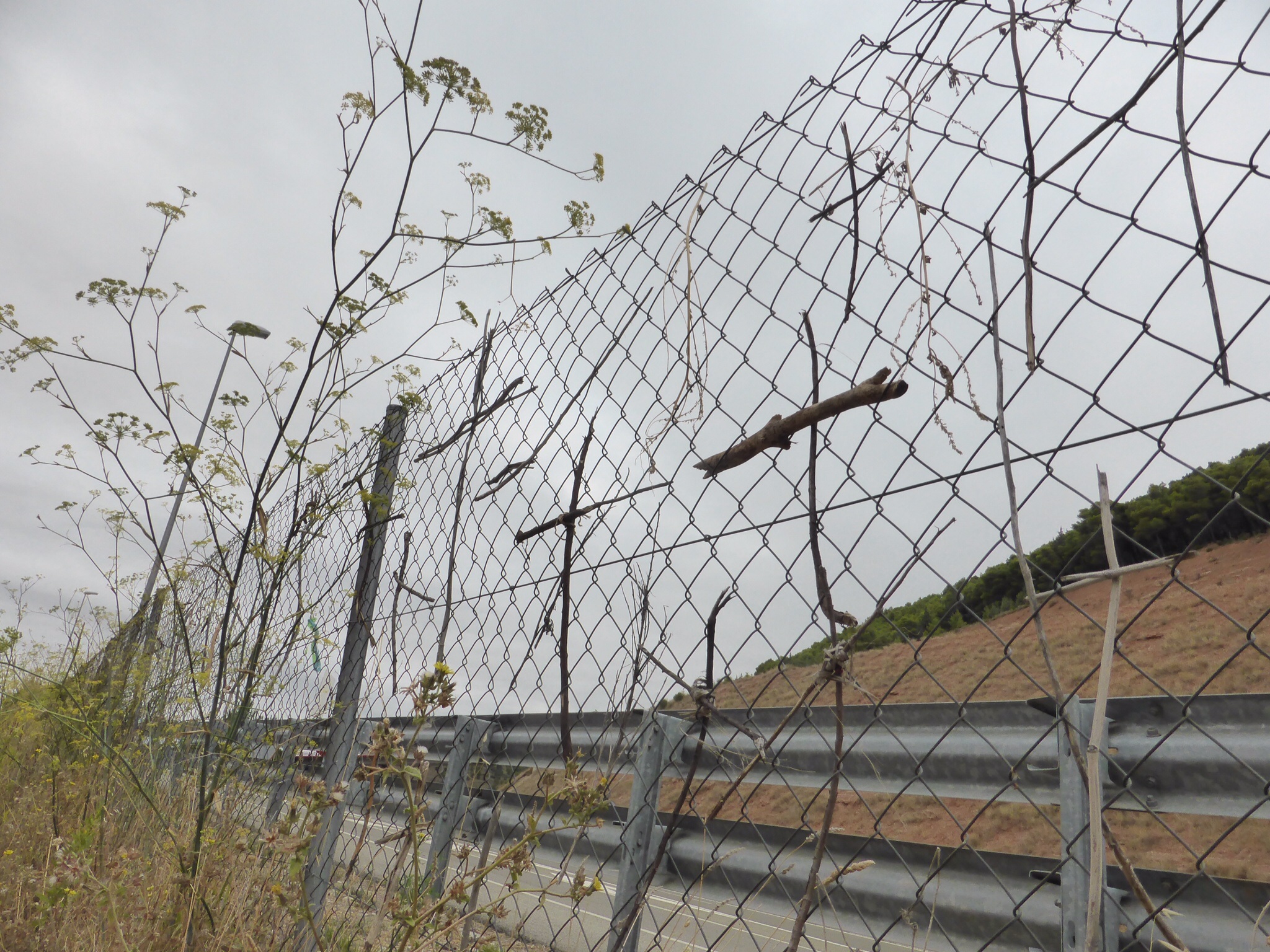
The back wall of this lovely little hotel is actually part of the town’s 1000 year old defence wall. We stayed in their bridal suite!Such a simple structure, four walls. Thats Delana to the left for a size comparison.After every bridge is a hill up the other side, this one moderately steepTough goingInside the Ermitage de San Miguel. This was the spiritual highlight to date: such a simple structure, over a thousand years old. Very powerful to think of the thousands of pilgrims who have stood at this alter.At first I was so excited – there are olive trees everywhere ( as well as fig and almond) but it is a long long flavour journey from a green olive on a tree to a greek salad! Wow are they sour!Pretty good looking after a thousand years (referring to the bridge….)All along the Camino pilgrims leave behind various expressions of their spiritualism. Here it was simply weaving sticks in the form of a cross in a highway fence.
DAY 7: August 30, Puente la Reina to Estella (23km)
Puente la Reina is one of the most emblematic places on the Camino Frances as well as being a town founded for and by the Camino route. There are four roads leading to Santiago de Compostele and they all come together in Puente la Reina. Our hotel was one of the towers of the town wall. Our hosts were the loveliest couple who offered us COLD, freshly squeezed lemonade when we arrived tired and parched. All the villages and towns along the Camino are charming with their stone houses, cobblestone streets and beautiful flower boxes, but Puente la Reina is one of the loveliest. We would have liked to have remained longer but the Camino does beckon you onward. The countryside is now vineyards and olive groves and almond orchards. The villages along the
Camino have many private vegetable gardens and the larger towns have community gardens. Primarily tomatoes,sweet red peppers. sweet onions, and artichokes are the crops. The food in this part of Spain is not spicey at all and very good. However, the custom is to eat late (2000) and there are two large courses plus dessert. We have learned that two pintxos (tapas) make a good meal.
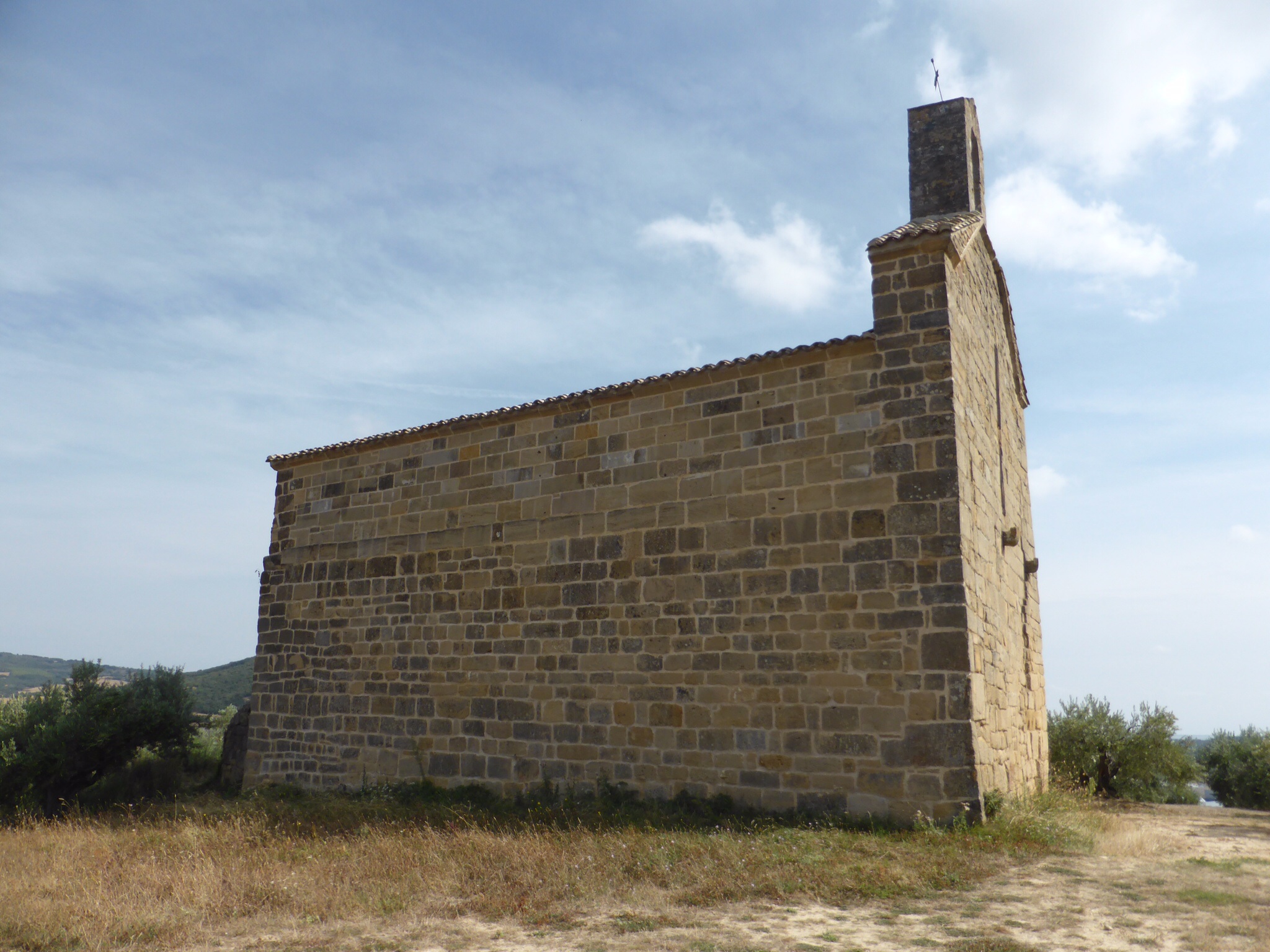
Just outside of Estella we stopped at Ermitage de San Miguel. What remains of the 1000 year old church is only the nave. It has been abandoned and weeds surround it. What compelled us to go there we do not know. This plain stone structure was so cool and peaceful. A sense of calm surrounded us. On the stone altar were pebbles, notes, and pictures left by pilgrims before us. We felt a sense of reverence and a connection to the meaning of the Camino.
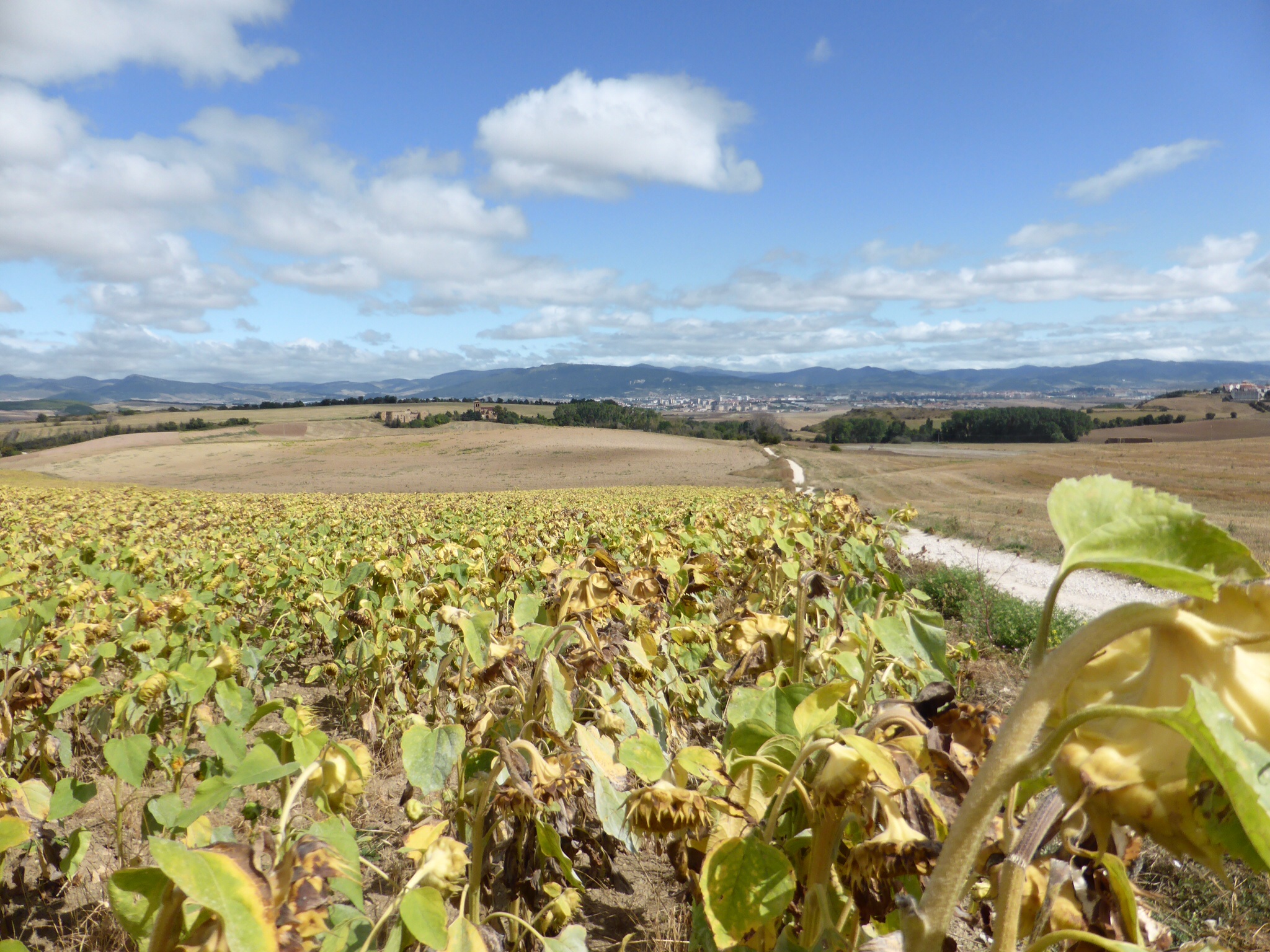
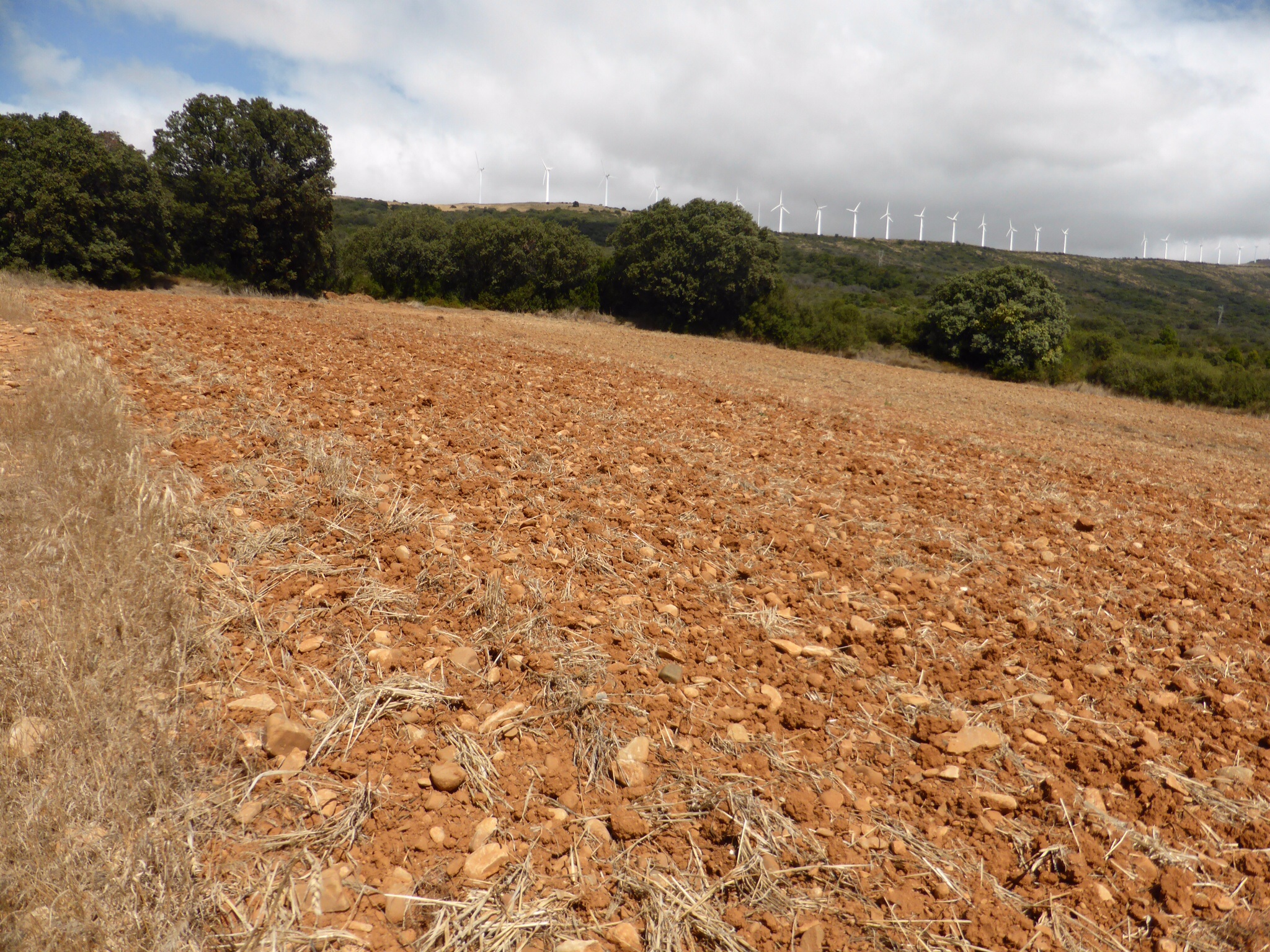
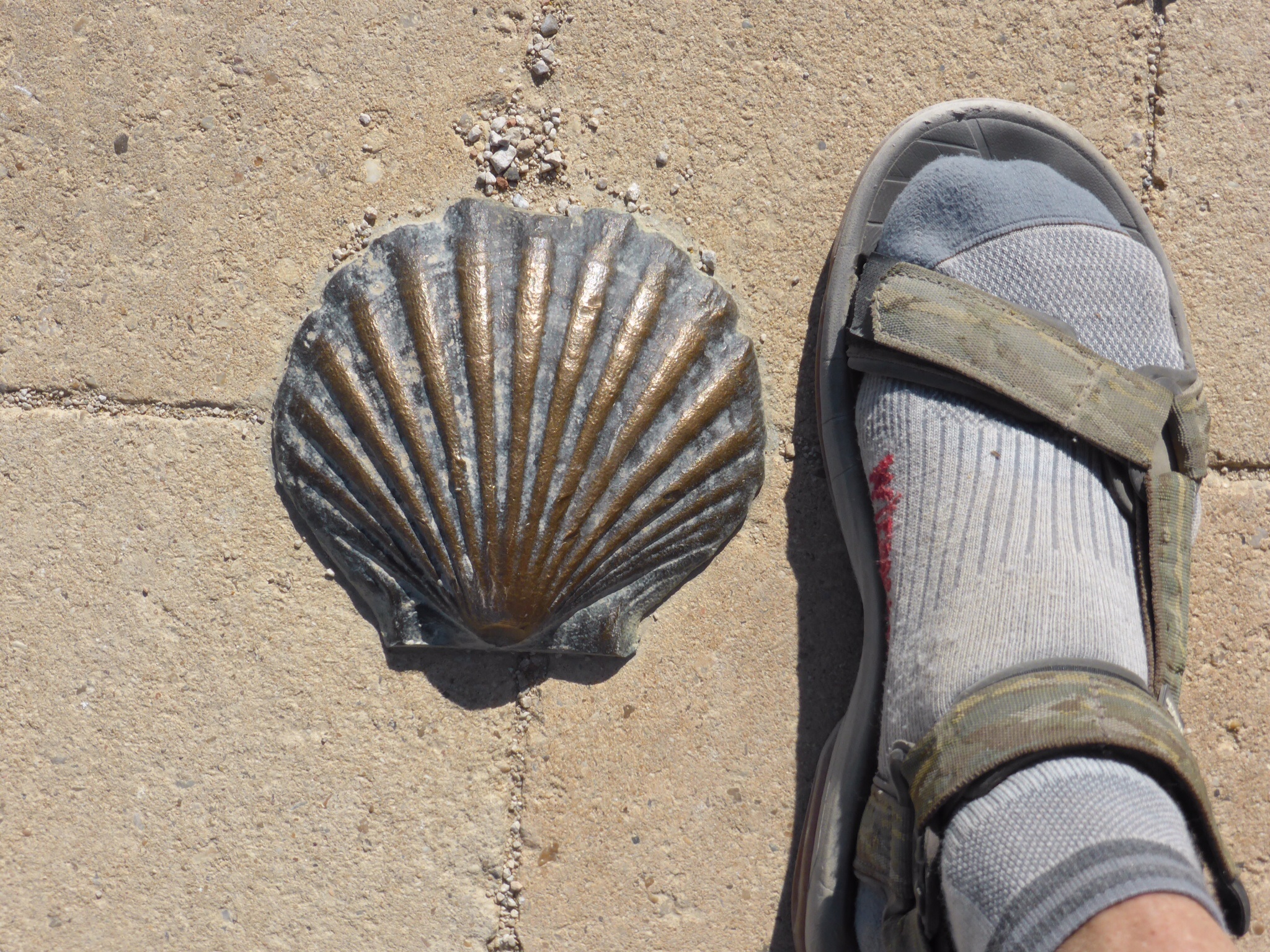
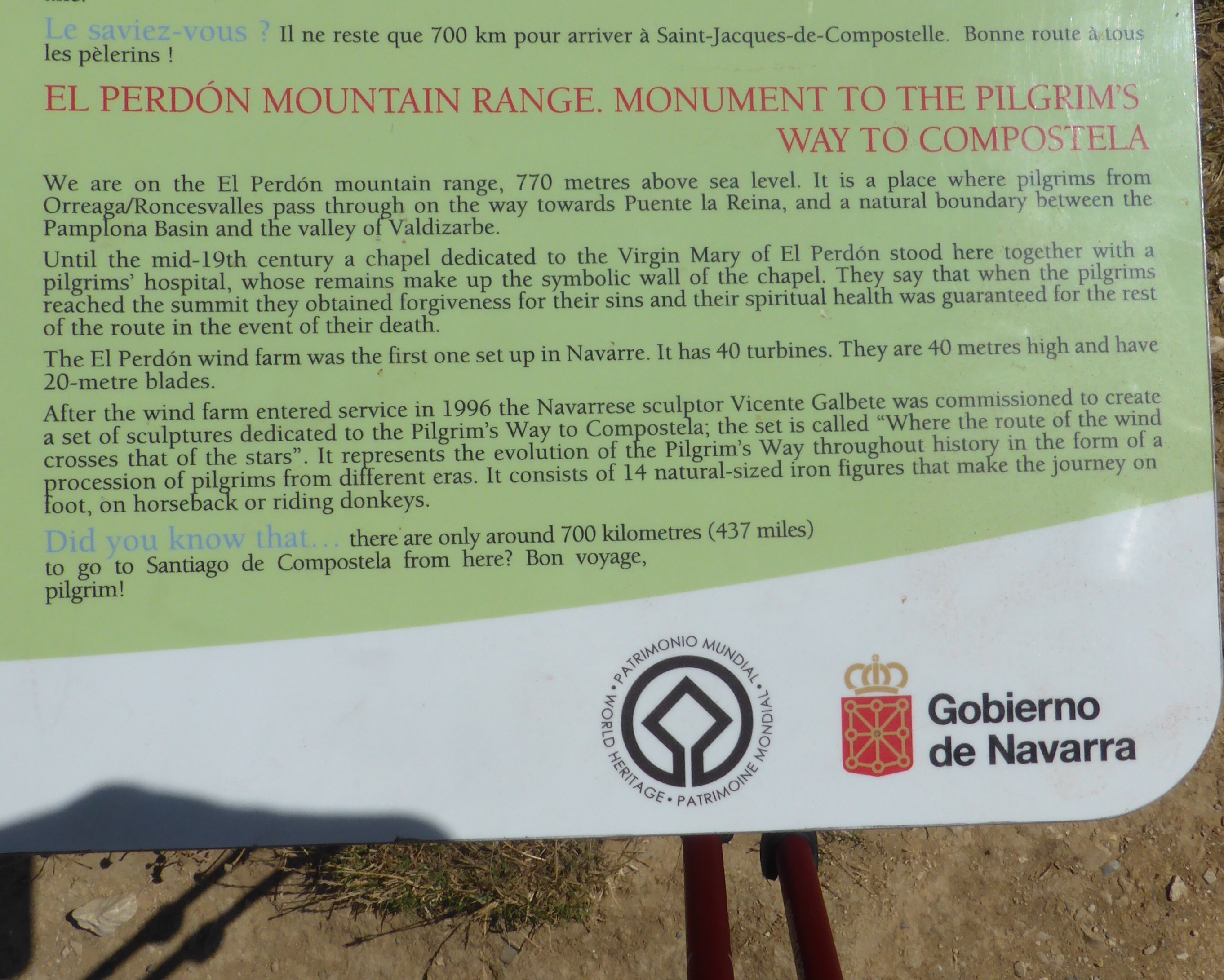
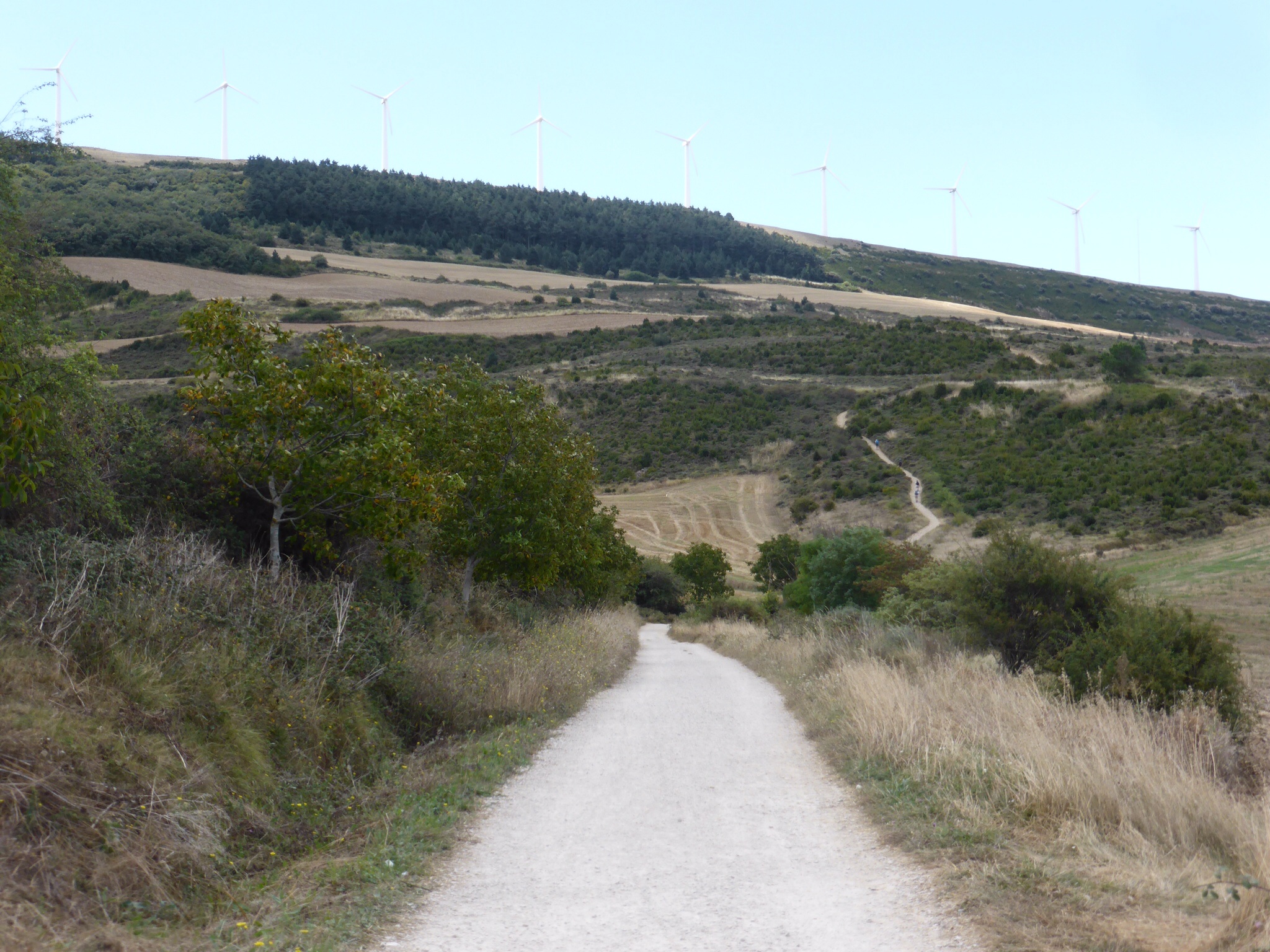
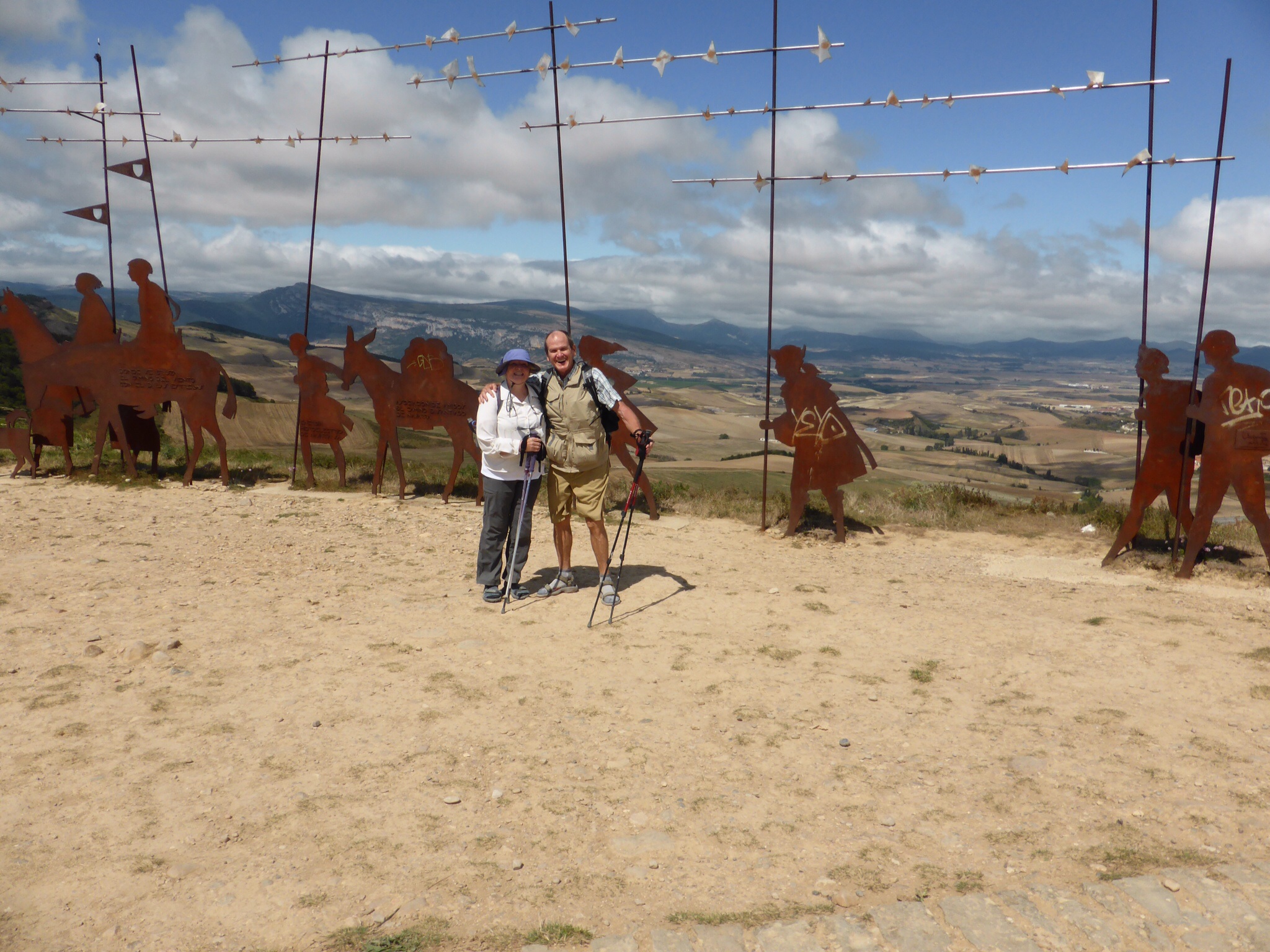
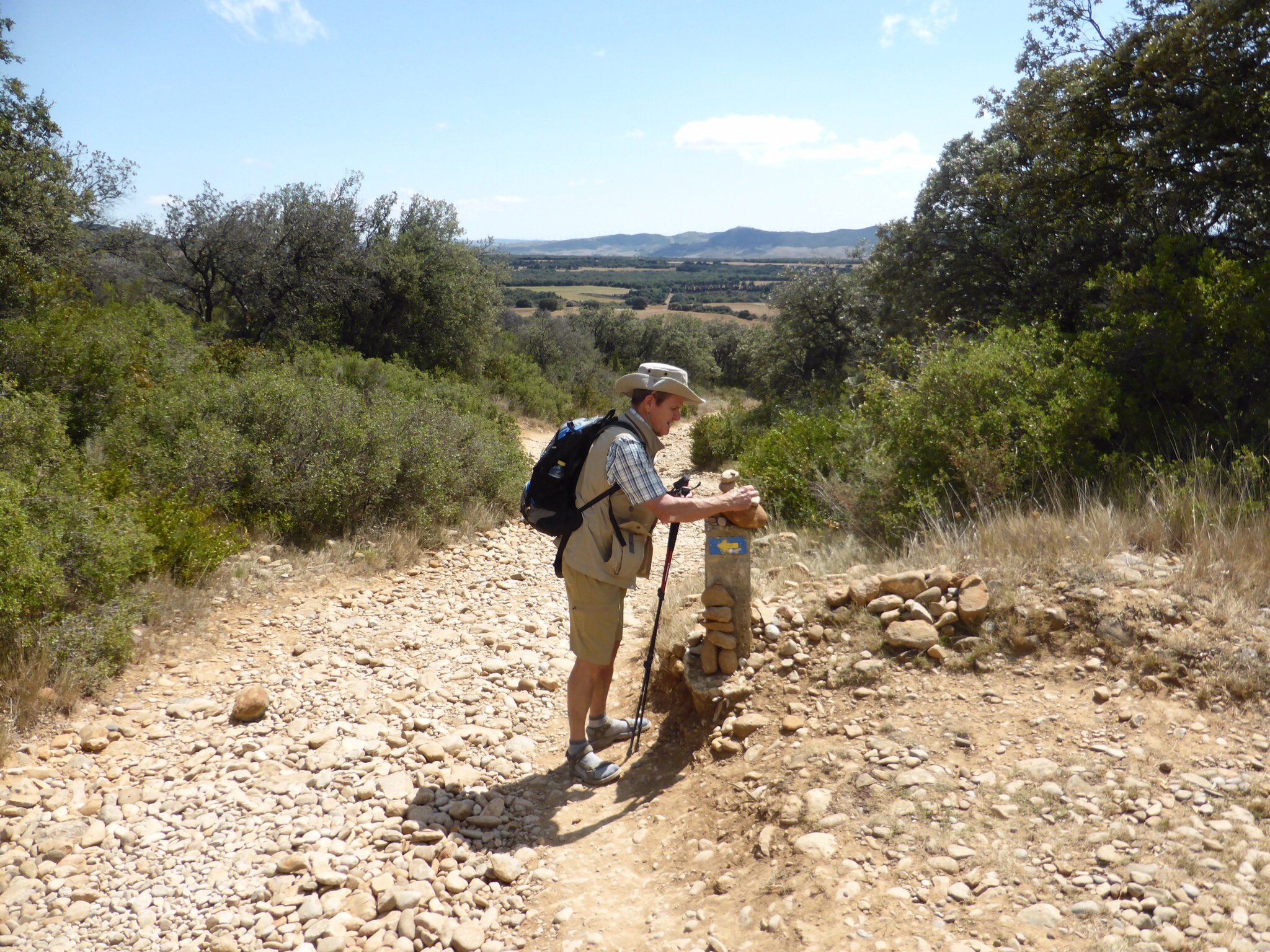
Off in the distance is our morning’s start point. Here we are in a sunflower field, have walked 8 km and are on our way to a 1500 foot high ridge topped with windmills supplying all the power for Pamplona, population 200,000We were amazed by how rock filled the fields are.The Camino is signed with many different types of markers, all originating from the shell. Many are like this, imbedded in sidewalk. One explanation of the shell: the lines represent the many camino routes towards Santiago.We hope you can make the wording out, it tells an interesting Camino storyThat’s our climb ahead, note the windmills at the top of the ridge – well maybe they are hard to see, but they are there!!Finally at the top. The metal figures are explained in the picture of the sign, two pictures earlier. (Have not figured out how to move pictures around yet….) It is a special place on the CaminoThis was on the way down. It was a bit of a slow go. Here Rod carefully places a stone on an inukshuks.
DAY 6: August 29, Pamplona to Puenta la Reina (24km)
We are recharged and rested and eager to be back on “the Way”. The walk begins easily, taking us through the university area. We are aware that the road will only get harder and higher. On a far hill in the distance we see rows of windmills. That is where the path will lead….14 km of stumbling along a road built by the Romans. Alongside us are fields of sunflowers growing in soil so rock laden it is a miracle that anything could survive. Strangely the sunflowers are harvested only by the birds. The steepest portion of the road ( 3km from the top) looks like it has never been repaired and is treacherous. We were exhilarated and relieved to reach Alto del Perdon and hear the sound of the windmills. These windmills supply power for Pamplona. The blowing of the wind itself as we rested at the top was so cooling and welcome. At this place where “the wind meets the stars” we felt for the first time with certainty that we could finish walking the Camino:-)
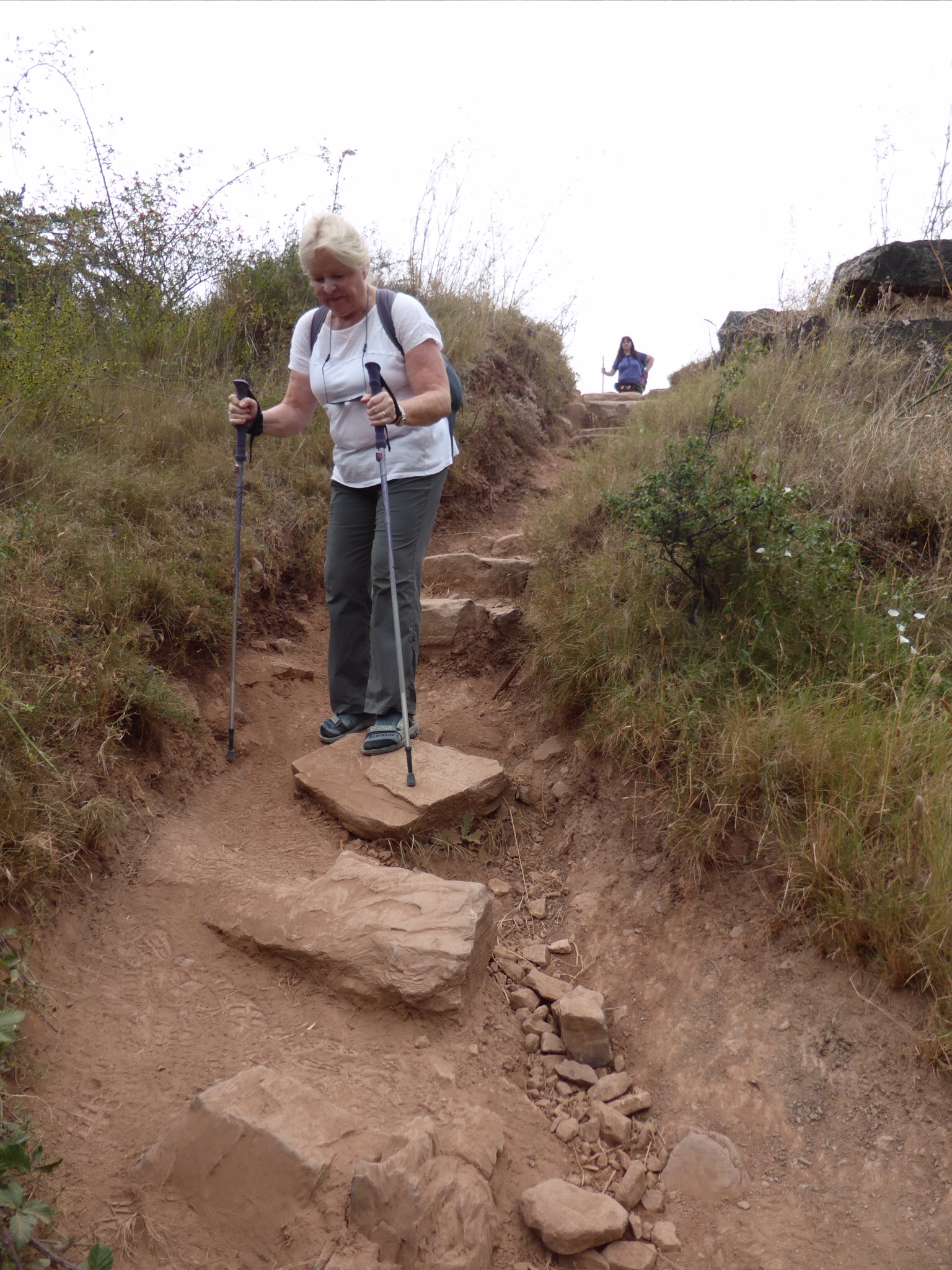
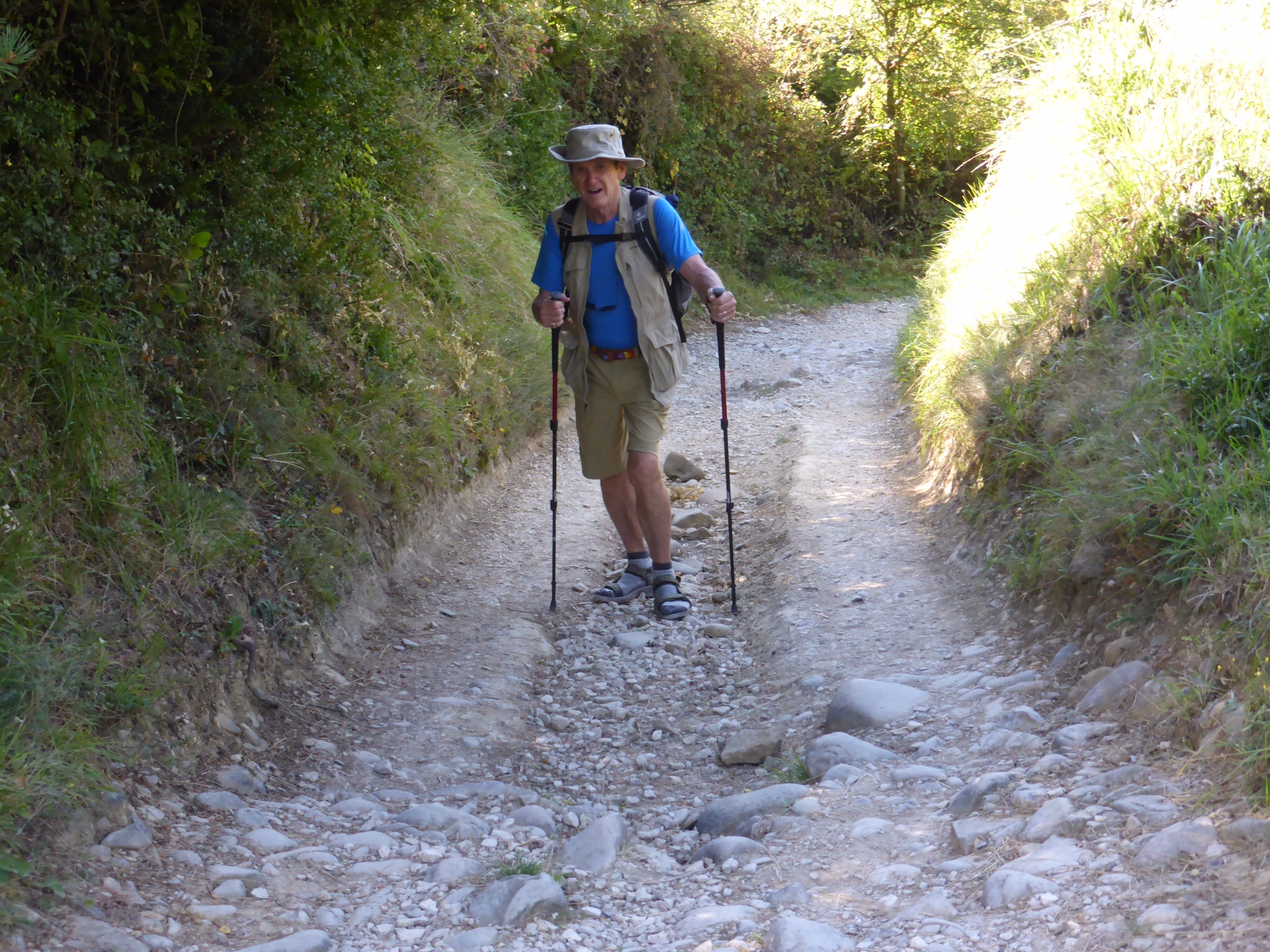
The descent was steep, uneven and composed of loose gravel and rock. We had been warned that more pilgrims injure themselves here than anywhere else on the Camino.
We climbed down slowly, grateful once again for our walking poles. At last we crossed the River Arga over an old Romanesque bridge and entered Puente la Reina with relief.
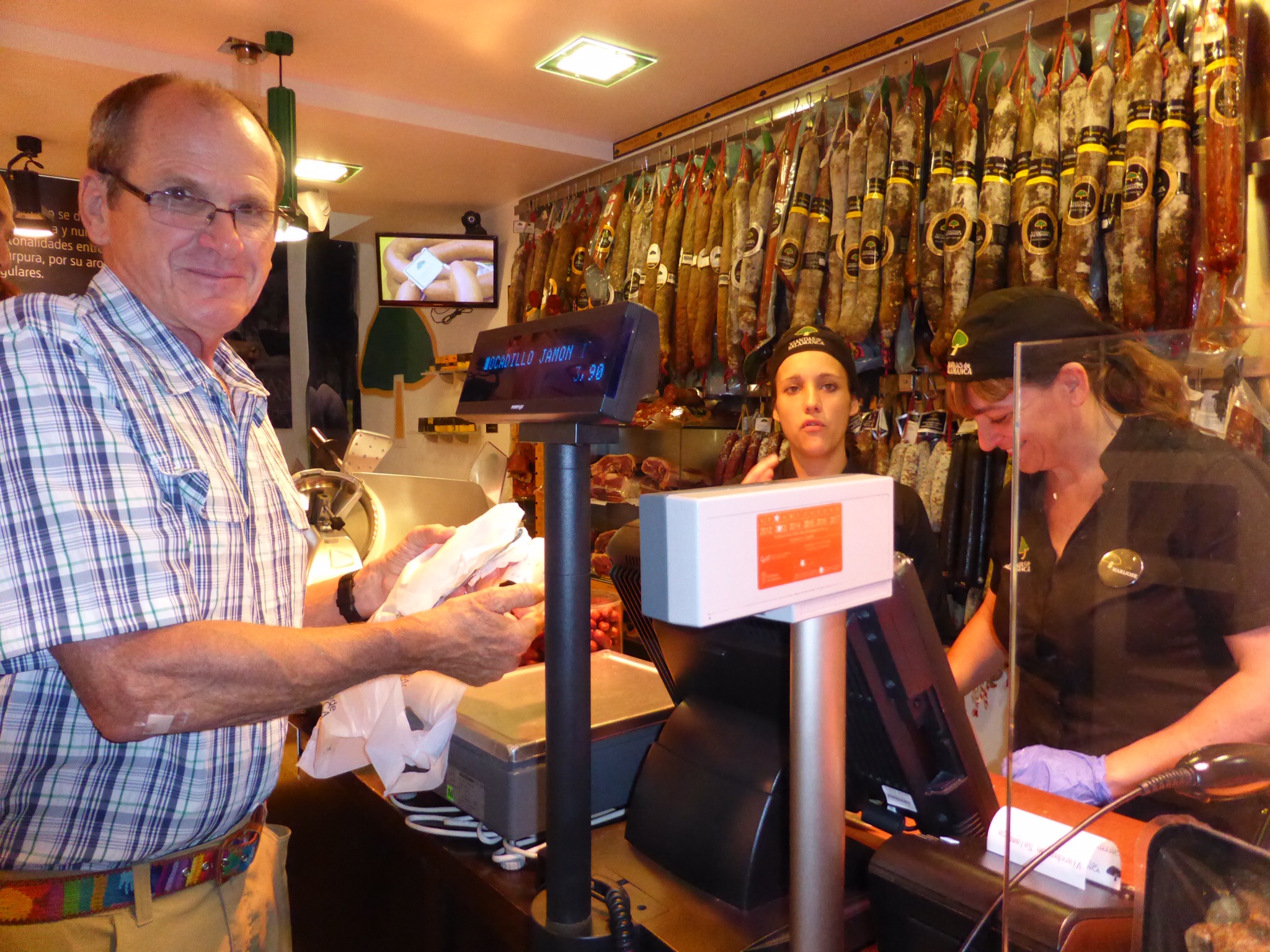
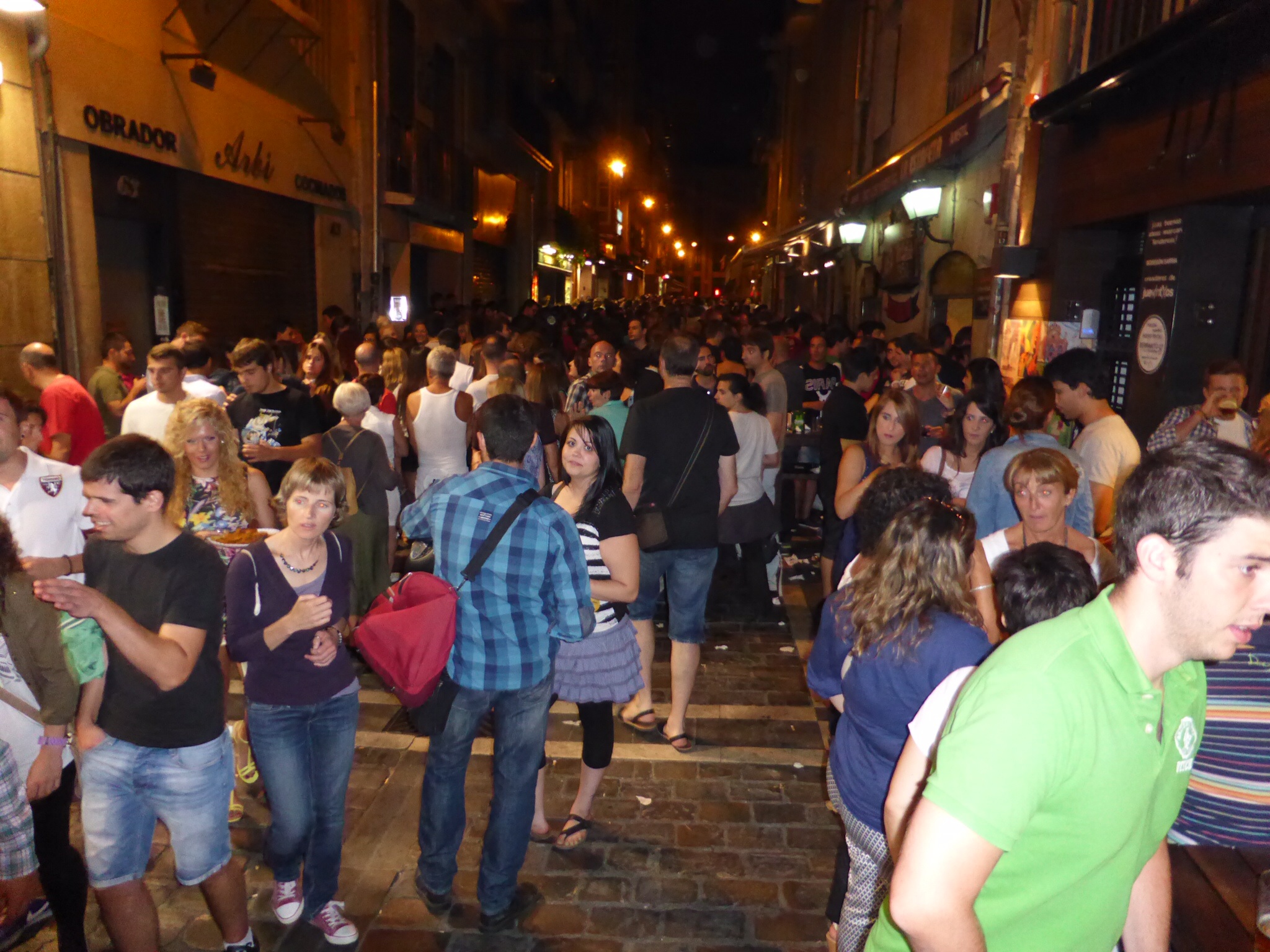
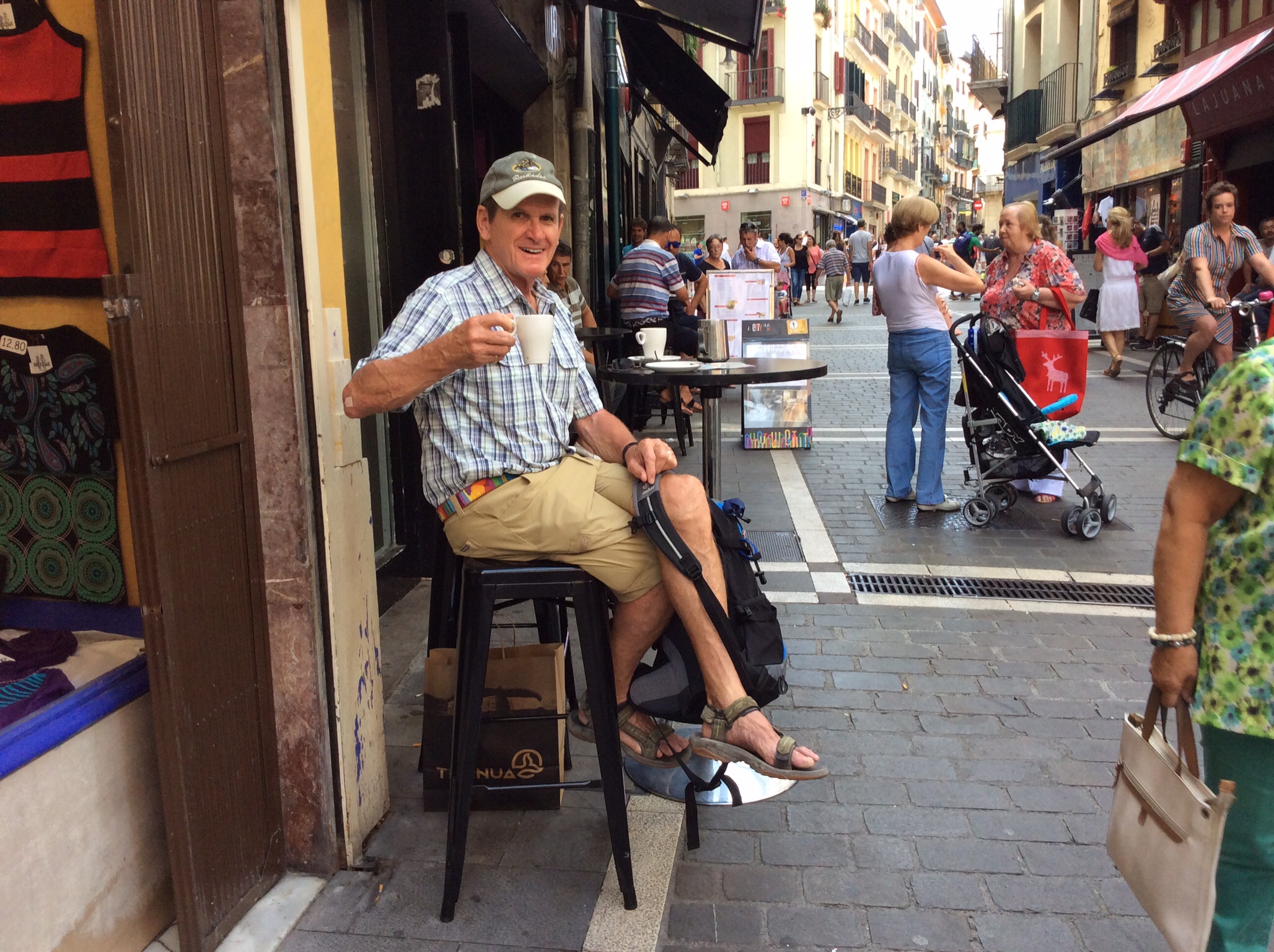
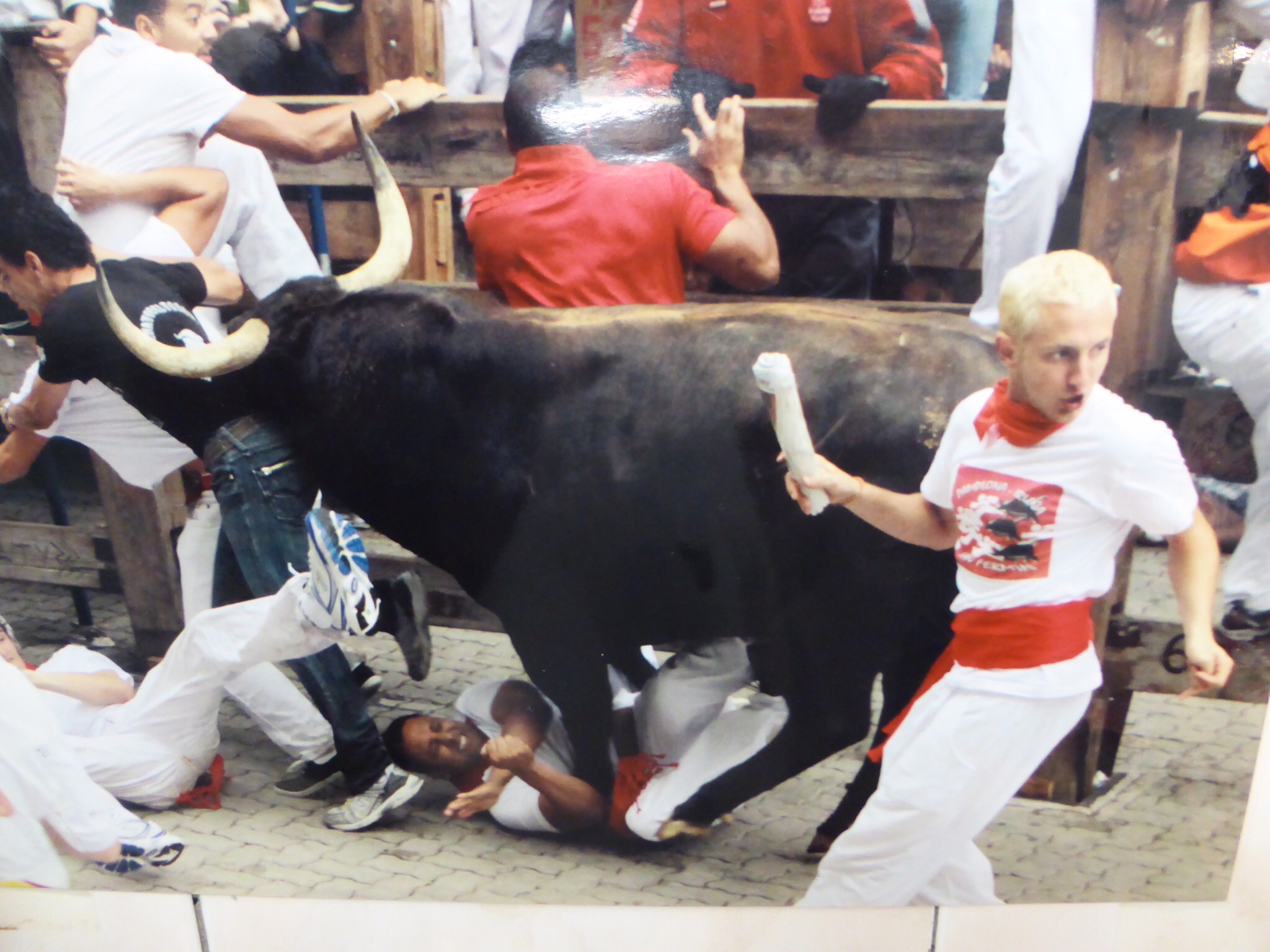
Rod has found the ultimate meat sausage store!This is the scene at 9 pm, the restaurants so full that people are sitting on the streets to eat and it is standing room everywhere in front of every bar. What is amazing is that the waiters can remember every item when adding up your tab!Morning coffee, really good. Best to order a large espresso with hot milk on the side hmmmmmA photo in a coffee shop of last years Running of the Bulls… No thanks!
DAY 5: Pamplona ( a blessed day of rest)
Pamplona,is the largest city in the Navarre region of Spain. It was built by the Romans (74BC) on the site of the Basque village of Iruna and is named after General Pompey. Pamplona was a series of walled areas within a walled city as the Basque, Frank, and Jewish populations could not get along. The fortifications were completed in the 16th century and the inner walls were finally dismantled in the 19th century. Pamplona is now a lovely city of wide streets, many squares where people gather, green spaces and parks for children. There are numerous cathedrals, a grand citadel and city hall representing a mixture of Roman, Gothic and Neo-Classical architecture. We toured the town but only scratched the surface of it. It is a festive place and comes alive in the evenings. People spill out of the bars and restaurants. It is almost like a block party and the camaraderie is palpable. There is not enough seating so people stand or sit in the cobblestones and enjoy their vino and tapas ( “pintxos” in Basque). The pintxos are usually a bread or bun base with cheeses, meat, seafood and toppings we do not recognize piled on 3-4 inches high! They are amazing and 2 make a meal. Needless to say, Dad loves them. I stick to the ensalata which is always good.
Since Bayonne we have been travelling in the Basque country of France and Spain. The Basques claim to be the descendants of the first Europeans. They have their own language, customs, flag and coat of arms. Politically they are active but from what we have been told do not have a large following. Their violent actions have worked against them, it seems. However, signs are in Spanish and Basque and the languages are not at all similar. It is interesting that very few at hotels, shops and restaurants speak English. This is probably not the case in bigger cities or with young people.
We cannot leave Pamplona without mentioning the “Running of the Bulls”. It is not on now:-) However, the “encierro” is a major part of the Festival San Fermin, patron saint of Navarre and is held the 2nd week in July. The many young men we saw on crutches are all that remain of this year’s encierro.
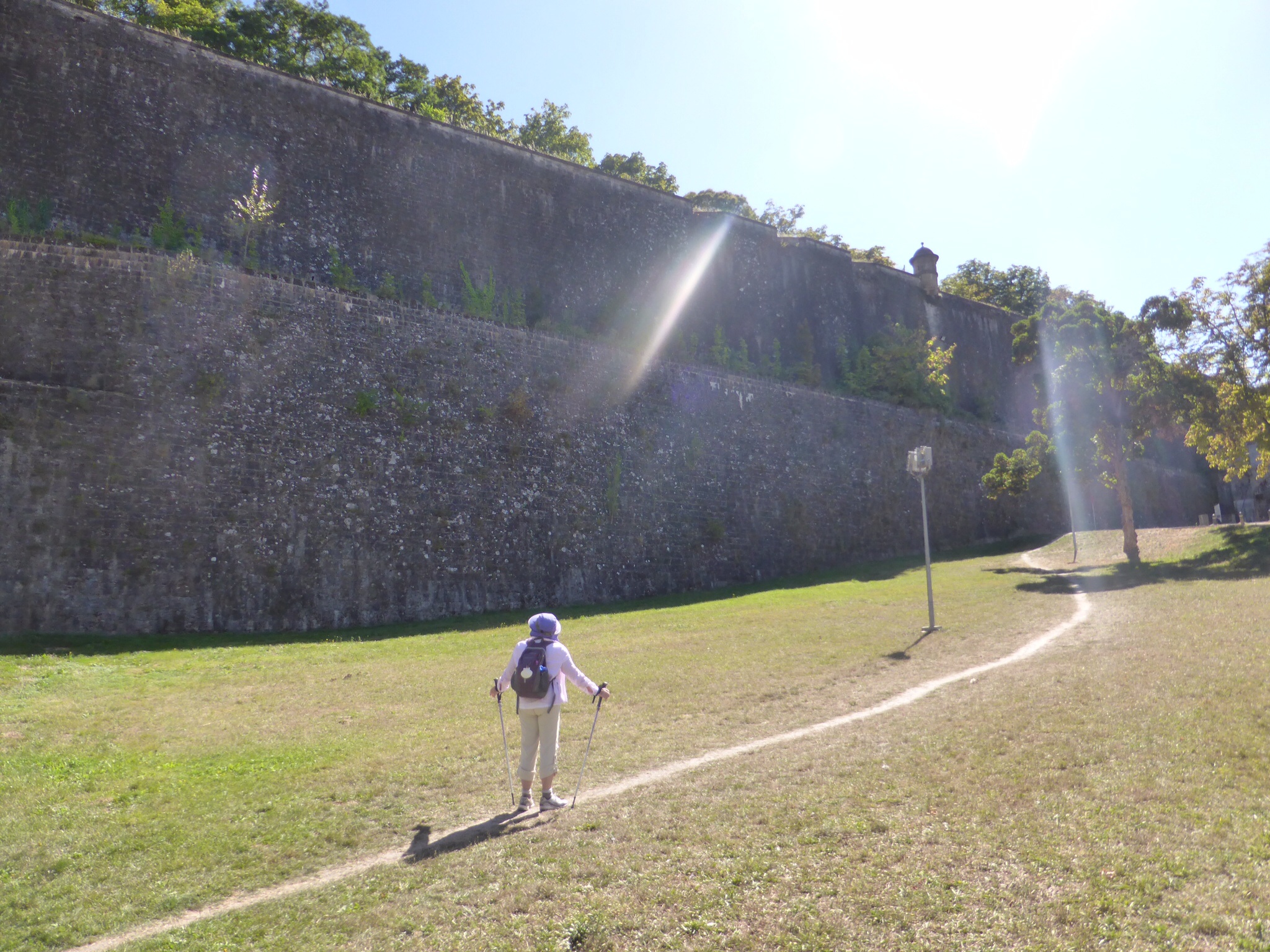
Determination… difficult to show an uphill grade. The wonderful news: sunshine every day!Entering Pamplona, about to go through the walls surrounding the 1500 year old city. We have just walked over the Magdalana bridge over the river Arga, that wall is over 60 feet high and 600 years oldA welcome break!We took this picture because it shows that there are places with more dandelions that at Forever House!
DAY 4: August 27 (Zubiri to Pamplona 23km)
We are excited as this is to be an easier day according to our guidebook….and we have a rest day in Pamplona. We have maps and a guide book but depend on the Camino markers like the other pilgrims. These sign posts can be beautiful and easily spotted ceramic tiles with a yellow scallop shell on a bright blue background, steel scallop shells imbedded in sidewalks, or yellow arrows painted on trees, stones, curbs, walls—anywhere. Sometimes the yellow arrows are missed….so far only once have we been headed the wrong way and a kindly and alert villager leaned out his upstairs window to holler and point us in the right direction.
Today’s walk did have more areas of level terrain but there were still some formidable climbs. The landscape is now a mixture of oak, beech and pine trees. Wild berries—- bramble, currant, and wild roses line much of the rural path. Many of the old villages are off the trail but we do not meander and add any more distance to our walk. At Villava , the last village before Pamplona, we are energized and when we cross Puente de la Magdalena, we are elated—we ‘re there!
The hotel is great and centrally located in the old town. We splurge and use their laundry service. Tomorrow is our first non walking day. We hope to get our blog going, get a Spanish SIM card and rest our feet.
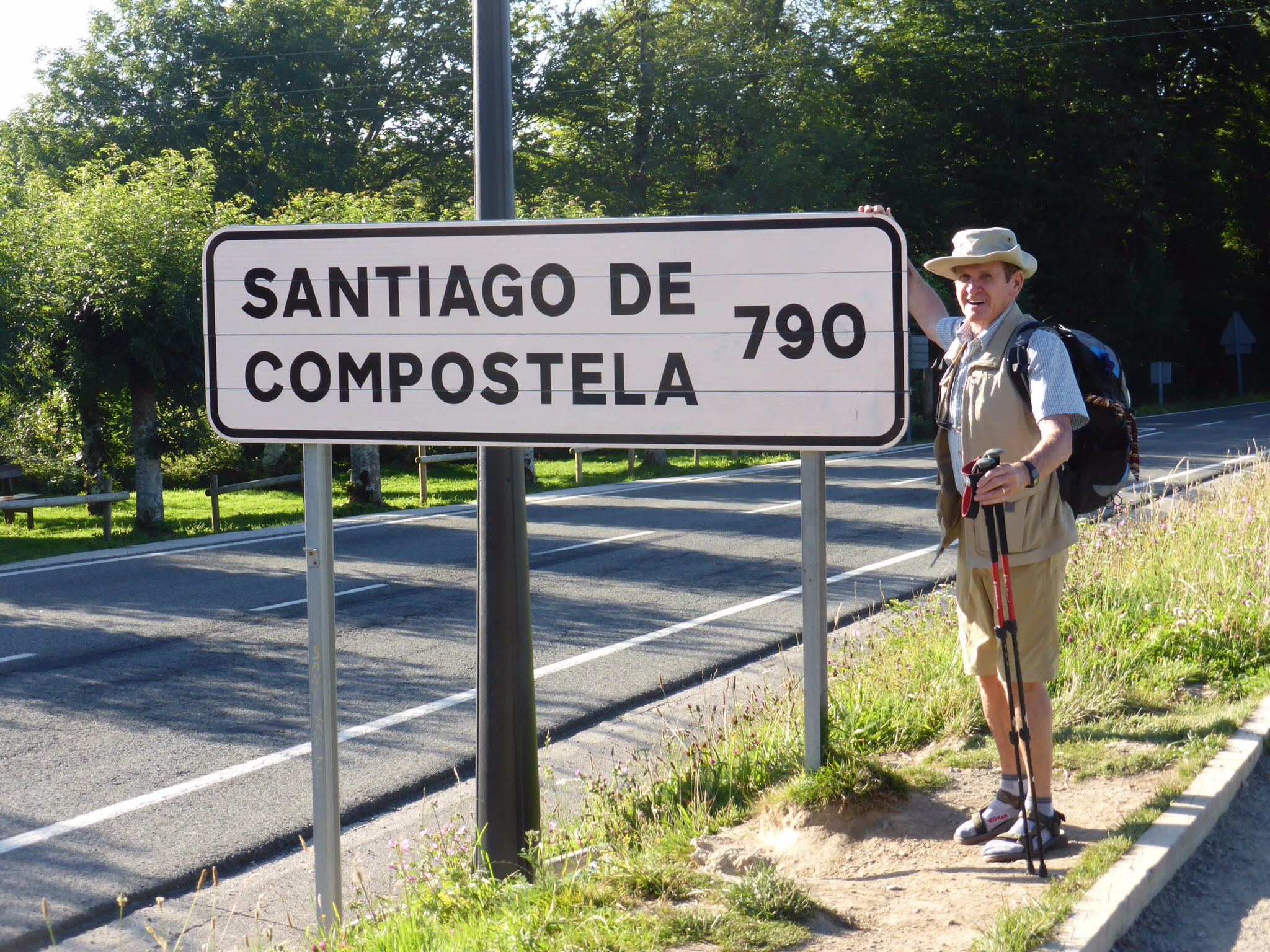
25 down, 790 to go!Some rocky and rough goingWe were so very lucky that it had not rained. Many small rivers become pretty wide and deep following usual rainDelana and Martin… turns out that Martin will not go over a bridge.Not everybody made it!!
DAY 3: August 26
Roncesvalles to Zubiri (21.5km)
Yet another day of challenging walking. Again lots of uphill on narrow pathways. Much of the pilgrims’ route followed where there would be churches or monasteries for food and shelter. These structures tend to be on hilltops so we are constantly climbing and descending. The Erro River is below or alongside us and we enjoy its sound. We eat a good breakfast before starting out and find we are not hungry along the way but our thirst is incredible and we drink prodigious amounts of water. For long stretches of this route it seems we are the only travellers. Each pilgrim sets his/her own pace. When there is a shaded spot to rest often there will be others there. Helpful hints, personal stories and Camino related health issues (usually foot and bowel) are exchanged. We are fortunate—so far all is well. It is good how fellow travellers look out for one another. Several our age have now opted to have their bags transported and carry day packs as we do.
We arrive weary in Zubiri. The dinner menu offers “bull in sauce” and “pig’s cheek”. Fortunately there are other choices. This area is renowned for ham in every form. Dad is delighted. OUR ROOM HAS A BATHTUB!!! So-o-o nice:-)
Part of the beautiful Auberge at Roncesvalles. Usual lodging cost there is about 5 – 9 Euros a night, many in room, few showers etc
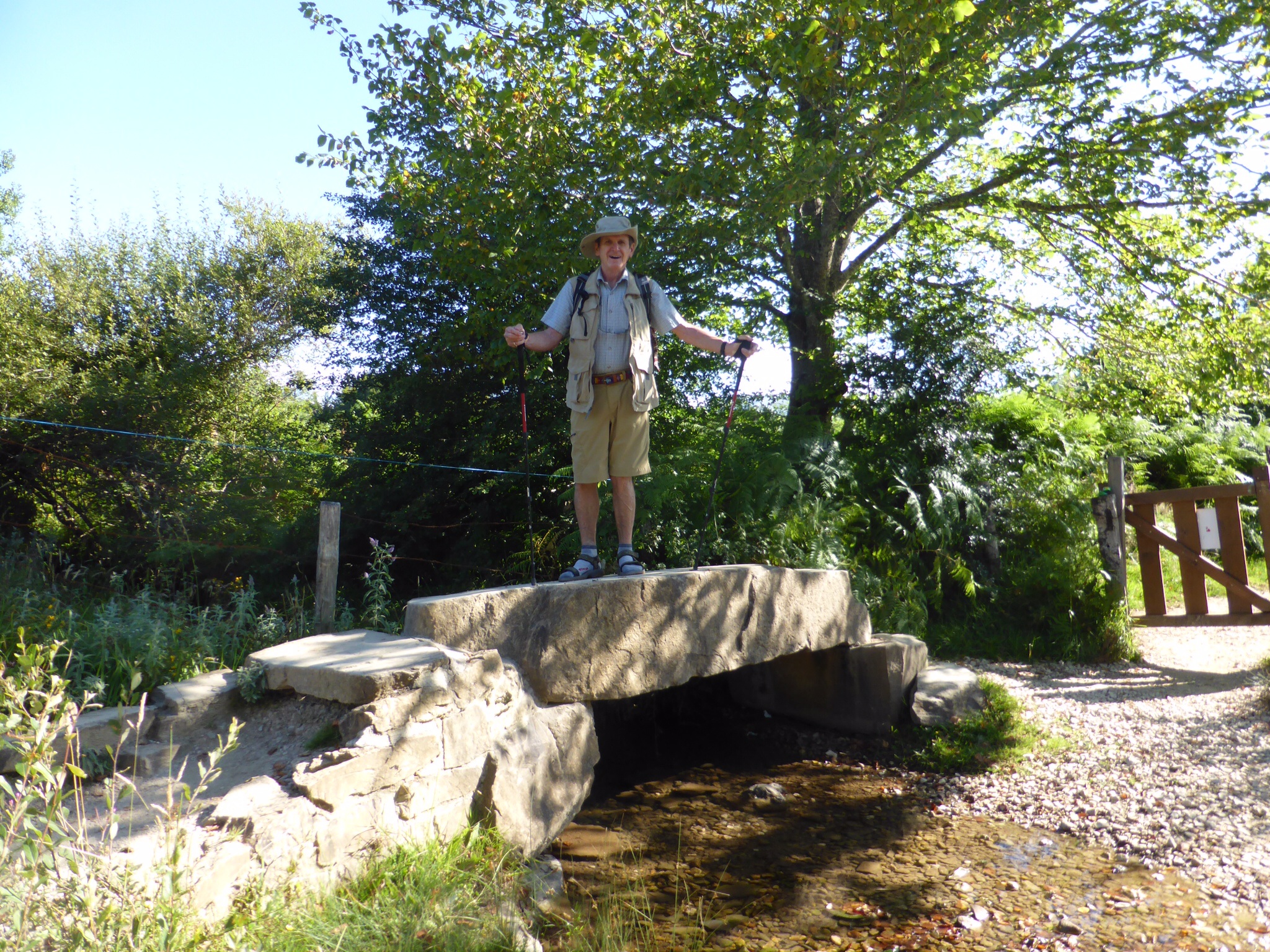
DAY 2: August 25 La Vierge d’Orisson to Roncevalles (16km) After a good sleep and healthy breakfast we hop into the van (which arrived on time:-) to travel to yesterday’s stop point. Passing the route we hiked yesterday we marvel at what we accomplished. In the distance we see today’s route—-it still goes up……another 8 km to climb up 1000 ft through the pass and across the border into Spain. This is a hard hike and once again the sun is hot, but most if the path is paved or through grazing land. We notice buzzards circling above us and we feel this an ominous sign. We later learn how ominous. ( http://www.independent.co.uk>News>World Europe>Europe) The upslope is beautiful with alpine flowers and here and there a copse of beech trees. We pass ancient stone shelters used by the herdsmen of long ago and cement blinds for bird hunters of nowadays. We are grateful to reach the peak and begin the final part of the day’s trek. The path is steep, narrow and rocky. In many areas the drop off is over 500 ft. We walk cautiously and close to the mountain side. Incredibly there are cyclists on this trail! The trail offers more shade now —and the alpine flowers have given way to heather and yellow gorse (broom) and a wild type of anise. The fragrance is lovely. Our hotel, a renovated monastery is a welcome sight:-). Dinner in Spain is later—2000 so we shower, change and head to the albergue (hostel in Spanish) for our Credencial. There we meet an Aussie woman who has come over the Pyrenees with tendonitis of her ankle. This puts our fatigue into perspective.

 walkingthecaminotogether